Navigating Post-Dobbs America: Mounting Confusion and Information Gaps Plague Women Seeking Reproductive Healthcare

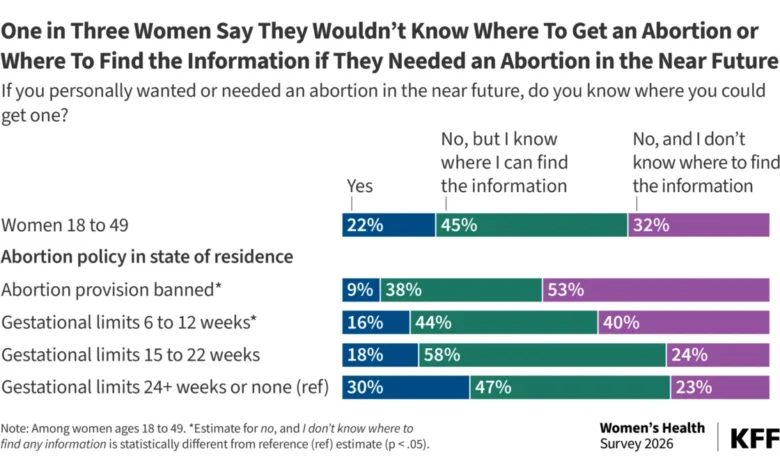
Four years after the historic Supreme Court ruling that dismantled the federal constitutional right to abortion, a profound information crisis has taken root across the United States. According to the newly released 2026 KFF Women’s Health Survey, a majority of reproductive-age women residing in states with total or near-total abortion bans are left entirely in the dark regarding where to seek essential reproductive healthcare or secure reliable information. This escalating uncertainty highlights a growing chasm between rapidly shifting state-level legal landscapes and the public’s awareness of their healthcare options, even as alternative pathways like telehealth medication abortion evolve.
The findings from the comprehensive survey—fielded between March 11 and April 14, 2026, among a nationally representative sample of 3,538 women aged 18 to 49—illustrate a sharp deterioration in public knowledge. As legislative restrictions multiply and legal battles continue to weave their way through federal and state courts, the fundamental mechanics of accessing reproductive healthcare have grown increasingly obscured, leaving vulnerable populations to navigate a labyrinth of conflicting laws, closed clinics, and shifting digital footprints.
Growing Information Deficits in Restricted States
The 2026 KFF data reveals that more than half (53%) of reproductive-age women living in states with active abortion-provision bans do not know where to go or where to find credible information if they or someone they know required an abortion. This statistic represents a significant and troubling jump from 43% in the 2024 iteration of the survey. The confusion is not confined solely to states with absolute bans; 40% of women living in jurisdictions with strict gestational limits capping procedures between six and 12 weeks report the exact same informational vacuum.
On a national scale, approximately one in three (32%) reproductive-age women stated they would not know where to access an abortion or find related information, up notably from one in four (26%) in 2024. Public health experts and legal advocates point out that this widening information gap is a direct consequence of a fragmented legal system. As clinics shuttered or relocated following the 2022 Supreme Court decision, the traditional brick-and-mortar infrastructure that once served as a primary point of contact and education has largely vanished from large swaths of the American map.
The Medication Abortion Disconnect
Compounding the logistical hurdles of physical clinic closures is a profound misunderstanding regarding medication abortion, a method that has fundamentally transformed the landscape of reproductive healthcare over the past several years. Telehealth-prescribed abortion pills sent via mail have become a vital lifeline, particularly for individuals residing in states where in-person clinical procedures have been outlawed.
While two-thirds (68%) of reproductive-age women across the country have heard of medication abortion pills, a startling disconnect remains regarding their legal and practical availability. Only 18% of women surveyed know that individuals in their respective states can legally obtain these pills online. The lack of awareness is even starker in restricted environments: a mere 8% of women living in states with abortion-provision bans are aware of online access options.
Furthermore, the survey indicates that a vast majority of women—71%—are either entirely unsure how they would secure medication abortion pills or have never heard of the medical protocol at all. An additional 11% incorrectly believe that obtaining these medications online is entirely impossible in their state. Healthcare analysts attribute this widespread ignorance to stringent state laws criminalizing or attempting to restrict digital health services, alongside chilling effects that discourage public health campaigns from openly advertising telehealth abortion resources.
Personal Toll and Real-World Difficulties
The cumulative effect of these compounding restrictions is no longer theoretical; it is actively shaping the lived experiences of millions of Americans. Four years after the Supreme Court’s Dobbs v. Jackson Women’s Health Organization ruling overturned Roe v. Wade, one in 12 reproductive-age women (12%) report that they personally know someone—including themselves—who has faced direct difficulty securing an abortion due to state-level restrictions. This figure has risen from 8% in 2024, signaling an escalating frequency of healthcare bottlenecks.
When respondents were asked about the specific hurdles encountered, three primary barriers emerged: the sheer necessity of traveling out of state to find a functioning clinic, the acute lack of knowledge regarding where to seek services, and prohibitive financial costs associated with travel, lodging, and out-of-pocket medical care.
Beyond immediate access challenges, the survey highlights a pervasive undercurrent of anxiety regarding future reproductive outcomes. A clear majority (59%) of reproductive-age women expressed deep concern that current abortion-provision bans could negatively impact the safety and quality of a future pregnancy for themselves or someone close to them. This concern cuts across various demographic lines, registering majorities among nearly all surveyed groups, with the notable exceptions of Republican respondents and women living in rural communities, whose policy viewpoints and localized health networks often align differently with current legislative frameworks.
A Four-Year Timeline: From Dobbs to the 2026 Landscape
To fully understand the gravity of the 2026 KFF survey results, it is essential to trace the chronological evolution of the American post-Roe legal and social environment:
- June 24, 2022: The U.S. Supreme Court issues its ruling in Dobbs v. Jackson Women’s Health Organization, effectively overturning Roe v. Wade and eliminating the nearly 50-year-old constitutional right to abortion. Authority to regulate or ban the procedure returns entirely to individual state legislatures.
- Late 2022–2023: A wave of "trigger laws" and newly enacted legislative bans take effect across large portions of the South, Midwest, and parts of the West. Clinics in states like Texas, Idaho, and Mississippi close their doors or shift operations to neighboring sanctuary states like Illinois, New Mexico, and Colorado. Concurrently, medication abortion via telehealth emerges as a frontline battleground, with states attempting to restrict the mailing of mifepristone and abortion-pill providers establishing legal safeguards and "shield laws."
- 2024: KFF fields its initial comprehensive baseline surveys tracking post-Dobbs public awareness, revealing that 43% of women in banned states and 26% nationally lack basic information on where to secure an abortion. At this stage, 8% of women report personal or close-contact difficulties navigating the system.
- 2025: Legal battles intensify over the regulatory status of mifepristone, the postal service’s role in distributing abortion medications, and the constitutional validity of interstate travel restrictions. State-level ballot initiatives protect abortion access in several conservative and battleground states, creating a deeply fractured patchwork of rights nationwide.
- March–April 2026: The 2026 KFF Women’s Health Survey is fielded, capturing a landscape defined by entrenched legal bans, expanding telehealth usage, and a widening public information deficit. The data shows that un-knowingness has climbed to 53% in banned states, while personal encounters with access hurdles have risen to 12%.
Broader Implications and Expert Analysis
Public health officials, legal scholars, and reproductive rights advocates view the 2026 KFF findings as a flashing warning sign regarding the public health consequences of legislative fragmentation. By driving information underground and complicating the dissemination of accurate medical guidance, state-level bans are inadvertently creating secondary hazards for patients. When individuals do not know where to turn for legitimate care, they may delay necessary medical interventions, experience heightened psychological stress, or face severe financial exploitation by unauthorized actors operating in unregulated spaces.
Conversely, anti-abortion organizations and policymakers who championed state-level restrictions often interpret these trends differently, arguing that the reduction of easily accessible clinics fulfills their legislative mandate to protect unborn life and prioritize maternal health through prenatal care infrastructure. From their perspective, the confusion reported by respondents reflects the natural sorting period of a society transitioning away from elective abortion toward state-supported family wellness models.
Nevertheless, the data underscores a critical challenge for healthcare providers, advocacy networks, and digital information platforms. As legal battlegrounds shift toward interstate telehealth, data privacy, and the enforcement of shield laws, bridging the widening information gap remains one of the most urgent public health imperatives in post-Dobbs America. Without concerted educational initiatives and clear channels of communication, millions of women will continue to navigate a high-stakes medical landscape in the dark.
Related posts: