Navigating the Shifting Landscape of Medicaid Managed Care: Rate-Setting Hurdles, Federal Policy Changes, and Major Insurer Exits

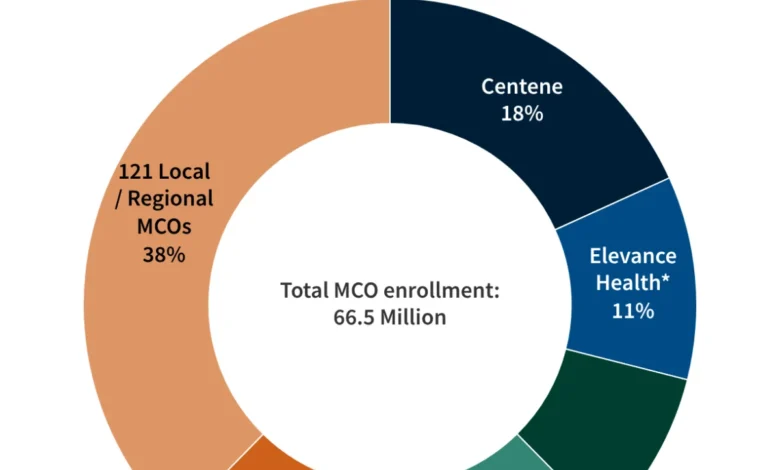
Managed care has long served as the cornerstone of the United States Medicaid delivery system, functioning as the primary vehicle through which care is distributed to tens of millions of low-income Americans. Nationally, over three-quarters of Medicaid beneficiaries are enrolled in comprehensive managed care organizations (MCOs), a system that accounted for half of total Medicaid spending in fiscal year 2024. However, the operational and financial stability of this critical healthcare ecosystem is facing unprecedented turbulence. The implementation of the 2025 federal budget reconciliation law, combined with lingering financial pressures from the pandemic-era unwinding period, has introduced complex rate-setting challenges for state governments and health plans alike.
These mounting financial pressures have begun to reshape the market in real time. Major multi-state parent firms are scaling back their national footprints, raising critical questions about long-term market competition, administrative burdens for healthcare providers, and potential disruptions in care for vulnerable enrollees. To understand the current trajectory of the Medicaid managed care market, policymakers, healthcare providers, and industry analysts are closely examining the intersection of federal policy shifts, actuarial rate-setting hurdles, and strategic insurer withdrawals.
The 2025 Reconciliation Law and Actuarial Rate-Setting Challenges
At the heart of the current market disruption are the structural changes mandated by the 2025 federal budget reconciliation law. As states roll out the legislation’s provisions—which include sweeping programmatic financing changes, federally mandated work requirements, and more frequent eligibility redeterminations for expansion adults—actuaries and state health officials face daunting uncertainties.
MCOs operate under financial risk models, receiving a prospective, per-member-per-month capitation payment to cover a defined set of services over a typical 12-month rating period. Because these rates are established prospectively, they must be actuarially sound to absorb fluctuations in healthcare costs and utilization. To balance financial risk, states frequently utilize risk-mitigation tools such as risk-sharing arrangements, acuity adjustments, medical loss ratios (MLRs), and incentive structures.
However, projecting member enrollment and health risk (or acuity) has become exceptionally difficult under the new federal guidelines. In KFF’s 2025 Medicaid budget survey, numerous state Medicaid directors reported anticipating severe challenges in predicting the impacts of new work requirements and frequent eligibility checks. Furthermore, caps and reductions on provider taxes and state-directed payments have compounded these rate-setting difficulties, leaving many managed care plans squeezed between rising healthcare utilization and rigid capitation rates.
A Historical Precedent: The Pandemic Unwinding and Margin Compression
These emerging federal hurdles arrive on the heels of a tumultuous period characterized by the unwinding of the pandemic-era continuous enrollment provision. Between April 2023 and mid-2024, millions of individuals were disenrolled from Medicaid as states resumed routine eligibility renewals. As overall enrollment declined, plans experienced a sharp increase in average member acuity, as remaining enrollees tended to have higher, more complex health care needs and utilization patterns.
The financial fallout of these shifts has been well-documented. Data from the National Association of Insurance Commissioners (NAIC), analyzed by KFF, revealed that the average medical loss ratio—the percentage of premium revenue spent directly on medical care—for the Medicaid managed care market spiked from 88 percent in 2023 to 91 percent in 2024. This marked the highest average MLR observed across all major health insurance markets, including individual, group, and Medicare Advantage plans, for that year, and represented the highest figure recorded for the Medicaid managed care sector in a decade. A higher MLR inherently signals a compression of operating margins and a potential decrease in underwriting profitability for participating insurers.
The Dominance of For-Profit Firms and the Elevance Health Exit
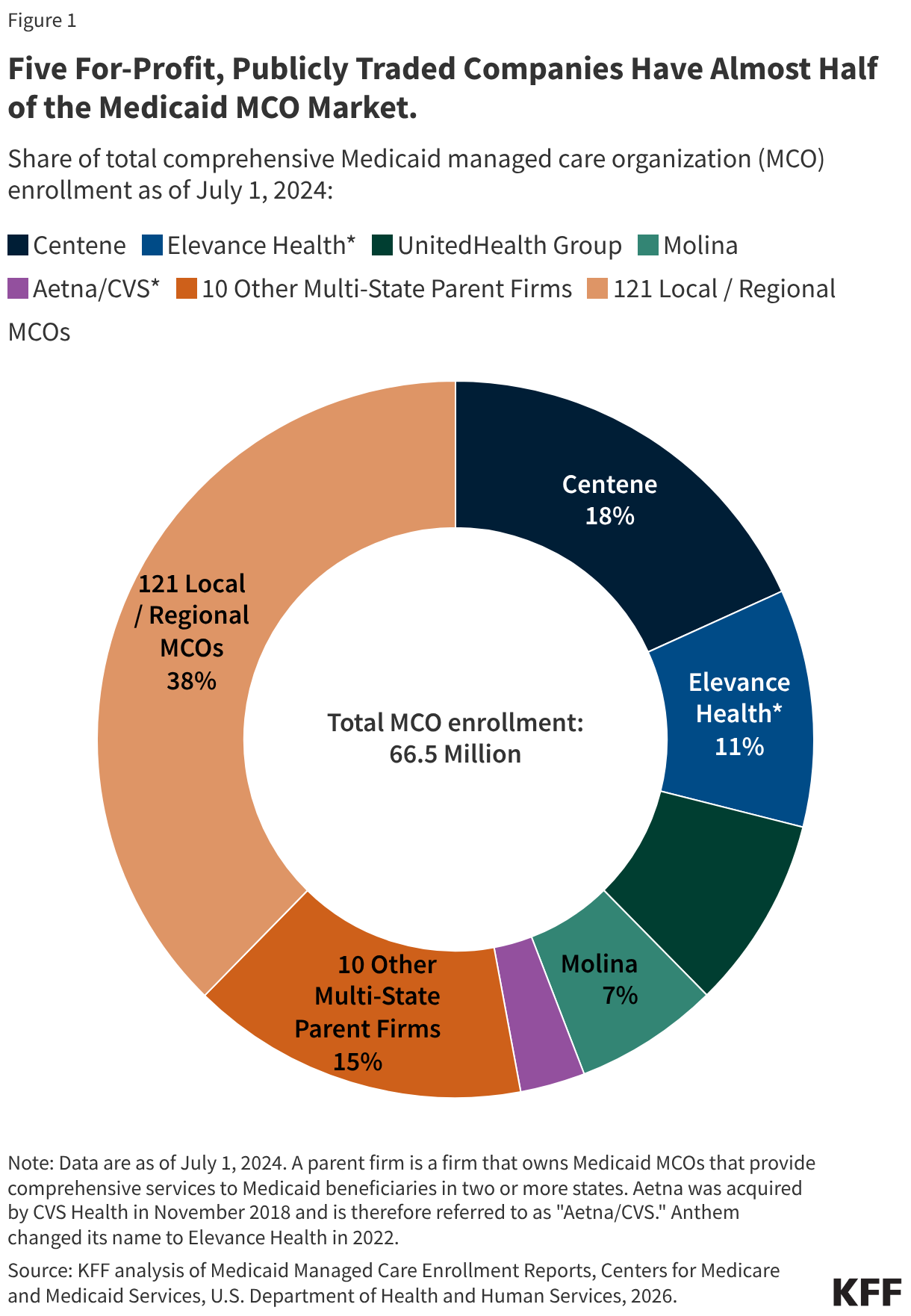
The national Medicaid managed care market is heavily consolidated. Five for-profit, publicly traded corporations—Centene, Elevance Health, UnitedHealth Group, Molina Healthcare, and CVS Health (Aetna)—account for nearly half of all Medicaid MCO enrollment nationwide. Each of these corporate giants boasts a massive geographic footprint, operating MCO programs in 13 or more of the 42 states that utilize comprehensive managed care delivery systems.
Given this heavy concentration, strategic decisions made by these parent firms carry profound national implications. In July 2026, during a quarterly earnings call, executives from Elevance Health announced a major strategic pivot, signaling plans to exit several Medicaid markets over the subsequent 12 to 18 months. Company leadership stated they would intentionally withdraw from markets "where the economics don’t support sustainable performance."
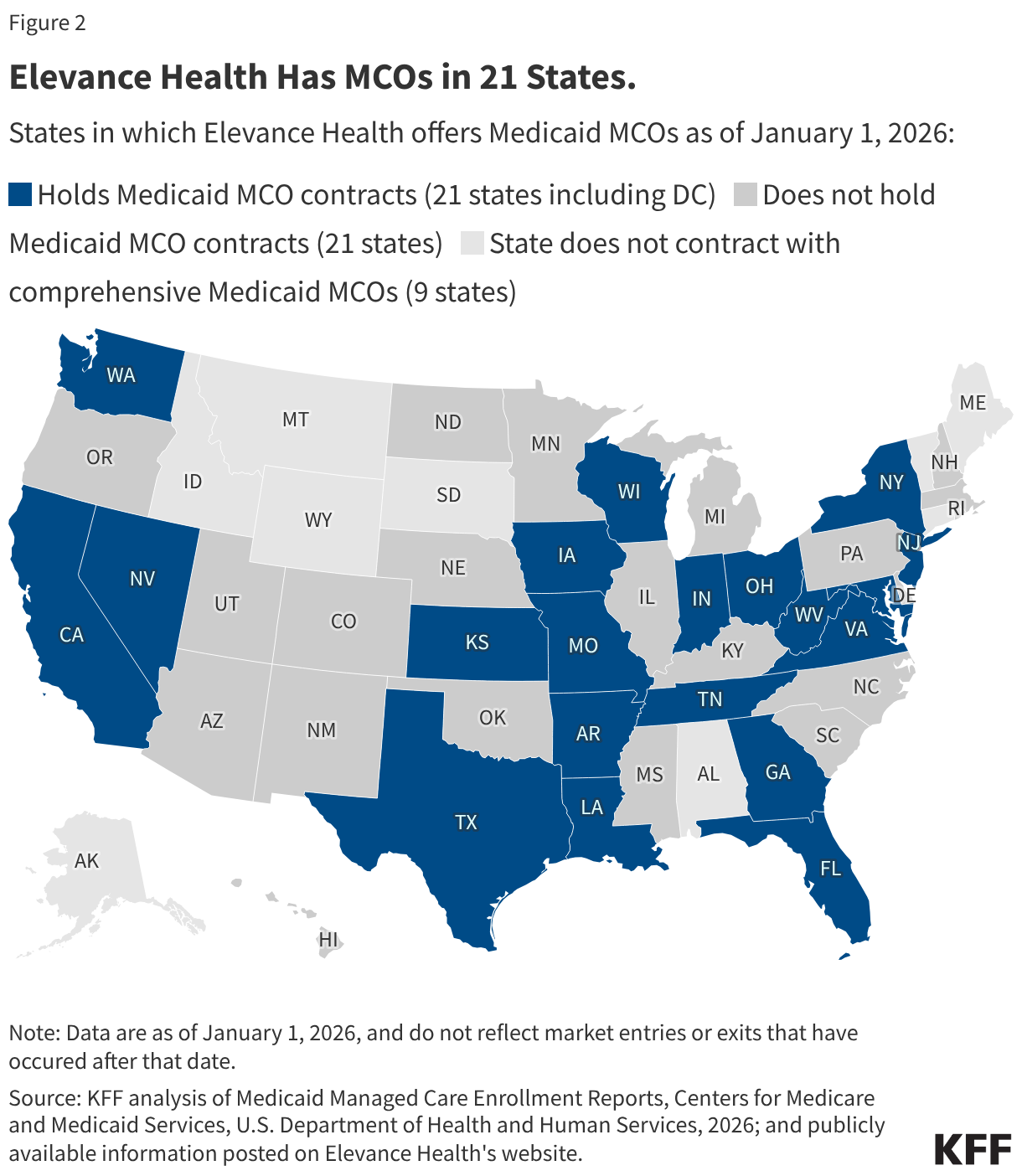
Elevance operates MCOs in 21 states, with its market share varying widely from 6 percent to 44 percent. Medicaid members comprise roughly 20 percent of the firm’s total medical membership. During the earnings call, executives noted that while acuity shifts were beginning to moderate and rates were increasingly reflecting historical experience, healthcare utilization remained persistently elevated compared to pre-pandemic baselines. Consequently, the firm projected its full-year 2026 Medicaid operating margin to drop to -1.75 percent, anticipating continued incremental acuity pressure into 2027.
A Timeline of Recent Insurer Withdrawals
The ripple effects of Elevance’s market reassessment were swift:
- August 1, 2026: Wellpoint DC, an Elevance Health subsidiary, officially exited the Washington, D.C. Medicaid managed care program following a mutual agreement with the D.C. Department of Health Care Finance. The contract, originally awarded in 2022 after a heavily contested procurement process, was slated to run through January 2028.
- September 2026: The Louisiana Department of Health announced that Elevance’s Healthy Blue plan would formally exit the state’s Medicaid managed care program upon the expiration of its contract at the end of 2026.
- July 2026: Beyond Elevance, reports surfaced that Centene Corporation plans to end its participation in Arkansas’s Medicaid expansion program in 2027, citing ongoing funding challenges within the program, which uses public Medicaid funds to purchase commercial Marketplace coverage.
While other major for-profit parent firms—such as Centene, Molina, UnitedHealth, and CVS—did not explicitly announce broad market exits during their mid-2026 earnings calls, the cumulative financial strain has prompted widespread scrutiny of state-level contract profitability.
Implications for Providers, Enrollees, and State Health Systems
The withdrawal of major MCOs from state Medicaid markets introduces immediate operational challenges for healthcare providers and substantial risks for program beneficiaries.
For healthcare providers, plan transitions create immediate administrative friction. Clinics, hospitals, and physician groups must navigate new contract negotiations, adjust billing systems, and often assist patients in understanding shifts in coverage networks. This administrative burden arrives at a delicate time, as providers are already heavily engaged in helping patients navigate complex new eligibility verification rules and work requirement exemptions.
For enrollees, insurer exits frequently trigger disruptions in continuity of care. If a beneficiary’s primary care physician or specialist is not part of the incoming plan’s network, or if patients are forced to re-obtain prior authorizations for ongoing medical treatments, health outcomes can be compromised. These disruptions pose acute dangers for vulnerable populations, including pregnant individuals, children with special healthcare needs, and patients undergoing active courses of treatment for chronic or severe illnesses.
To mitigate these risks, federal regulations and state contractual requirements mandate specific transition protocols. Federal rules require robust consumer notice timeframes and data transfer protocols between exiting plans, state agencies, and incoming MCOs. Furthermore, states possess the regulatory authority to mandate continuity-of-care protections, such as requiring newly assigned plans to honor existing prior authorizations for a transitional period and permitting enrollees to continue seeing out-of-network providers temporarily.
Long-Term Market Dynamics and Policy Considerations
Looking beyond immediate operational hurdles, large-scale managed care exits could permanently alter the structural landscape of the Medicaid market. On one hand, industry analysts note that the departure of chronically underperforming plans could theoretically elevate overall market quality and force remaining insurers to refine their delivery models.
Conversely, further consolidation within an already concentrated marketplace risks diminishing market competition. Reduced competition can weaken state leverage during contract bidding processes and potentially drive up administrative costs while limiting consumer choice and access to care.
To safeguard program integrity, state policymakers are increasingly leveraging procurement strategies and program design parameters. By carefully calibrating the number and mix of participating plans, setting robust performance benchmarks, and utilizing risk-mitigation corridors, states aim to maintain stable, competitive managed care markets. As federal policies continue to evolve and health plans grapple with persistent financial headwinds, the resilience of the Medicaid managed care model will rely heavily on proactive regulatory oversight, collaborative rate-setting, and an unwavering commitment to protecting vulnerable enrollees.
Related posts: