The Pursuit of Longevity: Why Mastered Basics Outperform Extreme Biohacking Protocols

In an era dominated by wellness podcasters, longevity influencers, and advanced biohacking startups, the pursuit of eternal youth has become a mainstream fixation. From cold plunges and hyperbaric oxygen chambers to expensive supplement stacks and wearable continuous glucose monitors, contemporary health culture dictates that preserving life requires a meticulous, high-budget, and complex daily routine. Millions of people are bombarded with messaging implying that standard diet and exercise habits are no longer enough to fend off chronic illness and extend healthspan into one’s nineties and beyond. However, emerging health data and insights from large-scale coaching organizations suggest a drastically different reality: modest, consistent adherence to fundamental lifestyle behaviors yields superior results compared to intensive, highly optimized protocols, while preserving the mental and emotional well-being essential to a high quality of life.

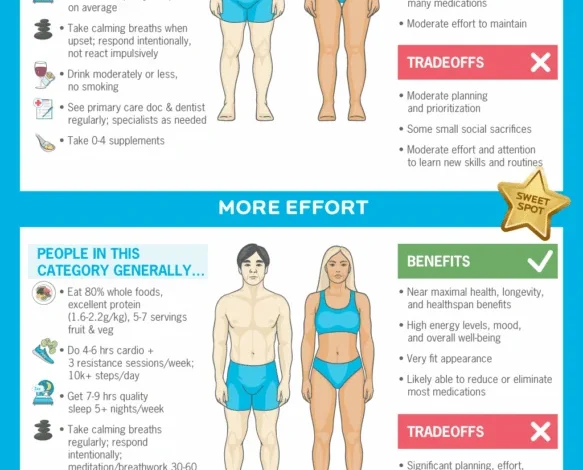
The cultural obsession with health optimization has been fueled largely by prominent figures in the medical and wellness media space—including physicians, researchers, and self-experimenting technologists—who promote cutting-edge interventions designed to push human physiology past historical limits. While the psychological appeal of designing a "perfect" health plan offers a comforting sense of control, industry analysts and behavioral health experts note that "optimal" is rarely realistic for the average person managing a career, family, and standard human stressors. Furthermore, extensive coaching data indicates that optimal is simply not necessary to achieve significant health transformations. Individuals who practice basic health-promoting behaviors with just 50 to 80 percent consistency frequently experience measurable reductions in body fat, improved metabolic markers, and lowered risks of all-cause mortality.

To understand why foundational habits outperform fringe interventions, researchers point to the law of diminishing returns in human physiology. Small, incremental shifts in physical activity and nutrition drastically improve longevity outcomes when transitioning from a completely sedentary lifestyle to a moderately active one. However, as effort, financial investment, and behavioral rigidity scale upward into the realm of extreme biohacking, the marginal health gains level off significantly. Excessive focus on micro-optimization often introduces severe friction into daily life, heightening the risk of burnout, psychological distress, and orthorexia—an unhealthy obsession with healthy eating. Consequently, individuals frequently abandon rigid protocols entirely, returning to unhealthy baselines rather than maintaining a sustainable middle ground.

Scientific literature consistently underscores that the core pillars of longevity remain remarkably straightforward, though vastly under-practiced by the general population. These foundational behaviors center on regular physical activity, a nutrient-dense diet emphasizing whole foods, adequate sleep, effective stress management, and robust social connections, coupled with the active minimization of known harms such as smoking and heavy alcohol consumption.

Physical activity serves as one of the most potent predictors of longevity. Comprehensive long-term studies, including historical analyses of Harvard alumni and large-scale assessments of older adults, demonstrate that any level of regular movement reduces the risk of all-cause mortality, regardless of genetic predisposition or body weight. The greatest return on investment occurs when individuals accumulate between 7.5 and 15 MET-hours (Metabolic Equivalent Hours) of activity per week—roughly equivalent to standard brisk walking or moderate aerobic exercise combined with two to three resistance training sessions. Resistance training is particularly critical for aging populations, as it preserves lean muscle mass, enhances bone mineral density, and directly mitigates the risk of fatal falls. Conversely, a completely sedentary lifestyle doubles the risk of premature death over a two-decade span compared to maintaining basic physical activity levels.

Nutritional science reinforces a similar principle of simplicity over complexity. Extensive epidemiological data tracking millions of participants indicates that dietary patterns rich in whole and minimally processed foods correlate strongly with reduced rates of cardiovascular disease, type 2 diabetes, and mental health disorders. Conversely, ultra-processed foods (UPFs) have been causally linked in massive global studies to dozens of adverse health outcomes, including a significantly elevated risk of premature mortality. Health authorities recommend that roughly 70 to 80 percent of daily caloric intake stem from minimally processed sources, alongside the well-established guideline of consuming five servings of fruits and vegetables daily to saturate protective physiological benefits. Beyond protein optimization—where a minimum intake of 1.2 grams per kilogram of body weight is advised to prevent sarcopenia—further nutritional micromanagement yields negligible returns for the average person.

Sleep duration and quality represent another non-negotiable pillar of metabolic and cognitive health. Clinical research links consistent sleep deprivation of less than seven hours per night to heightened rates of hypertension, type 2 diabetes, and neurodegenerative conditions such as dementia, largely due to the brain’s reliance on deep sleep cycles to clear metabolic waste products like beta-amyloid plaques. Similarly, chronic, unmanaged stress elevates systemic inflammation and cardiovascular strain, whereas modest stress-regulation practices and strong social integration act as powerful protective buffers against premature death. Notably, long-term Harvard studies tracking adult development over eight decades have identified robust social relationships as the single greatest predictor of overall life satisfaction and longevity, outranking financial wealth, social class, and even genetic factors.

The financial and temporal divergence between a standard health-conscious lifestyle and an extreme "optimizer" lifestyle is stark. Individuals pursuing high-end biohacking protocols often invest three to four times the weekly hours and upwards of $10,000 annually into specialized blood panels, continuous diagnostic testing, specialized hyperbaric therapies, and expensive supplement regimens. While these interventions may appeal to those seeking absolute physiological perfection, financial analysts and public health experts emphasize that such expenditures are entirely unnecessary for securing a long, healthy, and vibrant life.

Ultimately, the broader implications of longevity culture point toward a paradigm shift in how modern medicine approaches preventative health. Rather than succumbing to the paralysis of all-or-nothing thinking—wherein individuals believe that failing to execute a rigorous 5.00 a.m. workout routine renders health efforts pointless—experts advocate for a balanced, personalized approach. By prioritizing the masterable basics, remaining consistent with foundational habits, and tuning out the commercial noise of the wellness industry, individuals can achieve up to 80 percent of maximum health benefits while retaining the time, financial resources, and mental freedom required to genuinely enjoy life.