The Advancing Global Health Annual Program Statement (AGH/APS) Mechanism: Supplementing the America First MOUs

The architecture of United States foreign assistance has undergone a profound transformation following sweeping structural shifts initiated early in the second Trump administration. These reforms included a significant consolidation of supported international development projects, the formal dissolution of the U.S. Agency for International Development (USAID), and the subsequent transfer of remaining global health portfolios directly to the U.S. Department of State. In September 2025, after months of operational uncertainty that left international aid organizations and partner governments awaiting direction, the State Department released its definitive blueprint: the America First Global Health Strategy (AFGHS). This new strategic framework represents a paradigm shift away from traditional multilateral models and legacy foreign assistance delivery mechanisms, establishing instead an aid paradigm anchored primarily by bilateral agreements negotiated on a nation-to-nation basis.
Chronology of the Policy Shift and MOU Rollout
The implementation of the AFGHS relies heavily on targeted Memoranda of Understanding (MOUs) established directly with host governments that receive U.S. health assistance. As of late 2026, 36 bilateral agreements have been successfully executed, representing a combined financial commitment of $26.7 billion. While official details regarding the specific operational status of all individual agreements remain limited, the overall financial structure relies on joint investments between the United States and partner nations. Specifically, the U.S. government has committed $15.9 billion toward these bilateral pacts, while partner countries have pledged a cumulative co-investment of $10.3 billion.
To operationalize these agreements, the State Department identified government-to-government (G2G) funding as its primary implementation vehicle. However, because G2G mechanisms require extensive administrative capacity and considerable time to establish, the State Department introduced a complementary, open-ended competitive funding mechanism in early 2026 known as the Advancing Global Health Annual Program Statement (AGH/APS). Announced in March 2026 through the Department’s Bureau of Global Health Security and Diplomacy, the AGH/APS serves as a flexible contracting and grant framework designed to bridge the gap and accelerate the rollout of AFGHS goals.
The State Department projected that the AGH/APS framework would channel up to $4.5 billion—subject to annual congressional appropriations and fund availability—across four distinct funding windows spanning from March 2026 through February 2027. Individual awards under this program range widely, from $500,000 to as much as $250 million, structured over performance periods of up to five years. Eligible applicants form a broad coalition of domestic and international stakeholders, including for-profit commercial enterprises, public and private universities, faith-based and secular non-governmental organizations, Public International Organizations (PIOs), and sovereign foreign government institutions.
Breakdown of AGH/APS Funding Windows and Addenda
A detailed analysis of the AGH/APS portfolio reveals the systematic release of 12 distinct addenda across the first three funding windows, offering up to 122 potential project awards totaling $1.43 billion as of November 2026. This initial tranche accounts for approximately 32% of the total $4.5 billion anticipated under the overarching program statement. The addenda are broadly categorized into two distinct operational strategies: country-specific solicitations tied directly to MOU implementation plans, and area-specific solicitations addressing cross-cutting global health priorities.
The funding windows were rolled out sequentially to maintain momentum:
- Window 1 (March 5 – May 31, 2026): Allocated up to $542.65 million across 21 potential awards.
- Window 2A (June 2 – July 31, 2026): Allocated up to $295 million across 39 potential awards.
- Window 2B (July 1 – September 15, 2026): Allocated up to $315.4 million across 25 potential awards.
- Window 3 (August 15 – October 30, 2026): Allocated up to $277 million across 37 potential awards.
- Window 4 (Expected November 15, 2026 – January 29, 2027): Concludes the primary application cycle.
Geographically and thematically, the released addenda are evenly split between localized and thematic directives. Country-specific addenda account for roughly 51% of the allocated capital (up to $730 million), while area-specific addenda represent the remaining 49% (up to $700 million).
Country-Specific Investments and Strategic Objectives
The seven country-specific addenda published thus far focus heavily on institutionalizing sustainable, government-led health systems capable of maintaining previous public health gains without perpetual foreign dependency.
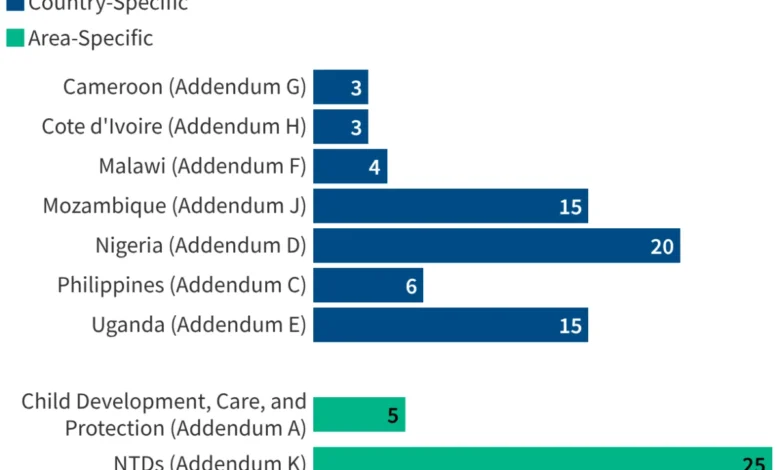
Leading the financial commitments is Nigeria, which accounts for an up to $200 million solicitation spanning 20 potential awards (Addendum D). The Nigerian program focuses on expanding access to affordable, integrated health services across public, private, and faith-based facilities, with a strong emphasis on improving maternal and child health outcomes, enhancing health insurance coverage, and reinforcing supply chains.
Similarly, the Philippines represents a $200 million investment distributed across 6 awards (Addendum C), uniquely structured to leverage private-sector partnerships between U.S. and Philippine firms. This initiative focuses on piloting and scaling digital health infrastructure, regulatory innovations, and advanced laboratory supply chains to bolster disease surveillance while promoting the adoption of U.S. technological standards.
Other major country-specific allocations include:
- Mozambique (Addendum J): Up to $180 million across 15 awards aimed at strengthening national and subnational health systems, improving maternal-neonatal survival rates, and fortifying biosecurity against emerging threats.
- Uganda (Addendum E): Up to $60 million across 15 awards directed toward scaling community-based health financing, power solutions for rural clinics, and supply chain accountability.
- Cote d’Ivoire (Addendum H): Up to $50 million across 3 awards to accelerate the nation’s transition toward an accountable, government-led health system by 2030.
- Malawi (Addendum F): Up to $35 million across 4 awards targeting integrated service delivery across HIV, tuberculosis, malaria, and maternal-child health platforms.
- Cameroon (Addendum G): Up to $5.4 million across 3 awards focused on strengthening integrated disease surveillance and emergency response through a unified "One Health" framework.
Thematic and Area-Specific Priorities
In parallel with localized bilateral agreements, the area-specific addenda target critical transnational challenges that require specialized technical interventions across multiple regions.
The largest area-specific allocation is found in Rapid Outbreak Response (Addendum B), which provides up to $290 million across 10 awards designed to enable immediate surge capabilities, early containment, and cross-border mitigation during the nascent stages of emerging pathogen threats.
To address persistent regional disease burdens, the State Department launched Addendum K, committing up to $162 million across 25 awards for Neglected Tropical Diseases (NTDs). This initiative targets high-burden populations across the Western Hemisphere (including Haiti, Bolivia, and Brazil), Africa (spanning Nigeria, the DRC, Tanzania, and others), and the Asia-Pacific region (such as Bangladesh and Papua New Guinea).
Additional thematic priorities include:
- Accelerating Nutrition Progress (Addendum L): Up to $115 million across 12 awards targeting maternal and child malnutrition across 12 high-burden countries in Africa and the Caribbean.
- Innovations in Population-Based Surveys and Surveillance (Addendum I): Up to $80 million across 4 awards to help partner nations develop self-sustaining health data architectures.
- Child Development, Care, and Protection (Addendum A): Up to $52.65 million across 5 awards focused on strengthening national child welfare systems and preventing institutionalization.
Background Context and Global Health Implications
The transition to the AFGHS model marks one of the most consequential departures in modern U.S. foreign policy. For decades, international health assistance was dominated by vertically integrated programs managed primarily by specialized agencies and multilateral institutions, which often operated independently of host-government ministries. Proponents of the Trump administration’s strategy argue that the new bilateral, co-investment model fosters genuine national ownership, enhances fiscal transparency, and compels partner governments to take long-term responsibility for the health of their citizens.
Conversely, global health analysts and international development experts have expressed caution regarding the speed and scale of the restructuring. The dissolution of USAID and the rapid pivot to State Department oversight have raised operational concerns among non-governmental implementers regarding continuity of care, potential disruptions in pharmaceutical and medical commodity supply chains, and the capacity of local ministries to absorb complex financial and administrative responsibilities. Furthermore, the emphasis on domestic co-investments—such as the $10.3 billion pledged by partner nations—has led to debates over whether economically fragile states can sustain these financial commitments during domestic fiscal downturns.
As the implementation phase progresses through its final funding windows, policymakers, international monitors, and public health researchers will closely evaluate how the AGH/APS mechanism interacts with the broader bilateral MOUs. With no formal award announcements publicly finalized as of late 2026, the true operational impact of the America First Global Health Strategy remains on the horizon, poised to reshape the delivery of American foreign assistance for the foreseeable future.