Breaking Up With Macro Tracking: How Dr. Gabrielle Fundaro Created the RPE-Eating Scale to Restore Food Freedom

For more than a decade, Dr. Gabrielle Fundaro stood as a pillar of reliability in the fitness and nutrition communities. Armed with a PhD in Human Nutrition, over ten years of intensive nutrition coaching experience, and a competitive background in six powerlifting competitions, she appeared to be the absolute authority on metabolic optimization. Yet, behind the credentials and the meticulously maintained physique lay a private fatigue. Dr. Fundaro had spent years using macro counting as an unyielding anchor to stay on track with her eating habits, calculating proteins, carbohydrates, and fats down to the single gram.
While the methodology had initially delivered the structural precision she desired, it eventually transformed into a psychological cage. She grew exhausted by the constant vigilance required to balance numbers for every single meal, longing instead for the simple luxury of selecting an item from a restaurant menu and enjoying it without enduring a mental calculus regarding her health and physique. However, the prospect of entirely abandoning macro tracking provoked genuine anxiety. Every time she considered quitting, familiar and distressing questions surfaced: What if her protein intake plummeted, causing her to lose hard-earned muscle mass? What if a lack of tracking led to accidental overeating and subsequent fat gain? Most pressingly, what would it say about her professional credibility as a nutritional expert if she no longer tracked her own food?
This internal friction galvanized a search for a viable alternative—a framework that could safeguard her physiological goals while restoring a sense of intrinsic peace and autonomy around eating. Conventional calorie counting offered no relief, serving merely as an alternative form of restriction. Similarly, traditional intuitive eating presented hurdles. Because intuitive eating relies heavily on an individual’s ability to interpret internal hunger and fullness cues, years of leaning entirely on external metrics left Dr. Fundaro feeling disconnected from her own biological signals. She craved structure, but a healthier kind of structure.
The breakthrough arrived through an unexpected avenue: the weight room. While training, Dr. Fundaro began implementing the Rate of Perceived Exertion (RPE) scale, a well-established framework used to quantify physical effort during movement. Originally developed in the 1960s by Gunnar Borg for clinical physiotherapy, the modern 0-to-10 RPE scale allows athletes to gauge how hard they are working on a subjective, individual basis rather than relying blindly on external metrics like velocity trackers. By integrating the RPE scale into her lifting regimen, Dr. Fundaro noticed simultaneous improvements in both strength gains and physical recovery. This realization sparked a pivotal question: If the Rate of Perceived Exertion could optimize physical training, could a parallel framework transform nutritional habits?
The Evolution and Mechanics of the RPE-Eating Scale
To understand the mechanics of Dr. Fundaro’s subsequent invention—the RPE-Eating Scale—it is helpful to examine the historical trajectory of RPE within sports science. Gunnar Borg’s original formulation utilized a 6-to-20 scale designed to correspond roughly with heart rates during physical exertion. Over decades of clinical and athletic application, the fitness industry streamlined this into a more intuitive 0-to-10 scale. A rating of 0 signifies complete rest, 5 represents moderate effort, and 10 denotes maximum, absolute physical output.
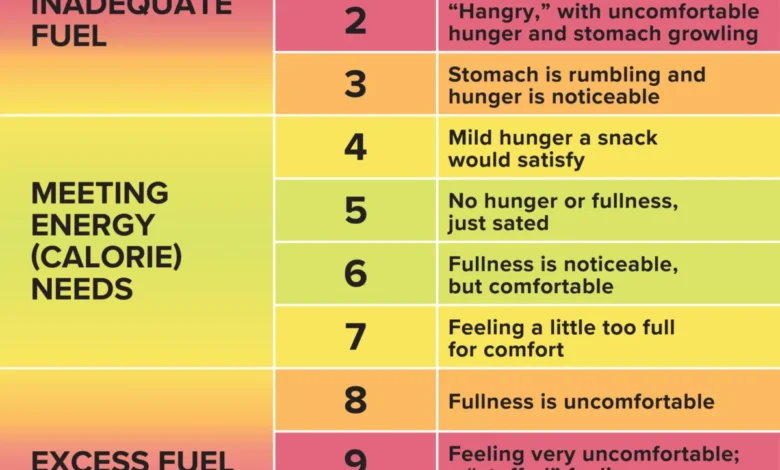
Because human physiology is deeply subjective, the RPE scale succeeds by granting the practitioner autonomy. A coach might prescribe a target of 7 out of 10 for a specific set of squats, but the athlete determines what that numerical threshold feels like in their body on that particular day. Dr. Fundaro recognized that dietary habits could be governed by the exact same principle. Instead of measuring grams of macronutrients, the RPE-Eating Scale measures levels of hunger and satiety on a 1-to-10 spectrum.
The newly established scale categorizes the human experience of eating into distinct zones. The lower end, spanning levels 1 through 3, represents inadequate fuel, characterized by dizziness, extreme hunger, or stomach growling. The middle tier, encompassing levels 4 through 7, denotes adequate fuel, where an individual transitions from mild hunger to comfortable, sated fullness. The upper spectrum, covering levels 8 through 10, indicates excess fuel, ranging from uncomfortably full to feeling physically sick from overeating.
The primary objective of RPE-Eating is not immediate weight loss or rapid physique transformation. Rather, it serves as a psychological and physiological bridge, cultivating interoceptive awareness—the ability to recognize and interpret internal bodily sensations—so that individuals can nourish themselves effectively without needing external digital trackers.
A Step-by-Step Implementation Guide for Practitioners

Adopting the RPE-Eating framework requires patience, particularly for individuals who have spent years or decades ignoring their body’s natural cues in favor of rigid meal plans. Dr. Fundaro outlines a structured, four-step process for those looking to transition away from compulsive food tracking.
The first step requires establishing clear, non-aesthetic goals. RPE-Eating is fundamentally distinct from traditional dieting; it is not designed to rapidly alter body composition or enforce a rigid sense of dietary control. While the method can be loosely adapted to support specific body-weight goals, its primary purpose is fostering self-trust and nutritional competence. Practitioners must accept that their bodies may undergo minor, natural fluctuations as they learn to prioritize internal nourishment over external validation.
The second step involves systematically identifying true physical hunger cues by learning to differentiate hunger from mere appetite. While physical hunger manifests as an empty stomach, rumbling, or lightheadedness driven by actual energy deficits, appetite represents the psychological desire or sensory craving for food—such as the impulse to consume a rich dessert despite already feeling physically full. To untangle these two drives, practitioners are encouraged to record their hunger level on the 1-to-10 scale before a meal, pause midway through to reassess their physical state, and log their final rating upon completion. By intentionally internalizing the physical sensation of satisfaction, the brain gradually updates its internal software, replacing external app notifications with biological feedback.
The third step addresses non-hunger eating triggers. Life rarely unfolds in a controlled laboratory setting, and emotional stressors—such as workplace anxiety or interpersonal conflict—frequently drive mindless, rapid consumption. Utilizing a strategy known as "notice and name," practitioners are taught to pause when they feel an urgent compulsion to eat, identify the underlying emotion or preceding event, and determine whether food is the appropriate remedy. By expanding their repertoire of self-soothing techniques, such as taking a brief walk or practicing deep-breathing exercises, individuals learn to address emotional needs without resorting to compulsive eating.
The fourth and final step emphasizes eating for both satiety and satisfaction. True nourishment requires meeting both physical energy needs and psychological desires. Restricting entire food groups or labeling favorite items as "off-limits" frequently backfires, creating a pendulum swing between strict restriction and eventual binge eating. By incorporating enjoyable foods into the RPE-Eating framework, practitioners discover how to fuel their bodies adequately while maintaining a sustainable, pleasurable relationship with food.
Broader Implications, Target Demographics, and Skepticism
As the nutrition industry increasingly recognizes the psychological toll of chronic dietary tracking, frameworks like RPE-Eating offer a valuable off-ramp for individuals trapped in cycles of food anxiety. Experts note that while macro tracking is an educational tool, it was never intended to be a lifelong mandate. Transitioning away from it, however, often triggers a fear of losing control. RPE-Eating provides a structured alternative that softens this transition, particularly for populations at elevated risk for developing disordered eating patterns, such as athletes in weight-class sports or individuals with a long history of yo-yo dieting.
Critics of the methodology often argue that RPE-Eating relies too heavily on subjective feelings rather than hard biochemical facts. However, proponents draw parallels to the initial skepticism surrounding RPE in strength sports. Decades ago, powerlifters dismissed autoregulation based on perceived exertion as unscientific, preferring strict mathematical percentage tables. Today, RPE is widely validated in sports science literature as an effective, highly practical method for managing training stress. Similarly, proponents argue that tuning into internal biological markers—such as stomach contractions and stabilizing blood sugar—is far more accessible and sustainable for the general population than continuous glucose monitoring or relentless gram-counting.
Nevertheless, experts emphasize that RPE-Eating is not a universal solution. The method demands a high degree of emotional and mental labor, requiring practitioners to pause, reflect, and process complex physical and emotional sensations. For individuals facing demanding work schedules, parenting responsibilities, or chaotic daily routines, continuous mindfulness at every meal may prove impractical. In such cases, experts recommend utilizing the framework selectively—applying specific steps during quieter moments of the day rather than striving for perfection.
Ultimately, the RPE-Eating scale represents a shift in modern nutritional coaching, moving away from restrictive compliance and toward sustainable autonomy. By bridging the gap between structure and intuition, Dr. Gabrielle Fundaro’s framework demonstrates that individuals can successfully nourish their bodies, build lasting self-trust, and achieve health independence without a single macro tracker in sight.
Related posts: