The Growing Burden of Healthcare Costs: A Comprehensive Analysis of Medical Inflation Versus the Broader Economy

For decades, the financial architecture of the United States has been strained by a persistent and widening gap between the cost of living and the price of staying healthy. According to a recent analysis by the Peterson-KFF Health System Tracker, medical care prices and overall health spending have historically outpaced growth in the rest of the American economy. This phenomenon places a heavy and growing burden on households, employers, and government budgets alike.
As healthcare costs consume an ever-larger share of the nation’s gross domestic product (GDP), millions of American families face a precarious financial reality. Over the past two and a half decades, the cost of medical services and health insurance premiums has routinely outstripped wage growth. The disparity is not merely a short-term economic blip; it represents a long-term structural trend that continues to challenge policymakers, healthcare providers, and consumers.
A Deep Dive into Bureau of Labor Statistics Data
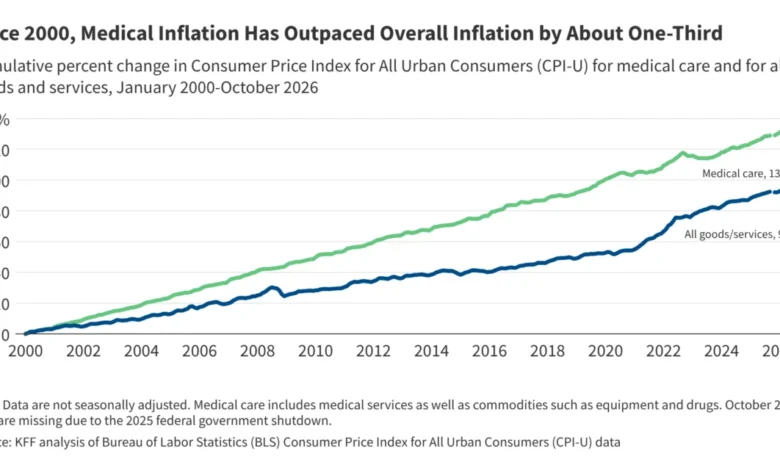
To understand the mechanics of this divergence, researchers relied heavily on data from the Bureau of Labor Statistics (BLS), specifically examining inflation trends among urban consumers through the Consumer Price Index for All Urban Consumers (CPI-U). By comparing these metrics against specific healthcare sub-indexes—including hospital services, physician services, and prescription drugs—the KFF analysis paints a vivid picture of how medical inflation operates independently of broader economic cycles.
The findings are stark. Between January 2000 and projected baseline metrics extending to October 2026, medical care prices grew by a staggering 33% more than overall consumer prices. While general inflation fluctuates in response to monetary policy, energy markets, and global supply chain disruptions, medical inflation has exhibited an almost relentless upward trajectory.
Within the healthcare sector, not all services have experienced inflation equally. The price of hospital services has consistently emerged as the fastest-growing component of medical expenditures. Advanced medical technologies, consolidation within hospital systems, administrative overhead, and the rising cost of specialized labor have all been cited by health economists as primary drivers behind the steep escalation in inpatient and outpatient facility fees.
Chronology and Long-Term Inflation Trends
To contextualize the current state of medical inflation, it is helpful to examine the historical timeline of healthcare price growth in the United States.
The roots of modern medical inflation trace back to the late 20th century, following the widespread adoption of managed care and the subsequent deregulation and consolidation of health insurance markets. However, the distinct divergence between medical and general consumer prices became acutely pronounced at the turn of the 21st century.
During the 2000s, while the broader economy experienced the housing boom and subsequent financial crisis, medical prices climbed steadily upward. Even during periods of general economic deflation or ultra-low inflation following the 2008 Great Recession, medical services continued to inflate at rates significantly higher than the Consumer Price Index for all items.
By the mid-2010s, the implementation of the Affordable Care Act (ACA) introduced new regulatory frameworks, insurance marketplaces, and subsidies aimed at expanding coverage. While the ACA successfully extended health insurance to millions of previously uninsured Americans, it did not fundamentally curb the underlying unit prices of medical goods and services. Consequently, healthcare spending as a percentage of GDP continued its upward march, hovering near 18% in recent years.
The onset of the COVID-19 pandemic in 2020 introduced a new set of economic pressures. Initially, overall inflation spiked due to federal stimulus, supply chain bottlenecks, and labor shortages. For a brief period, general inflation rates rivaled or momentarily exceeded certain healthcare price indices. However, as the broader economy began to stabilize and post-pandemic inflation cooled, medical inflation resumed its historical pattern of outpacing the general CPI, driven by acute labor shortages in the nursing and medical fields, wage increases for healthcare workers, and rising costs for pharmaceuticals and medical supplies.
The Impact on American Families and Wages
The practical consequence of this persistent inflation is felt most acutely at the kitchen table. For the average American worker, wage growth has historically failed to keep pace with the combined increases in out-of-pocket medical costs and employer-sponsored health insurance premiums.
According to data compiled by KFF in previous employer health benefits surveys, the average cost of family health insurance coverage has more than doubled over the past fifteen years, vastly outpacing both worker earnings and overall inflation. As premiums rise, employers frequently shift a greater share of the financial burden onto employees through higher deductibles, steeper copayments, and narrower provider networks.
This dynamic has given rise to the phenomenon of underinsurance, where individuals possess health insurance coverage but remain vulnerable to catastrophic medical debt due to high out-of-pocket exposure. Many families report delaying or forgoing necessary medical care, prescription drugs, and preventative screenings due to cost barriers. In a wealthy nation, the necessity of choosing between medical treatment and basic living expenses remains a critical social and economic failure.
Official Responses and Policy Debates
The KFF analysis arrives amid intense political and economic debate regarding how to rein in healthcare spending without compromising the quality of care. Policymakers on both sides of the aisle acknowledge the severity of the crisis, though proposed solutions vary widely based on ideological approaches.
Progressive lawmakers and healthcare advocates argue that runaway medical prices are the direct result of a market failure driven by private insurer profits, pharmaceutical monopolies, and hospital consolidation. Proposals from this camp often center on introducing public option models, expanding Medicare, empowering the federal government to negotiate prescription drug prices directly, and implementing strict price caps on hospital and outpatient services. Proponents of these measures argue that only robust government intervention can counterbalance the unchecked market power of large healthcare conglomerates.
Conversely, conservative economists and policymakers emphasize market-based reforms to foster competition and transparency. Their strategies frequently include expanding the use of Health Savings Accounts (HSAs), promoting association health plans, allowing the interstate sale of insurance policies, and increasing price transparency mandates so consumers can shop for healthcare services based on cost and quality. Advocates of this approach contend that heavy-handed government price controls could stifle medical innovation, reduce the availability of advanced treatments, and lead to provider shortages.
Meanwhile, healthcare providers and hospital associations push back against simplistic narratives regarding price growth. Representatives from major health systems argue that hospitals operate on razor-thin operating margins, particularly in rural and underserved urban communities. They attribute rising costs to mounting regulatory compliance burdens, expensive electronic health record mandates, escalating liability insurance premiums, and the uncompensated care provided to uninsured or underinsured patients. Furthermore, hospitals emphasize that they must pay competitive wages to attract skilled clinicians in the wake of severe nationwide labor shortages.
Broader Economic Implications and Future Outlook
The macroeconomic implications of unchecked medical inflation extend far beyond individual household budgets. For American businesses, the rising cost of providing health insurance to employees acts as a hidden tax on competitiveness, potentially suppressing wage growth and limiting corporate investment in research, development, and expansion.
At the public sector level, federal and state governments face mounting fiscal pressures. Programs like Medicare and Medicaid consume significant portions of government budgets. As the U.S. population ages and the ratio of workers to retirees shifts, the combination of demographic pressures and above-average medical inflation threatens the long-term solvency of these vital social insurance programs. Without systemic reforms to control the underlying growth of medical prices, federal debt projections will remain under severe strain.
Looking ahead, the Peterson-KFF Health System Tracker and related research tools will continue to serve as essential resources for monitoring these trends. As the United States navigates the remainder of the 2020s, economists stress that addressing the root causes of medical inflation will require a multifaceted approach. Whether through enhanced market competition, regulatory reform, or payment model innovation, stabilizing the cost of healthcare remains one of the most pressing domestic policy challenges of the modern era. Without meaningful intervention, the widening chasm between medical prices and the broader economy will continue to define the financial landscape of American life.