WHO and Switzerland Renew Strategic Partnership to Advance Public Health Priorities through 2028

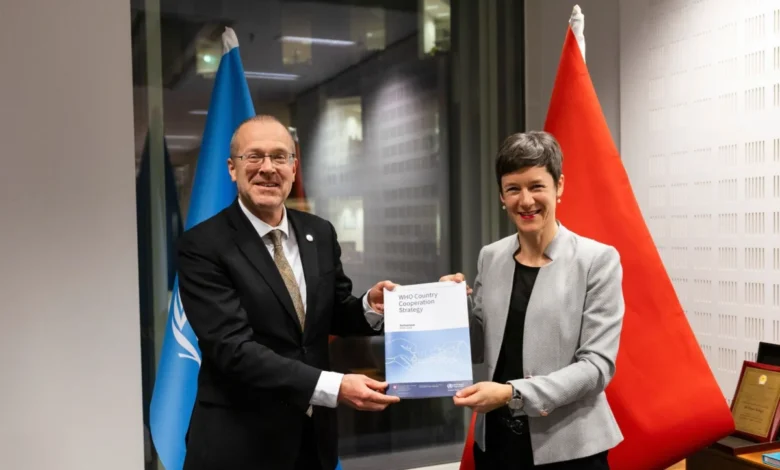
The World Health Organization (WHO) and the Swiss Confederation have officially cemented their long-standing partnership by renewing their joint Country Cooperation Strategy for the 2024–2028 cycle. The formal agreement was concluded and signed at the WHO Regional Office for Europe in Copenhagen, Denmark, marking another milestone in a relationship that has served as a pioneering model for high-income nations engaging with international health bodies.
This newly ratified framework builds upon a foundation laid more than a decade ago, setting clear strategic priorities for bilateral health cooperation, emergency preparedness, health security, and multilateral health governance. The signing ceremony brought together key diplomatic and public health figures, including Dr. Hans Henri P. Kluge, WHO Regional Director for Europe, and Barbara Schedler, Ambassador for Global Health at the Swiss Federal Office of Public Health. Together, they reaffirmed their mutual commitment to addressing contemporary health challenges both within Europe and on the global stage.
Historical Context and Evolution of the WHO-Switzerland Partnership
The collaboration between Switzerland and the WHO holds unique significance within the global health architecture. Switzerland is not only the host country for the global headquarters of the World Health Organization in Geneva, but it has also actively integrated its national public health strategies with broader European and international frameworks.
In 2013, Switzerland made history by becoming the first high-income country within the WHO European Region to pilot a dedicated country cooperation strategy. Prior to this initiative, such strategic frameworks were primarily deployed in low- and middle-income countries requiring technical assistance, capacity building, and resource allocation. By establishing a framework with a high-income nation, WHO and Switzerland demonstrated that advanced economies also benefit immensely from structured, collaborative policy alignment, mutual learning, and joint responses to cross-border health threats.
Over the subsequent decade, the partnership evolved organically. The initial success of the 2013–2017 framework led to subsequent renewals, adapting to shifting epidemiological landscapes, the emergence of antimicrobial resistance, non-communicable disease burdens, and the devastating impact of global health emergencies such as the COVID-19 pandemic. The decision to update and renew the strategy for the 2024–2028 period was jointly reached in 2022, reflecting a shared recognition that post-pandemic recovery requires enhanced resilience, robust health systems, and deeper international solidarity.
Key Pillars of the 2024–2028 Cooperation Strategy
The newly adopted WHO-Switzerland Country Cooperation Strategy for 2024–2028 is designed to address a comprehensive spectrum of public health priorities. While high-income countries like Switzerland boast advanced healthcare infrastructures, they remain vulnerable to systemic shocks, workforce shortages, aging populations, and the health impacts of climate change.
The strategy is anchored around several core thematic areas:

- Strengthening Health Security and Emergency Preparedness: Drawing vital lessons from the COVID-19 pandemic, the framework emphasizes enhancing surveillance systems, rapid response mechanisms, and cross-border data sharing. Switzerland’s advanced technological and research capabilities play a crucial role in supporting WHO’s broader European health emergency architecture.
- Advancing Global Health Diplomacy and Governance: As a neutral nation and a central hub for international organizations, Switzerland utilizes its diplomatic standing to champion equitable access to medical countermeasures, universal health coverage (UHC), and negotiations surrounding international instruments such as the global pandemic agreement.
- Innovation, Research, and Digital Health: The partnership leverages Switzerland’s world-class academic institutions, pharmaceutical sector, and research hubs to drive innovation in diagnostics, therapeutics, and digital health tools, ensuring that technological advancements are translated into accessible public health solutions.
- Addressing Chronic Challenges: Non-communicable diseases (NCDs), mental health, and the health consequences of environmental degradation remain focal points of the strategy, aligning national Swiss health targets with the European Programme of Work (EPW).
Chronology of Key Milestones
To understand the trajectory of this renewed partnership, it is instructive to examine the chronological development of key milestones connecting WHO and Switzerland over the past decade:
- 2013: Switzerland becomes the pioneer high-income country in the WHO European Region to adopt a pilot Country Cooperation Strategy, establishing a novel precedent for collaboration between WHO and developed member states.
- 2017–2020: The partnership focuses on aligning national innovation capacities with regional health targets, addressing aging demographics, and strengthening health systems resilience.
- 2020–2022: The COVID-19 pandemic tests bilateral and multilateral mechanisms. Switzerland plays a critical role in supporting global initiatives, hosting crucial logistics and scientific consultations, and reinforcing multilateral cooperation.
- 2022: WHO and Switzerland formally decide to update, revise, and renew their cooperation strategy to reflect post-pandemic realities and emerging strategic health priorities.
- June 2024: WHO and Switzerland further strengthen their operational ties by deepening their partnership within the global BioHub system, facilitating the safe sharing of novel pathogens and clinical materials for rapid countermeasure development.
- March 4, 2025: The WHO-Switzerland Country Cooperation Strategy for 2024–2028 is officially signed at the WHO Regional Office for Europe in Copenhagen, Denmark, by Dr. Hans Henri P. Kluge and Ambassador Barbara Schedler.
Integration with Global Initiatives: The BioHub System
A critical dimension of the broader cooperation between Switzerland and the World Health Organization is the integration of Swiss scientific infrastructure into global health security networks, most notably the WHO BioHub System.
Established to facilitate the rapid, safe, and transparent sharing of SARS-CoV-2 variants and other high-threat pathogens, the global BioHub system relies heavily on advanced containment laboratories and standardized biological resource centers. Switzerland’s participation underscores its commitment to global health security. By integrating national reference laboratories into the global BioHub network, Switzerland ensures that scientists worldwide can rapidly access pathogen materials to study transmission dynamics, develop effective vaccines, and design diagnostic tests. This practical cooperation bridges domestic scientific excellence with international public health imperatives.
Official Responses and Statements
The signing ceremony in Copenhagen was marked by optimistic assessments from leadership on both sides regarding the trajectory of public health cooperation in Europe and globally.
Dr. Hans Henri P. Kluge, WHO Regional Director for Europe, underscored the unique value of the Swiss partnership. He noted that Switzerland’s dedication to public health excellence, human rights, and universal health coverage makes it an exemplary partner for the WHO. Dr. Kluge emphasized that while the strategic framework is tailored to address mutual priorities, its impact extends far beyond Swiss borders, serving as a catalyst for technical innovation and solidarity across the entire 53-Member State European Region.
Echoing these sentiments, Barbara Schedler, Ambassador for Global Health at the Swiss Federal Office of Public Health, highlighted Switzerland’s steadfast commitment to multilateralism. Ambassador Schedler stated that global health challenges—ranging from pandemics to the health effects of climate change—cannot be solved in isolation. By renewing the Country Cooperation Strategy through 2028, Switzerland reaffirms its role as a reliable partner to the international community, dedicated to investing in robust health systems, scientific collaboration, and equitable health governance.
Broader Impact and Implications for Global Health
The formalization of the 2024–2028 cooperation strategy carries several important implications for the broader landscape of international public health:
- A Benchmark for Developed Nations: By maintaining an active country cooperation strategy, Switzerland continues to provide a template for other high-income nations to structure their relationship with WHO. It demonstrates that advanced economies benefit from structured self-assessment and strategic alignment with international public health standards.
- Support for Multilateralism: At a time when global geopolitical tensions frequently threaten multilateral institutions, the enduring and deepening partnership between WHO and Switzerland sends a strong signal of confidence in cooperative, science-based global governance.
- Catalyzing Resource and Technical Sharing: The framework ensures a steady, predictable channel for technical expertise, enabling the transfer of knowledge between Swiss institutions and WHO technical programs, which in turn supports vulnerable populations across the broader European region and globally.
As the implementation phase of the 2024–2028 strategy gets underway, both WHO and Swiss authorities will monitor progress through joint steering committees, periodic evaluations, and alignment with regional and global health targets. Through this structured cooperation, both entities aim to foster resilient health systems capable of withstanding the complex epidemiological and environmental challenges of the 21st century.