Disparity in Health Insurance Access: A Deep Dive into Employer-Sponsored Coverage for Lower-Wage Workers Reveals Significant Gaps

Health insurance constitutes approximately 8% of total employee compensation on average in the United States, a substantial component of the overall benefits package. While the majority of employees typically opt for health insurance when it is provided by their employers, a recent comprehensive analysis underscores a critical and persistent inequity: lower-wage workers face significantly reduced access to such vital coverage. This finding stems from an in-depth study conducted by the Peterson-KFF Health System Tracker, which involved an examination of survey data and focus groups with over 100 U.S. employers collectively employing more than a quarter of a million individuals. The analysis paints a clear picture of a bifurcated system, where the economic realities of a worker’s wage directly correlate with their likelihood of receiving and enrolling in employer-sponsored health benefits.
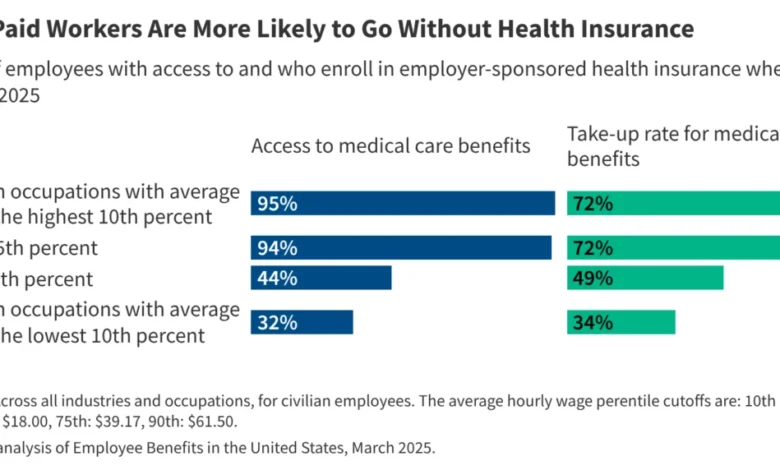
The study revealed that, on average, about three out of four employees are extended an offer of health insurance by their employers. Of those presented with this opportunity, nearly two-thirds ultimately enroll in the benefit. However, these averages mask profound disparities. Workers in occupations characterized by lower wages, such as many service sector roles, are markedly less likely to be offered health benefits through their jobs. Specifically, a staggering 94% of workers in higher-wage jobs have access to health benefits, compared to a mere 44% of those in lower-wage positions. The gap widens further when considering enrollment rates: even when lower-wage workers are offered insurance, they are much less likely to enroll, with a take-up rate of 49% versus 72% for their higher-wage counterparts. This data highlights not just an access problem but also an affordability and perceived value challenge for those at the lower end of the income spectrum.
The Evolving Landscape of Employer-Sponsored Health Insurance
The provision of health insurance by employers has been a cornerstone of the American healthcare system since World War II, largely evolving as a tax-advantaged benefit to attract and retain talent in a competitive labor market. Initially, this model gained prominence during wartime wage freezes, when employers sought alternative ways to compensate workers. The Internal Revenue Code solidified its tax-exempt status, making employer-sponsored insurance a highly attractive benefit for both companies and employees. This historical trajectory has cemented its role as the primary source of health coverage for working-age Americans, covering over 150 million individuals.
However, the dynamics have shifted dramatically over the decades. The cost of healthcare has skyrocketed, placing immense pressure on employers. Annual premiums for employer-sponsored health insurance have consistently outpaced wage growth and inflation, transforming what was once a robust benefit into an increasingly burdensome expense for businesses. According to the Kaiser Family Foundation’s (KFF) 2023 Employer Health Benefits Survey, the average annual premium for employer-sponsored health insurance in 2023 was $8,435 for single coverage and $23,968 for family coverage. These figures represent an increase of 7% from the previous year, highlighting the relentless upward trend in costs. Employers, particularly small businesses, grapple with these rising expenses, often leading to difficult decisions regarding the scope and affordability of benefits offered. The Employee Retirement Income Security Act (ERISA) of 1974 further complicated the landscape, establishing federal standards for most private industry employee benefit plans, yet also allowing for the proliferation of self-funded plans which are exempt from state insurance regulations, adding another layer of complexity to cost management and benefit design.
Stark Disparities in Access and Enrollment
The Peterson-KFF analysis underscores that the prevailing employer-sponsored model, while extensive, is far from universal and exhibits significant cracks, particularly at the intersection of employment and income. The almost 50-percentage-point difference in access to employer-sponsored health benefits between high-wage and low-wage workers is a stark indicator of systemic inequality. Lower-wage workers are disproportionately employed in sectors like retail, hospitality, food services, and caregiving, where employers often operate on tighter margins and may face greater economic constraints in offering comprehensive benefit packages. Furthermore, these sectors frequently rely on part-time or seasonal employment, which often does not qualify for benefits under many employer policies.
Beyond the initial offer, the analysis also reveals a significant "take-up" problem among lower-wage workers. Even when presented with the option, nearly half (49%) decline to enroll. This phenomenon is often attributed to the high out-of-pocket costs associated with employer plans, including premiums, deductibles, and co-pays. For a worker earning, for example, $15-$20 an hour, a monthly premium contribution of $100-$200, coupled with a high deductible often exceeding $1,500-$3,000 for an individual, can represent a prohibitive financial burden. Many low-wage workers face immediate financial pressures, prioritizing essential needs like rent, food, and transportation over a health insurance premium that may not seem immediately necessary, especially if they are generally healthy or have limited disposable income to cover potential deductibles. The perception that they cannot afford to use the insurance, even if they have it, also contributes to lower enrollment rates. This effectively creates a situation where access is theoretically present but practically out of reach due to affordability constraints, perpetuating a cycle of underinsurance and uninsurance among vulnerable populations.
Challenges Faced by Employers and the Economic Reality
The challenges in providing health insurance are not solely borne by employees; employers, especially small and medium-sized businesses (SMBs), face considerable hurdles. Large employers (typically those with 50 or more full-time equivalent employees) are mandated by the Affordable Care Act (ACA) to offer affordable health coverage, or face penalties. However, even for these employers, the definition of "affordable" under the ACA, which is based on a percentage of household income, can still translate to high costs for lower-wage employees. For small businesses, the ACA mandate does not apply in the same way, and they often lack the bargaining power of larger corporations to negotiate lower premiums with insurers. This often leaves them with higher per-employee costs, making it difficult to compete with larger firms on benefits.
Many employers have responded to rising costs by shifting more of the financial burden onto employees through higher deductibles and increased cost-sharing, often adopting high-deductible health plans (HDHPs) paired with Health Savings Accounts (HSAs). While HDHPs can lower monthly premiums for employers, they place a greater financial risk on employees, particularly those with chronic conditions or unexpected medical needs. For a lower-wage worker, a $5,000 deductible can be an insurmountable barrier to care, leading them to forgo necessary medical services or accumulate crippling medical debt. This strategic shift in benefit design, while economically rational for employers, inadvertently exacerbates the affordability crisis for their lowest-paid staff, contributing directly to the low enrollment rates observed in the Peterson-KFF study.
Profound Implications for Workers, Health, and Society
The repercussions of limited access to and enrollment in health insurance for lower-wage workers are far-reaching, impacting individual well-being, public health, and the broader economy. Individuals without adequate health coverage are significantly more likely to delay or forgo necessary medical care, including preventive services, screenings, and treatment for chronic conditions. This often results in conditions worsening, leading to more severe illnesses, emergency room visits, and higher overall healthcare costs down the line – costs that are frequently absorbed by uncompensated care or public programs, shifting the burden to taxpayers.
From an economic perspective, lack of health insurance can plunge individuals and families into medical debt, a leading cause of personal bankruptcy in the U.S. A single serious illness or accident can wipe out meager savings and push a low-income family into poverty. This financial instability creates a vicious cycle, impacting housing security, food security, and overall quality of life. For employers, a workforce with inadequate health coverage can translate to lower productivity, increased absenteeism due to illness, and higher turnover rates. Workers who are unwell are less efficient, and those facing medical crises may be forced to leave their jobs, creating recruitment and training costs for businesses. Furthermore, the persistent health inequities fueled by uneven insurance access contribute to broader societal challenges, including disparities in life expectancy and overall community health.
Policy Responses and Ongoing Debates
Addressing the coverage divide for lower-wage workers remains a central challenge in U.S. health policy. The Affordable Care Act (ACA), enacted in 2010, made significant strides by expanding Medicaid eligibility for low-income adults in participating states and establishing health insurance marketplaces with income-based subsidies. For many low-wage workers not offered employer-sponsored coverage, or for whom it is deemed unaffordable, the ACA marketplaces offer a potential pathway to insurance. However, the ACA’s impact is uneven; 10 states have yet to expand Medicaid, leaving millions of low-income adults in a "coverage gap," earning too much for Medicaid but too little for marketplace subsidies.
Policy discussions continue to explore various avenues for improvement. Proposals range from enhancing ACA subsidies to make marketplace plans even more affordable, to strengthening employer mandates, or exploring alternative models like a public health insurance option or universal healthcare systems such as Medicare for All. Some states have also implemented their own initiatives, such as state-based subsidies or innovative programs to support small businesses in offering benefits. The ongoing debate centers on how to balance the principles of individual choice, employer responsibility, and governmental intervention in ensuring that all Americans, regardless of their income or employment status, have access to affordable, quality healthcare.
Perspectives from Stakeholders
The findings of the Peterson-KFF analysis resonate deeply across various stakeholder groups, each with a distinct vantage point on the issue.
Employer Associations, such as the U.S. Chamber of Commerce or the National Federation of Independent Business (NFIB), often emphasize the significant financial pressures faced by businesses. A hypothetical statement might be: "Balancing the need to offer competitive wages and comprehensive benefits with the ever-increasing cost of healthcare is one of the most significant challenges for American businesses, especially small and medium-sized enterprises. We are committed to supporting our employees, but the current system’s cost trajectory makes it increasingly difficult to extend robust benefits to every worker without impacting our bottom line or overall economic viability."
Worker Advocacy Groups and labor unions, conversely, underscore the fundamental right to healthcare and the imperative to decouple it from employment status. A representative sentiment could be: "Healthcare should be a right, not a privilege tied to one’s job or income level. The stark disparities highlighted in this report demonstrate a systemic failure to protect our most vulnerable workers. We must advocate for policies that ensure universal, affordable access to quality healthcare, so no one is forced to choose between paying for rent or going to the doctor."
Health Policy Experts, like those from the Kaiser Family Foundation or the Commonwealth Fund, often provide a more analytical perspective, focusing on systemic inefficiencies and potential policy levers. An expert might observe: "The Peterson-KFF study confirms what many have long suspected: while employer-sponsored insurance remains the bedrock of U.S. coverage, its design inherently perpetuates disparities for lower-wage workers. We need a multi-pronged approach, enhancing affordability through federal subsidies, promoting state-level innovations, and rigorously evaluating alternative models to ensure a truly equitable health system."
Finally, Human Resources Professionals at companies struggling with these issues might express the practical difficulties: "We strive to create an attractive benefits package for all our employees. However, the high premiums and deductibles, even for our most basic plans, often make it financially unfeasible for our lowest-paid staff to enroll, despite our best efforts. We’re constantly seeking solutions that are both sustainable for the company and truly beneficial for our entire workforce."
Looking Ahead: Addressing the Coverage Divide
The Peterson-KFF Health System Tracker’s analysis serves as a critical reminder of the enduring structural inequities within the U.S. healthcare system. The nexus of employment, income, and health insurance access creates a complex web of challenges that impact millions of Americans. As the nation continues to grapple with economic fluctuations, an aging workforce, and the persistent rise in healthcare costs, the issue of ensuring equitable access to health coverage for lower-wage workers will remain at the forefront of policy debates.
Addressing this coverage divide will require concerted efforts from policymakers, employers, and healthcare providers. It necessitates a re-evaluation of current incentives and mandates, a commitment to making insurance genuinely affordable for all income levels, and a willingness to explore innovative solutions that move beyond the limitations of the traditional employer-sponsored model. The long-term economic and social costs of inaction – in terms of public health crises, widespread medical debt, and diminished national productivity – far outweigh the investments required to build a more inclusive and equitable healthcare system for every working American. The findings from this analysis provide an urgent call to action to bridge the chasm of health insurance access for those who contribute so significantly to the nation’s economy but remain most vulnerable to its systemic gaps.
Related posts: