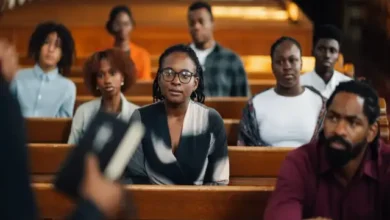
The Perils of Coerced Forgiveness: When Religious Counseling Inflicts Deeper Wounds


Amanda* vividly recalls a lunchtime encounter during her adolescence, where her biblical counselor, in a church setting mirroring her childhood congregation’s approach, dictated lines for her father to apologize for sexually abusing her since she was nine. This event unfolded in a church connected to her childhood faith, known for its distinctive approach to counseling that prioritizes theological interpretations over psychological principles. The incident highlights a troubling intersection of faith, power dynamics, and the complex process of forgiveness, particularly when survivors are pressured into premature reconciliation.
A Public Spectacle of Private Trauma: Amanda’s Ordeal
At 17, Amanda found herself in an unsettling public forum in 2002. She sat with her family, her individual counselor Lisa, and her parents’ marriage counselor David before a group of trainees at a large counseling center within an Indiana church. This institution adhered to a specific Christian counseling methodology popular in conservative Reformed traditions, which views the Bible as the ultimate authority for life’s problems, often valuing theology above established psychological science. The trainees consumed dinner while observing the family’s deeply personal session, a dynamic Amanda described as "coercive" and akin to "dinner and a show."
By this point, Amanda’s mother had been aware of the abuse for two years. Her father, however, had evaded criminal charges by hiring a lawyer and moving out. Amanda harbored profound concerns that her father might abuse others, making genuine forgiveness an impossibility for her in that state of awareness. Earlier that day, Lisa had met separately with Amanda and her mother, preparing them for her father’s presence at her grandmother’s funeral—a necessity given that the extended family was unaware of her parents’ separation. While Amanda waited in the car during her parents’ marriage counseling, her mother emerged with an unexpected directive: another session with David and her father was scheduled, and Amanda was required to attend. Lisa then ushered them into a large room where the adults orchestrated this additional session with the explicit goal of eliciting forgiveness from Amanda, simultaneously serving as a live training demonstration.
Amanda remembers her father’s reluctance and evasiveness when David prompted him to begin the session. David, intervening, supplied him with lines, saying, "Don’t you mean…", and had him repeat phrases to articulate his request for forgiveness. Then, it was Amanda’s turn. Unable to grant forgiveness under such duress, she remained silent. David filled the void by directly asking if she forgave him, to which she merely nodded, uttering no words. The counselors then unilaterally defined forgiveness as never speaking about the abuse again. To conclude the session, David prayed for a restoration of trust so profound that Amanda would one day place her future daughters on her father’s lap, a chilling prospect given the history of abuse.
Not long after, during her college years, Lisa terminated counseling with Amanda. "I did not agree with their definition for forgiveness," Amanda asserts. "I don’t think we should use Christian words like that without defining what they mean." Amanda’s experience raises critical questions about the authenticity of forgiveness under duress. Whether it’s a child forced to apologize by a parent or a survivor pressured to reconcile with an abuser, coercive dynamics are prevalent. However, psychological research and survivor narratives suggest that genuine forgiveness can still be attained even after such harmful dynamics, provided the process is handled with care, acknowledges the contexts of pressure, and proceeds patiently.
Understanding Genuine Forgiveness: A Psychological Perspective
Psychologist Loren Toussaint, a professor at Luther College, emphasizes that unequal power dynamics often compel individuals to "let people off the hook" for the sake of social harmony. Beyond extreme cases like Amanda’s, Toussaint identifies parent-child relationships and employee-employer relations as common scenarios. "There’s a certain sense of uneasiness… If I don’t forgive, there’s going to be ramifications because I’m subordinate to this person. In that case, especially, it’s really hard to guarantee and know that someone is engaging in authentic forgiveness," Toussaint explains.

Authentic forgiveness is a nuanced, unhurried process. It may begin with a conscious decision to refrain from retaliation or an early declaration to forgive, or at least to not harbor unforgiveness. Yet, it often entails years of processing the profound harm, repeatedly confronting anger, seeking justice or accountability, and grappling with the safety and health of any potential reconciliation. Ultimately, this journey can lead to seeing the offender in their full humanity, acknowledging their capacities and limitations, and genuinely wishing them growth and well-being. As Toussaint notes, forgiveness is inherently a process, not a singular event.
Toussaint recounts his own experience with a denied promotion years ago, and the offense he felt from his dean’s decision. Despite the slight, "the very first time I ran into him in person, I ran over with my hand extended," he recalls. This immediate, outwardly forgiving gesture was complicated by the underlying power dynamic. "The problem is that if you’ve been hurt by someone who is still in power over you, it’s really hard to know that you’re not forgiving out of perceived obligation to protect yourself." For Toussaint, a Catholic, his faith’s teachings also instilled a sense of compulsion to forgive. "That’s probably true for a lot of people even if they might not claim a faith," he posits. "They have a spiritual view on life or a philosophical view on life where they feel this is important: Somewhere we should find the will to forgive." Despite his early intention, it was years later before he truly recognized that he had released the resentment. Amanda’s case similarly highlights unequal power dynamics, with religious settings uniquely wielding additional authority that can, at times, lead to severe harm.
The Broader Context: Coerced Forgiveness, Spiritual Abuse, and Moral Injury
The intertwining of spiritual and moral authority within religious institutions can dangerously morph into coercive dynamics, perpetuating various forms of violence, including psychological, sexual, and economic abuse. This phenomenon is explored by attorney Renato Vera Osuna and Anahi Martinez Zuniga in a 2025 paper for the International Journal for Research and Innovation in Social Science. Drawing on sociological concepts of structural and symbolic violence, they describe how spiritual harm can become obscured, often escaping legal recognition as a crime. They advocate for legal recognition of spiritual abuse, the establishment of independent oversight bodies, and institutional reforms rooted in transparency, horizontal governance, and human rights principles.
Osuna and Zuniga’s review of reports concerning coercion and cover-ups in Catholic, evangelical, and non-denominational contexts across North America, Latin America, and Europe revealed a disturbing pattern. Through interviews with victims, legal practitioners, psychologists, and clergy, they identified common control mechanisms. These included concealing perpetrators (e.g., transferring leaders to new locations), threatening exclusion from the community, accusing dissenters of attacking the church, and manipulating theological interpretations. Such practices often silenced or re-victimized individuals attempting to report abuse or challenge authority.
Psychologists have also endeavored to define the distinct contours of harm arising in these settings. Since 1994, the Diagnostic and Statistical Manual of Mental Disorders (DSM), the authoritative guide for mental health professionals, has included "religious or spiritual problem." More recently, in fall 2025, the manual further recognized "moral problem" within the same category. Individuals experiencing religious problems may develop post-traumatic stress or other mental health challenges, benefiting significantly from counselors with specialized clinical training in these circumstances.
Tyler VanderWeele, director of the Human Flourishing Project at Harvard University, highlighted at a 2024 conference that "Sometimes clinical work has neglected the moral dimension… many world religions point to the moral dimension, and we cannot bring about full healing without addressing the moral dimension." Religions often provide a powerful social identity and serve as the lens through which individuals interpret the world, granting religious leaders and institutions unique spiritual and moral authority.
VanderWeele and other psychologists are actively defining and measuring the concept of "moral injury." While moral problems are not exclusive to religious settings, they can be a prominent feature of religious experiences. A moral injury occurs when a transgression violates deeply held moral assumptions, whether an individual perceives rightness and wrongness through a religious framework or another worldview. Initially conceptualized for veterans and healthcare workers, focusing on perpetrating or witnessing wrongdoing, the scope of moral injury has expanded to include victims’ experiences. When individuals question their own goodness, the goodness of God or a higher power, or the integrity of their faith leaders or system, it can profoundly disrupt their mental health. VanderWeele described a "moral trauma spectrum of severity and persistence" that can impede forgiveness and lead to symptoms such as guilt, shame, and powerlessness, varying in debilitating impact.
Harvard psychologist Heidi Ellis and her colleagues are also developing assessment tools to define and measure how "religious abuse" uniquely impacts individuals. While research is in its nascent stages, prevalence appears to vary based on demographic factors. For instance, relatively high rates have been observed among gay, lesbian, bisexual, and transgender individuals in Latter Day Saints communities and Native Americans who have experienced foster care. Their review of existing literature identified three consistent factors: misuse of power, psychological harm, and spiritual harm. In Amanda’s conservative evangelical context, the theological interpretation of "forgiveness" inadvertently protected her abusive father, prioritizing perceived restoration of relationship over accountability.

Harmful Practices: Spiritual Bypassing and Prescriptive Forgiveness
A prevalent error in some Christian contexts is the tendency to rush or aggressively push for forgiveness without first addressing practical concerns or the abuse survivor’s needs. Justin Holcomb, a Florida bishop in the Episcopal Church, stated in a 2019 conference talk, "I have never had to tell a survivor who is a Christian, ‘Hey, it’s about time you have to talk about forgiveness.’ I usually have to hold them back a little bit." He explained that Christians are constantly exposed to messages about forgiveness, and he cautioned support systems, including pastors, against "heaping burden on them with the command to forgive" when survivors share their stories.
This resonated deeply with Amanda, who cited Holcomb’s talk as validating her experience. She stresses that survivors require time to process their trauma. "We can’t forgive until we understand what’s happened…. Thinking about forgiveness can’t be the first thing that we do because it minimizes the sin." She uses the analogy of a nine-inch gash on a child’s leg: "We wouldn’t put a Band-Aid on it… We have to be able to understand that weight."
Focusing solely on spiritual healing while neglecting practical solutions—a phenomenon known as "spiritual bypassing"—can obstruct an honest appraisal of what is needed in the aftermath of an offense. Ellen Sinclair, in her research, highlights how "forgiveness interventions" can frame difficult events with positive thinking, yet fail to address the core problem of relational harm. An artificially positive outlook can blind individuals to the realistic dangers of an abusive situation. Sinclair’s review found that optimistic domestic abuse victims were more prone to miscalculate their risk, and spouses who forgave unremorseful partners were more likely to endure continued abuse. Misapplied, a positive approach can inadvertently blame the victim for their inability to cope with injustice.
Toussaint notes that forgiveness within faith communities can be challenging due to inadequate teachings. "There is a tendency especially in a religious setting to be prescriptive about forgiveness," he says, as sacred texts in Christian and other traditions often suggest forgiveness is non-optional. "But the second reason is that most people are being told what to do and they’re confused about what they are being asked to do," Toussaint adds. "Most people believe they are being asked to, number one, forgo any simultaneous requirement of justice and that they are to reconcile and even… to immediately reconcile." This conflation of forgiveness with reconciliation and the abandonment of justice can be profoundly damaging.
Finding Meaning and Redefining Forgiveness
Despite her harrowing experience, Amanda chose to remain in her church and, remarkably, found personal and spiritual growth through a deeper understanding of Jesus. Her journey aligns with findings by psychologist Paula Swindle, whose dissertation on religious abuse revealed that survivors exhibit seemingly opposite responses: some, like Amanda, integrate their faith even more centrally into their identity, while others leave their faith group entirely or seek new congregations.
Amanda’s resilience was fostered by a new pastor who took leadership of her childhood church, acknowledging the harm many had experienced within the previous church culture. He patiently built a relationship with Amanda, waiting for her to share her story. When Amanda was 23, her youngest sister disclosed that she too had been abused by their father, bringing the family’s full history to light and prompting a crucial shift in Amanda’s healing.
Her new pastor engaged Amanda in conversations about the true meaning of forgiveness. "One of the things we talked about: that David’s view of forgiveness actually makes the offended party have to be the savior," Amanda explains. "When you forgive someone, you take the relational weight upon yourself rather than putting it on the offender. I was expected to carry the uncomfortableness and not make my dad carry it."

Amanda now believes in the Christian scripture’s understanding of forgiveness, which, to her, means not impeding the true bearer of relational weight. She asserts that her father requires Jesus’s forgiveness, which cannot be a watered-down version. While Jesus offers forgiveness, Amanda emphasizes, "he doesn’t take away the consequences for sin here in this world… Relational consequences stay." She references the biblical narrative of King David, whose murder of Bathsheba’s husband to cover up his predatory actions and adultery led to the loss of his son and the fracturing of his kingdom, illustrating that divine forgiveness does not erase earthly consequences.
Her previous counselors had urged her to "believe the best" about her father after his purported repentance. Amanda’s counter-response is clear: "I say we should believe the truth about others. I need to believe that my dad has abused multiple children, and there’s no reason to believe that he will stop if given access to children. It’s having a realistic view of what is best for him. I think that does mean making sure he doesn’t have access to children again. I don’t think that’s in his best interest." This perspective underscores the vital distinction between forgiveness and the cessation of accountability or the restoration of unsafe relationships.
Advocacy and Recommendations for Religious Institutions
Since Amanda began sharing her story almost seven years ago, she has received numerous requests from churches seeking her consultation on behalf of victims. She observes that victims often "don’t even know what you need. But you need someone else to be able to say it for you."
Her primary caution to churches concerns the unique power dynamics inherent in religious and faith leadership, which legal scholars and psychologists are increasingly documenting. Furthermore, she highlights how abusers can manipulate communities. Many churches are eager to help individuals who confess their sins. When an abuser displays superficial repentance—in a conservative Christian context, "repentant" signifies not only sorrow but also an intention to cease wrongdoing—this can inadvertently create an opening for manipulators to exploit the community’s good faith.
Lastly, Amanda advocates for clear and precise definitions of forgiveness within faith communities. Genuine forgiveness, she likens to a seed planted years ago, which "continues to grow, and I continue to deepen that understanding" decades later. It is not a one-time event or a forced declaration, but an ongoing process of healing, understanding, and redefining boundaries. Her advocacy serves as a critical call to action for religious institutions to re-evaluate their approaches to counseling, prioritize victim safety, and cultivate an environment where authentic healing, rather than coerced reconciliation, can truly flourish. The implications extend beyond individual survivors, challenging religious organizations to confront systemic issues of power, accountability, and the often-unseen spiritual wounds inflicted within their own walls.