Senate Appropriations Committee Releases Final Five FY 2027 Funding Bills Including Critical Global Health Allocations

The United States Senate Appropriations Committee officially released the final five fiscal year 2027 appropriations bills and their accompanying explanatory reports on November 16, 2026. Among the most closely watched packages within this legislative release are the measures concerning State, Foreign Operations, and Related Programs—alternatively designated in previous cycles and House versions as National Security, Department of State and Related Programs—alongside the expansive Labor, Health and Human Services, Education, and Related Agencies bill. Together, these legislative instruments constitute the financial backbone of the vast majority of United States global health activities, providing crucial funding streams, statutory directives, and policy provisions that govern how federal agencies address international health crises, combat infectious diseases, and support multilateral health organizations.
The release of these final five bills represents a pivotal milestone in the annual federal budgeting cycle. As international health advocates, lawmakers, and federal agencies parse the fine print of the legislative text and accompanying explanatory statements, attention has immediately turned toward how the Senate’s numbers compare with those advanced earlier by the House of Representatives. With billions of dollars in foreign assistance and domestic public health programs hanging in the balance, the committee’s proposals set the stage for intense bicameral negotiations aimed at finalizing a comprehensive budget before the expiration of existing funding mechanisms.
Legislative Chronology and the Path to the FY 2027 Appropriations
The introduction of the FY 2027 appropriations bills by the Senate Appropriations Committee is the culmination of months of hearings, bipartisan negotiations, and fiscal planning that began earlier in the calendar year. The federal budget process traditionally commences in the early spring when the executive branch submits its comprehensive budget request to Congress, outlining the administration’s priorities for the upcoming fiscal year. Following the submission, both the House and Senate appropriations committees hold numerous oversight hearings, summoning cabinet secretaries, agency heads, and global health experts to justify their requested resource allocations.
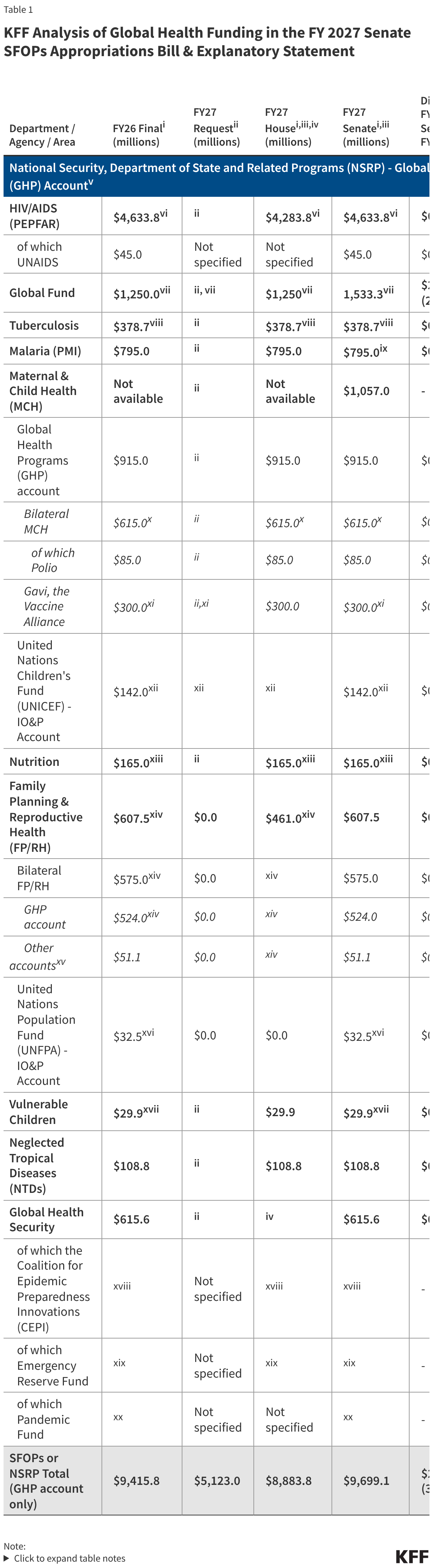
During the summer months, the House of Representatives advanced its own version of the appropriations bills, setting initial benchmarks for various federal accounts. Notably, the FY 2027 House bill and its accompanying explanatory statement put forward $8.8 billion for the Global Health Programs (GHP) account. While the House explanatory statement designated specific funding amounts for key areas such as HIV/AIDS, the Global Fund to Fight AIDS, Tuberculosis and Malaria, tuberculosis programs, malaria prevention and treatment, maternal and child health, nutrition, vulnerable children programs, and neglected tropical diseases, it notably omitted specific line-item amounts for global health security and family planning and reproductive health programs.
Following the House action, the Senate Appropriations Committee deliberated extensively over its own version of the bills, working to reconcile competing priorities within a constrained fiscal environment. The release of the Senate package on November 16, 2026, provides a direct legislative counterweight to the House measures. The Senate SFOPs bill and its detailed explanatory statement outline specific funding totals and nuanced policy guardrails for programs managed by the Department of State and the U.S. Agency for International Development. Simultaneously, the Labor, Health and Human Services, Education, and Related Agencies (LHHS) bill addresses domestic health infrastructures that frequently intersect with international health monitoring, research, and workforce development.

Detailed Breakdown of the Senate SFOPs and LHHS Proposals
The legislative texts released by the committee offer a granular view of congressional priorities regarding international aid and public health. The State, Foreign Operations, and Related Programs bill directly impacts America’s diplomatic footprint and foreign assistance architecture. Global health programs housed within the State Department and USAID rely on these allocations to execute long-term strategic plans, such as the President’s Emergency Plan for AIDS Relief (PEPFAR) and bilateral initiatives targeting preventable maternal and child deaths.
In parallel, the Labor, Health and Human Services, Education, and Related Agencies bill provides vital support for domestic agencies whose mandates extend into the global sphere. Organizations such as the Centers for Disease Control and Prevention and the National Institutes of Health collaborate extensively with international partners, research institutions, and foreign ministries to track emerging pathogens, share epidemiological data, and fund groundbreaking biomedical research. The juxtaposition of these two bills in the November 16 release underscores the interconnected nature of domestic and international health security.
Historical Context and Comparative Funding Metrics
To fully understand the significance of the FY 2027 Senate appropriations bills, policy analysts frequently look to historical annual appropriations and tracking tools maintained by organizations such as KFF, which specialize in analyzing health policy and global health financing trends. Over the past decade, U.S. funding for global health has experienced various fluctuations driven by shifting geopolitical priorities, emerging infectious disease threats such as the COVID-19 pandemic, and changing congressional majorities.
Comparing the newly released Senate proposals with historical baselines reveals how lawmakers are attempting to balance routine health maintenance—such as routine immunizations and basic healthcare delivery—with urgent preparedness initiatives. As documented in the comprehensive data tables compiled by budget analysts, the Senate framework establishes specific benchmarks that will serve as the primary baseline during upcoming conference committee negotiations with the House. These tables meticulously break down accounts across major health domains, allowing lawmakers and stakeholders to identify shifts in emphasis between infectious disease control, maternal and child health, and health systems strengthening.
Reactions from Stakeholders and Global Health Advocates
The immediate aftermath of the Senate Appropriations Committee’s announcement prompted a flurry of analysis and commentary from global health advocates, policy institutes, and international development organizations. While many stakeholders welcomed the timely release of the bills as a necessary step toward avoiding a prolonged funding impasse, reactions to specific funding levels and policy riders remained mixed.
Proponents of global health security praised the Senate for providing clearer funding designations in areas where the House bill remained ambiguous, arguing that dedicated resources are essential for maintaining robust surveillance networks and preventing future pandemics. Conversely, representatives from various advocacy groups expressed concern over potential funding ceilings and policy conditions that could restrict the operational flexibility of implementing agencies and non-governmental organizations operating in complex humanitarian environments.
Furthermore, international organizations and multilateral bodies monitoring the U.S. legislative process emphasized the critical role that American financial contributions play in global funding mechanisms like the Global Fund and Gavi, the Vaccine Alliance. Any divergence between House and Senate funding marks is closely watched by international partners who rely on multi-year predictability to plan large-scale vaccination campaigns, antiretroviral drug distributions, and vector control programs across developing nations.
Broader Impact and Policy Implications
The ultimate enactment of the FY 2027 appropriations bills carries profound implications for the global standing and strategic influence of the United States. Foreign assistance has long been recognized as a cornerstone of American soft power, fostering economic stability, strengthening democratic governance, and enhancing diplomatic partnerships across the globe. By dictating the precise allocation of resources for global health, Congress directly influences the capacity of partner nations to withstand public health emergencies and build resilient healthcare systems.
From a domestic perspective, robust investments in global health security are increasingly viewed as a vital national security imperative. Pathogens and infectious diseases do not respect international borders; consequently, robust surveillance and containment efforts abroad serve as the first line of defense in protecting American citizens from imported outbreaks and biological threats. The policy provisions embedded within the SFOPs and LHHS bills—ranging from transparency requirements to administrative oversight measures—shape how effectively taxpayer dollars are translated into measurable health outcomes on the ground.
As the legislative process moves forward, lawmakers from both chambers must reconcile the discrepancies between the House’s $8.8 billion GHP allocation and the Senate’s corresponding figures, along with differences in policy riders related to family planning, global health security, and multilateral contributions. The final compromise text agreed upon during these negotiations will determine the trajectory of U.S. global health policy for the remainder of the fiscal year, setting operational parameters for federal agencies and implementing partners worldwide.
Related posts: