CMS Finalizes 2027 OPPS Rule Implementing Steep Cuts to 340B Drug Reimbursements Amid Intense Industry Backlash and Budget Neutrality Mandates

The Centers for Medicare & Medicaid Services has officially published the finalized 2027 Medicare Hospital Outpatient Prospective Payment System rule, enacting a contentious policy that substantially reduces federal reimbursements for outpatient drugs acquired through the federal 340B Drug Pricing Program. Under the finalized regulation, Medicare payments for these specialized drugs will plummet from the standard Average Sales Price plus 6 percent down to ASP minus 28 percent. This represents a staggering 32 percent payment reduction designed to align federal payouts more closely with the actual acquisition costs incurred by participating hospitals.
The policy revival marks a significant chapter in a long-standing federal battle over drug pricing, corporate margins, and the financial sustainability of the healthcare safety net. Originally implemented during the first Trump administration in 2018, similar reimbursement cuts were ultimately struck down by the United States Supreme Court in 2022 because the Department of Health and Human Services had failed to conduct a mandated empirical acquisition cost survey prior to execution. Armed with fresh data from a comprehensive hospital acquisition cost survey completed in early 2026, federal regulators have structured the new rule to withstand anticipated legal challenges. While the agency initially floated an even deeper cut of ASP minus 33.4 percent based strictly on the survey data, the final rule settled on ASP minus 28 percent—leveraging the maximum allowed acquisition costs under the 340B statute to streamline future regulatory updates.
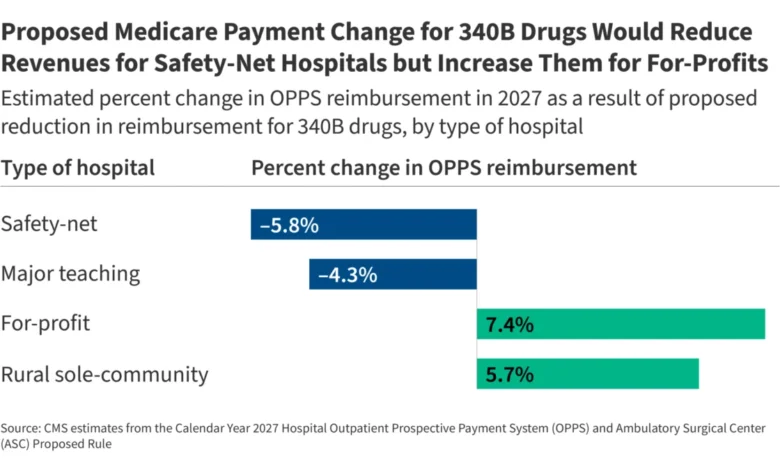
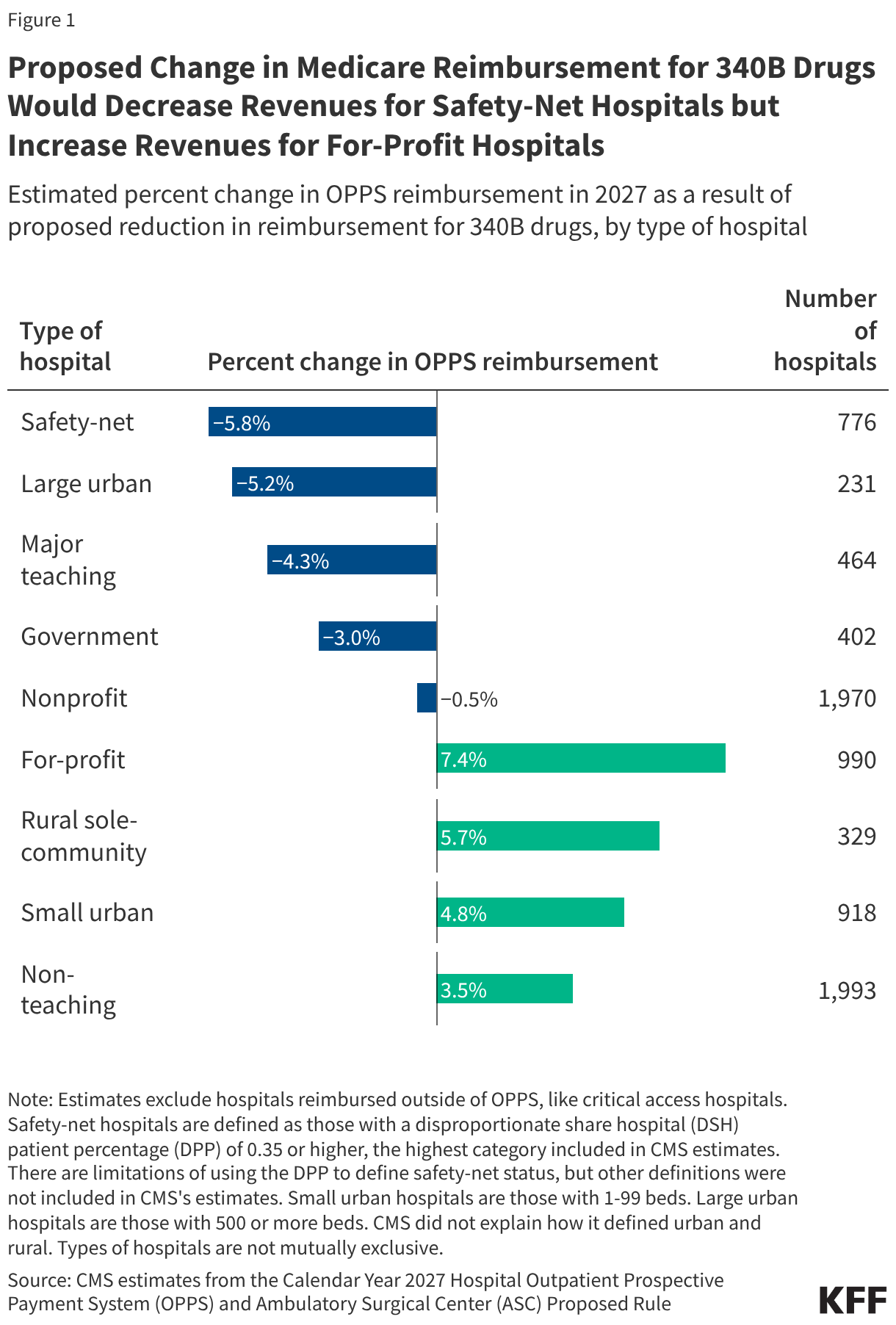
The structural mechanics of the policy dictate that Medicare spending on 340B drugs will contract by an estimated $4.65 billion in 2027 alone. However, due to strict federal budget neutrality provisions governing the outpatient prospective payment system, aggregate spending levels cannot simply decrease. Consequently, CMS is required to reallocate those billions of dollars across the broader healthcare landscape. To satisfy the budget neutrality mandate, the agency has finalized a uniform 7.5 percent across-the-board payment increase for non-drug outpatient hospital services. This counterbalancing adjustment effectively neutralizes the net change in total federal spending while radically shifting the financial distribution among different classes of healthcare providers and patient cohorts.
The ripple effects of this reallocation will be deeply asymmetrical. Safety-net hospitals, disproportionate share hospitals, and public institutions that rely heavily on 340B margins to cross-subsidize care for low-income and uninsured patients face a severe contraction in federal revenues. Conversely, non-340B hospitals—particularly for-profit health systems and suburban facilities that do not participate in the discount program—will experience a net financial windfall driven entirely by the 7.5 percent bump in non-drug outpatient reimbursements.
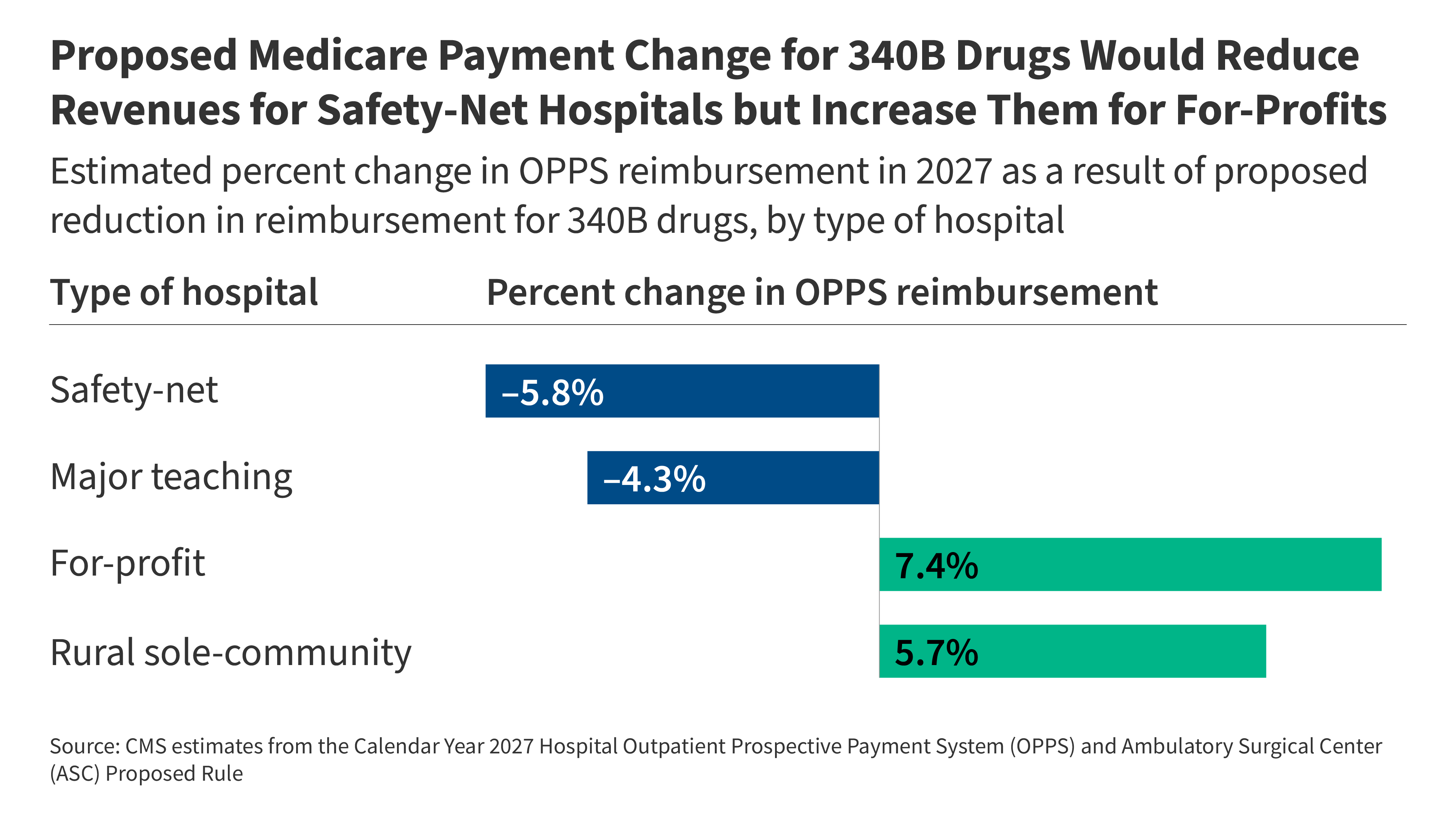
According to federal modeling, the financial disparity will directly impact operating margins across the hospital sector. Safety-net institutions traditionally operate on razor-thin or negative operating margins, absorbing the uncompensated care burdens of vulnerable communities. Stripping away the financial buffer provided by 340B margins could push these institutions into acute financial distress, a vulnerability compounded by broader federal austerity measures. Analysts note that safety-net hospitals are also disproportionately exposed to simultaneous funding cuts stemming from the 2025 federal reconciliation law, which achieved the bulk of its legislative savings through deep reductions in federal Medicaid expenditures. For-profit health systems, meanwhile, enter this regulatory shift with significantly higher baseline operating margins, positioning them to absorb adjustments and capture the upside of the non-drug outpatient payment increases.
For Medicare beneficiaries, the finalized rule creates a complex, bifurcated financial reality. Patients who regularly rely on 340B-acquired outpatient drugs will see a collective reduction in out-of-pocket cost sharing totaling an estimated $1.1 billion in 2027, as coinsurance calculations are applied to a drastically lower cost baseline. At the same time, however, beneficiaries requiring non-drug outpatient hospital services—ranging from diagnostic imaging and surgical procedures to routine clinic visits—will face higher cost-sharing liabilities resulting from the 7.5 percent payment increase mandated by the budget neutrality rules.
Importantly, the policy includes targeted exemptions to shield certain vulnerable healthcare niches from immediate fiscal shock. Rural sole community hospitals, designated children’s hospitals, and Prospective Payment System-exempt cancer hospitals are entirely exempt from the 340B reimbursement reductions. Furthermore, hospitals reimbursed outside of the outpatient prospective payment system—most notably critical access hospitals, which constitute the vast majority of rural medical facilities nationwide—remain untouched by the regulatory changes.
The rollout of the 2027 OPPS rule occurs against a backdrop of intensifying national scrutiny over the trajectory, scope, and operational integrity of the 340B program. Established by Congress via the Veterans Health Care Act of 1992, the 340B program was created to enable safety-net providers to stretch scarce federal resources further, reaching more eligible patients and providing comprehensive services. Participating drug manufacturers, as a condition of having their products covered by Medicaid, are required to sell outpatient drugs to eligible healthcare entities at steep discounts. Over the past decade, however, the program has experienced exponential growth in both participating entities and contract pharmacy partnerships, transforming it into a multibillion-dollar enterprise.
This meteoric expansion has polarized stakeholders. Critics, including pharmaceutical manufacturers and free-market think tanks, argue that the program has drifted far beyond its original legislative intent. Opponents contend that the 340B framework lacks sufficient targeting mechanisms, fails to guarantee that financial savings are directly passed down to vulnerable patients, and actively incentivizes major hospital systems to acquire independent physician practices and community clinics solely to extend 340B pricing privileges into more lucrative suburban settings. Supporters, including major hospital associations and patient advocacy groups, maintain that the revenue generated from the spread between discounted drug acquisition costs and third-party reimbursements is the lifeblood of the safety net, enabling facilities to maintain 24/7 emergency departments, fund specialized psychiatric care, and operate specialized clinics in economically depressed regions.
The legislative and judicial branches have increasingly become battlegrounds for the future of the program. At the federal level, lawmakers have introduced a flurry of legislative proposals in recent sessions aimed at either preserving the core mission or imposing stricter operational guardrails. Bills such as the 340B Drug Pricing Integrity and Affordability for Patients Act have sought to increase market transparency by forcing hospitals to report specific programmatic savings and detailing how those funds are reinvested into community care. Simultaneously, state legislatures have grown increasingly active. Following pioneering transparency laws enacted in states like Minnesota, numerous jurisdictions have passed legislation mandating detailed financial disclosures regarding 340B revenues, while other states have enacted statutes protecting the rights of hospitals to utilize multiple contract pharmacies for drug distribution.
Pharmaceutical companies have also pursued private-sector remedies to curb perceived abuses within the supply chain. Several major drug manufacturers have attempted to transition their 340B distribution mechanisms away from upfront discounts toward a post-sale rebate model. Under this proposed framework, hospitals would be required to purchase outpatient drugs at full wholesale acquisition cost and subsequently receive retroactive rebates only after submitting granular patient claims and dispensing data to manufacturers.
These corporate initiatives have met fierce resistance from the hospital industry and have triggered a protracted legal war. In 2025, the Trump administration attempted to operationalize a formal federal 340B Rebate Model Pilot Program, but federal courts swiftly halted the initiative following a lawsuit filed by the American Hospital Association and allied healthcare coalitions. Undeterred, the Department of Health and Human Services announced a revised rebate model pilot in July 2026, which immediately drew fresh legal challenges from healthcare providers arguing that the agency lacks statutory authority to unilaterally restructure the program’s foundational mechanics.
As the January 1, 2027 effective date for the finalized Medicare OPPS rule approaches, healthcare administrators, pharmaceutical executives, and federal policymakers are bracing for the operational and legal fallout. Hospital networks are currently running complex financial modeling to determine their net exposure under the combined weight of the 340B drug cuts and the 7.5 percent non-drug outpatient payment adjustments. For safety-net institutions already grappling with inflationary pressures, workforce shortages, and Medicaid funding retrenchments, the coming year will test their capacity to absorb multibillion-dollar federal shifts without compromising patient access to vital care. Legal analysts anticipate further courtroom battles as industry groups weigh challenges to the methodology behind the final acquisition cost calculations, ensuring that the future of the 340B program will remain a dominant flashpoint in American healthcare policy for the foreseeable future.