Nebraska Becomes First State to Implement Medicaid Work Requirements as Early Data Reveals Mixed Impact on Enrollment

The landscape of American public health insurance shifted significantly on May 1, 2026, when Nebraska officially became the first state in the nation to enforce mandatory work and community engagement requirements for certain adult Medicaid enrollees. This policy rollout marks the practical beginning of a nationwide shift authorized by federal legislation, setting a precedent that health policy analysts, state legislators, and advocacy groups are closely monitoring.
The implementation follows the passage of the contentious 2025 federal reconciliation law. Under this federal framework, states are mandated to condition Medicaid eligibility for adults falling under the Affordable Care Act (ACA) expansion group—as well as enrollees in specific federal waiver programs, such as those historically operating in states like Georgia and Wisconsin—upon compliance with strict work requirements or valid exclusion criteria. While the federal deadline for full implementation across participating states is set for January 1, 2027, the legislation granted individual states the administrative option to fast-track their rollouts. Nebraska seized this opportunity, becoming the early test case for a policy designed to connect public benefits with employment, education, or community service.
Background Context and Legislative Genesis
The integration of work requirements into Medicaid has long been a polarizing debate within American healthcare policy. Proponents of the policy argue that tying public assistance to employment or community engagement promotes individual self-sufficiency, transitions low-income adults into the formal labor market, and ensures that taxpayer-funded safety-net programs are preserved for those deemed most in need. Supporters point to broader economic goals, emphasizing that work provides long-term financial stability and employer-sponsored health insurance alternatives.
Conversely, public health experts and safety-net advocates have consistently raised alarms regarding the practical hurdles such mandates impose. Comprehensive analyses conducted by organizations like KFF (Kaiser Family Foundation) have historically shown that the vast majority of non-elderly adults enrolled in Medicaid who can work are already doing so. For those not actively employed, data frequently highlights deep-seated structural barriers, including chronic physical and mental health conditions, severe caregiving responsibilities, lack of reliable transportation, or unstable housing. Critics argue that administrative burdens—such as complex reporting protocols and mandatory documentation—often result in eligible, vulnerable individuals losing vital healthcare coverage simply due to bureaucratic red tape rather than a true failure to meet work standards.
The Nebraska Verification Mechanism and Hardship Exceptions
To operationalize the mandate, the Nebraska Department of Health and Human Services (DHHS) established a multi-tiered verification framework combining automated data matching with self-attestation mechanisms. When the state’s administrative systems can automatically verify that an individual is meeting qualifying work activities or falls under an exclusion category through existing state databases, an approval notice is swiftly issued.
However, in instances where automated data is insufficient, the state issues a formal notification detailing the exact information required. Enrollees and applicants are provided with a specific declaration form that must be completed and returned within a strict 30-day window. Through this interim framework, individuals can attest to their fulfillment of qualifying activities—which include employment, job training, education, or community service—or claim specific statutory exclusions, such as medical frailty, pregnancy, or primary caregiving for a dependent.
Recognizing the potential for immediate administrative disruption and unforeseen socioeconomic challenges, Nebraska also instituted optional, short-term hardship exceptions. These temporary protections shield enrollees and applicants from losing coverage if they encounter severe extenuating circumstances. Qualifying hardships include residing in designated counties experiencing high local unemployment rates, being displaced by natural disasters, being admitted to an inpatient hospital or nursing facility, or needing to travel outside one’s local community for an extended period to secure essential medical care for oneself or a dependent.
Under current federal guidance, states are permitted to accept self-declarations through the end of 2027. However, federal oversight rules dictate that beginning in January 2028, states must generally transition away from broad self-attestation and require tangible, verified documentation for all work requirement exemptions, with narrow exceptions reserved strictly for medical frailty determinations.
Early Data: Application and Renewal Outcomes Through August 2026
Insights gathered from Nebraska’s September Medicaid Advisory Committee (MAC) meeting shed light on the initial real-world outcomes of the policy. Analyzing data from the state’s rollout between May and August 2026 reveals how the requirements have directly influenced both new applicants and existing enrollees navigating the annual renewal process.
For newly incoming Medicaid applicants subject to the work mandates, a total of 9,614 applications were processed during the initial four-month window. Out of this total, a portion of applications had been submitted prior to the May 1 effective date and were consequently exempt from the new rules, while 4,434 applications were denied due to standard eligibility criteria unrelated to work requirements, such as household income exceeding state thresholds.
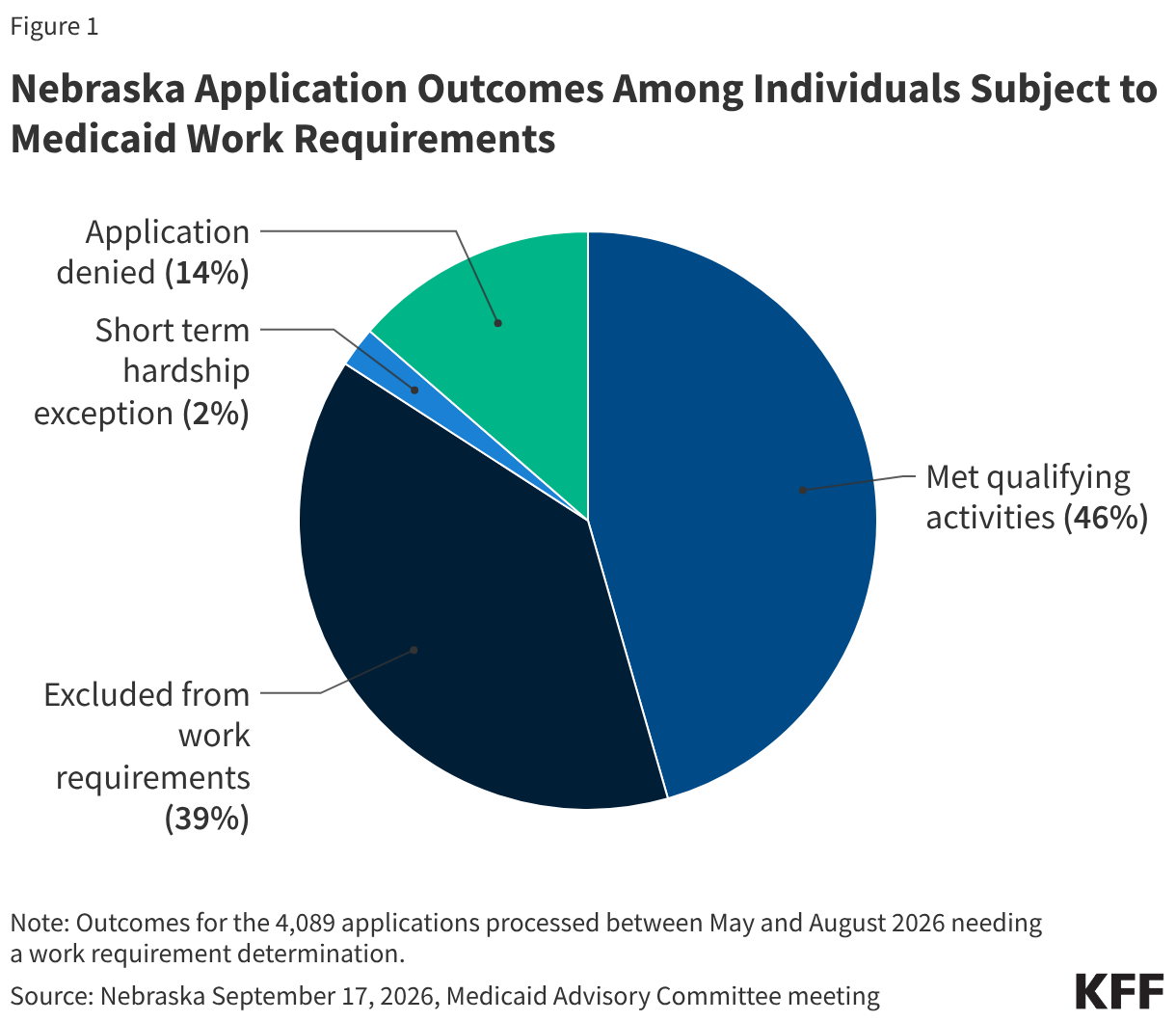
Focusing specifically on the remaining 4,089 new applications directly subject to the work requirements, data indicates that 86% successfully met the work criteria, qualified for an exclusion, or secured a short-term hardship exception. Conversely, 14% of these applicants experienced application denials directly tied to the new provisions.
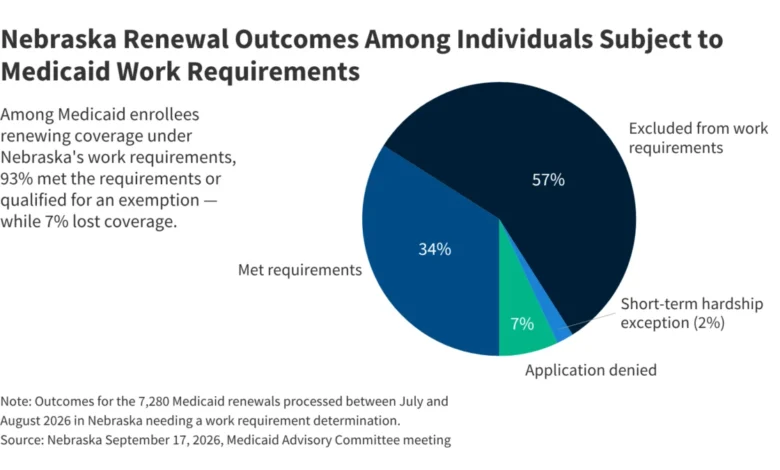
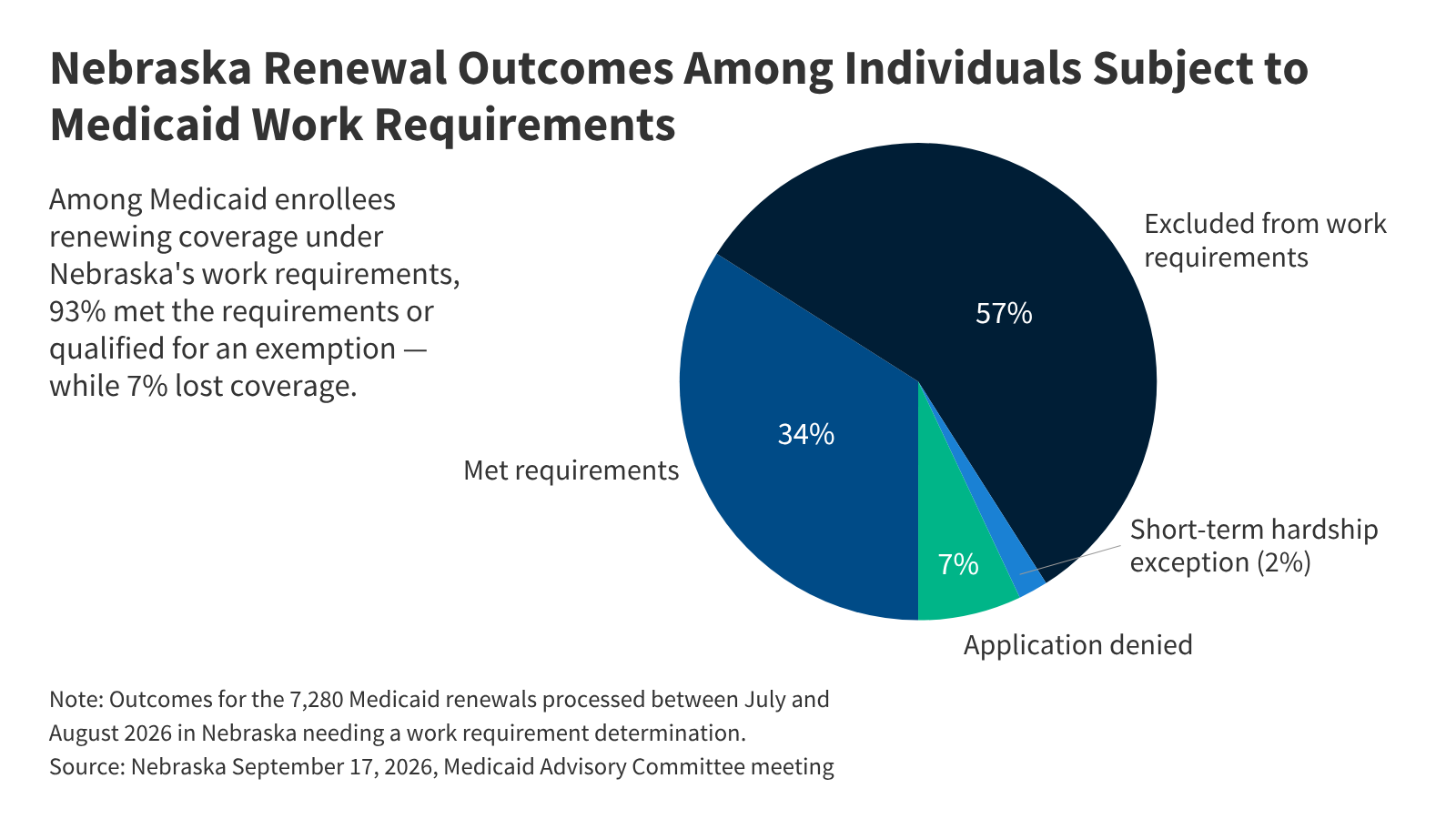
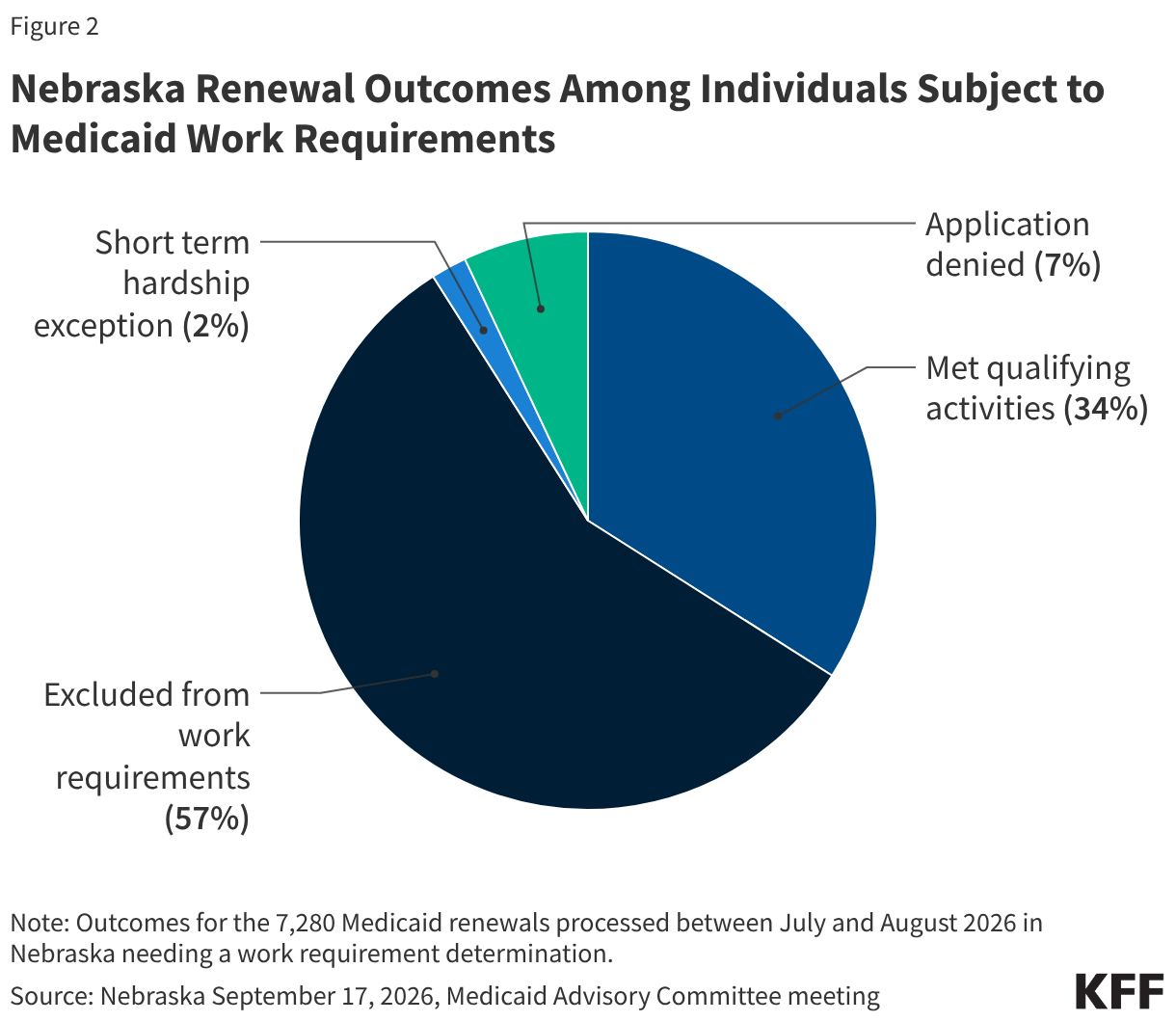
The outcomes for individuals undergoing their annual Medicaid coverage renewals reflect a similarly high initial compliance or exemption rate, though with a slightly smaller attrition footprint. Between July and mid-August 2026, the state processed 7,280 renewals subject to the work mandates. Among this cohort, 93% successfully demonstrated compliance with work requirements, qualified for an exclusion, or were granted a hardship exception, allowing their continuous healthcare coverage to be renewed. However, 7% of enrollees undergoing renewal lost their coverage. This disenrollment figure excludes expansion enrollees who lost coverage for other traditional administrative reasons, such as moving out of the state or experiencing a rise in income above eligibility limits.
Methodological Limitations and Missing Data Gaps
While these initial figures offer a preliminary snapshot of the policy’s mechanical rollout, healthcare analysts caution that surface-level data fails to capture the full picture of consumer impact. More granular data is required to understand the precise profile of individuals who lose coverage. For instance, specific sub-populations—such as gig economy workers, independent contractors, or individuals juggling multiple part-time positions with fluctuating hours—frequently struggle to compile the fragmented documentation required to prove consistent monthly engagement hours.
Furthermore, a significant data gap persists surrounding individuals who receive notices of non-compliance but fail to respond. It remains empirically unclear whether these individuals were genuinely ineligible for Medicaid, remained completely unaware of the new administrative requirement to provide additional proof, or simply gave up due to administrative exhaustion when attempting to navigate the declaration process. Tracking whether these disenfranchised individuals eventually attempt to reapply for coverage will be a critical metric for future policy evaluations.
Implications of Future Federal Adjustments and Policy Outlook
As Nebraska presses forward with its pioneering implementation, federal oversight is continuing to evolve. The Centers for Medicare & Medicaid Services (CMS) recently notified Nebraska state officials that modifications must be made to its specific medical frailty verification process. Should federal regulators compel the state to tighten these verification protocols, the number of individuals able to successfully qualify for medical frailty exemptions will likely decline, potentially pushing more vulnerable patients into mandatory work tracks or off the rolls entirely.
Longer-term projections suggest that disenrollment rates could shift significantly as the policy matures. The state’s current reliance on self-attestation throughout 2027 acts as an administrative cushion, preventing a steeper wave of coverage losses that would likely occur if rigid third-party documentation were enforced from day one. However, the anticipated sunset of broad self-attestation provisions in January 2028 introduces a looming structural barrier. When rigorous documentation becomes mandatory, the administrative friction may lead to a measurable contraction in the pool of enrollees able to successfully verify their status.
As the 2026 midterm elections approach, healthcare policy has re-emerged as a central flashpoint in American politics. Nebraska’s status as the vanguard of Medicaid work requirements places the state at the epicenter of a national debate. Policymakers, state health departments across the country, and federal legislators are closely tracking Nebraska’s trajectory to measure the delicate balance between promoting labor force participation and maintaining access to essential healthcare for low-income populations. Ongoing monitoring of application denials, disenrollment patterns, and overall shifts in state-level Medicaid enrollment will be vital in determining the ultimate viability and human cost of conditioning public health coverage on workplace metrics.
Related posts: