WHO and African Union Forge New Health Pact in Geneva to Combat Aid Cuts and Drive Continental Self-Reliance

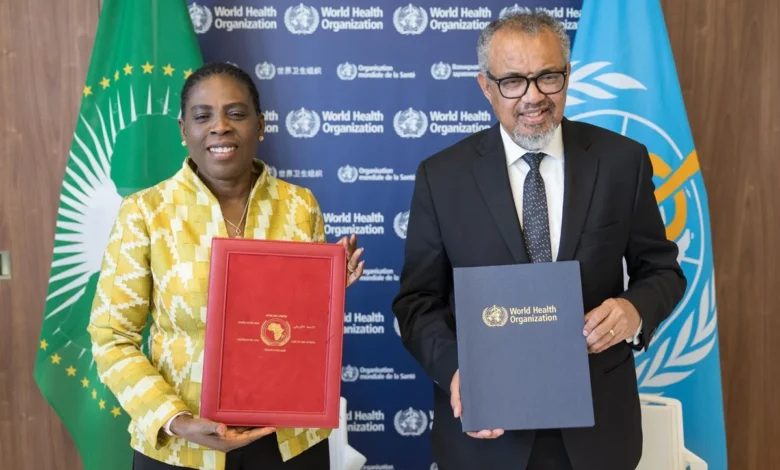
The global health architecture witnessed a significant milestone on the sidelines of the 78th World Health Assembly in Geneva, where the World Health Organization (WHO) and the African Union (AU) Commission officially renewed their longstanding strategic partnership. Against a backdrop of unprecedented financial turbulence, shrinking bilateral aid budgets, and shifting geopolitical priorities, the two organizations signed an updated Memorandum of Understanding (MoU). This renewed accord is designed to accelerate progress toward health security, universal health coverage (UHC), and sustainable development across the African continent. By fortifying institutional ties, the agreement aims to empower regional leadership, streamline multilateral cooperation, and chart a definitive course away from historical aid dependency toward enduring health sovereignty.
The high-level signing ceremony brought together key figures from both international bodies. The agreement was formally executed by Her Excellency Ambassador Amma Adomaa Twum-Amoah, Commissioner for Health, Humanitarian Affairs, and Social Development, representing His Excellency Mahmoud Ali Youssouf, Chairperson of the African Union Commission, alongside Dr. Tedros Adhanom Ghebreyesus, Director-General of the World Health Organization. This strategic alignment places the AU’s Department of Health, Humanitarian Affairs, and Social Development firmly at the operational center of continental health policy implementation, ensuring that regional solutions are deployed to address regional challenges.
Background Context and the Evolution of the Partnership
To understand the weight of this renewed Memorandum of Understanding, one must examine the evolutionary trajectory of institutional cooperation between the WHO and the African Union. The predecessor to the current agreement was signed in 2019, serving as a baseline framework that coordinated responses to numerous public health emergencies, most notably the COVID-19 pandemic, recurring Ebola outbreaks in West and Central Africa, and persistent epidemics of cholera, measles, and yellow fever.
Over the past half-decade, however, the global health landscape has undergone profound transformations. Traditional donor nations have increasingly faced domestic economic pressures, leading to systemic contractions in overseas development assistance and bilateral health aid. For Africa, where external financing has historically subsidized critical components of national health systems, these funding cliffs threaten to reverse decades of hard-won progress in maternal and child health, infectious disease control, and health infrastructure development.
Simultaneously, the African Union has steadily elevated its diplomatic and structural standing. A watershed moment in this regard was the African Union’s official admission as a permanent member of the G20. This historic inclusion expanded Africa’s voice in global economic and governance forums, providing a powerful platform to advocate for systemic reforms in international finance, debt relief, and equitable access to medical countermeasures. It is within this dynamic environment that the 2024-2025 MoU was conceived—not merely as a bureaucratic update, but as a strategic maneuver to leverage the AU’s growing global influence while securing the WHO’s unmatched technical, normative, and operational expertise.
Core Pillars of the Renewed Agreement
While building upon the foundational framework of the 2019 pact, the updated MoU introduces streamlined mechanisms to enhance cross-agency coordination across all AU institutions, including specialized technical bodies like the Africa Centres for Disease Control and Prevention (Africa CDC). The agreement explicitly reinforces the WHO’s central technical and normative leadership role globally and regionally, while explicitly binding the organization to support the AU and its member states in achieving the health-related targets enshrined in the United Nations Sustainable Development Goals (SDGs).
While the technical scope of the partnership is vast, policy analysts have noted that the operationalization of the MoU rests on five critical thematic pillars designed to address structural vulnerabilities in African health systems:
- Strengthening Health Security and Epidemic Preparedness: Establishing robust early-warning systems, bolstering genomic surveillance networks, and enhancing cross-border data sharing to detect and contain novel pathogens before they escalate into continental or global crises.
- Advancing Universal Health Coverage (UHC) and Primary Health Care (PHC): Aligning investments to reinforce community-level health systems, expanding insurance schemes, and ensuring equitable access to essential medicines and diagnostics.
- Fostering Local Manufacturing and Regulatory Harmonization: Scaling up domestic production of vaccines, therapeutics, and medical devices across the continent, supported by the African Medicines Agency (AMA) to streamline regulatory approvals and quality control.
- Human Resources for Health: Addressing severe workforce shortages by improving training, retention, and deployment strategies for healthcare professionals across rural and urban settings.
- Sustainable Financing and Resource Mobilization: Shifting away from volatile external aid dependency by institutionalizing domestic health financing frameworks, innovative public-private partnerships, and sustainable domestic revenue generation.
Official Statements and Leadership Perspectives
The gravity of the moment was underscored by the impassoned remarks delivered by the signatories during the Geneva assembly. Commissioner Amma Adomaa Twum-Amoah articulated the fundamental paradigm shift required by African nations in the face of shifting global aid paradigms.
"This Agreement marks a new chapter in AU-WHO cooperation," Commissioner Twum-Amoah stated during her address. "By working together more closely, we can better respond to the health needs of our populations and ensure that no one is left behind. The African Union values WHO’s central and leading role in global health and looks forward to deepening this strategic partnership in support of our shared goals."
Critically, the Commissioner directly addressed the structural financial dilemmas confronting the continent, issuing a rallying cry for self-determination. "We need to move from budgeting for survival to planning for health sovereignty," she added.
Echoing these sentiments, WHO Director-General Dr. Tedros Adhanom Ghebreyesus placed the agreement within the broader context of a perilous international funding environment. Dr. Tedros did not shy away from addressing the immediate threats posed by receding donor commitments.
"This renewed agreement comes at a critical time, as cuts to bilateral aid imperil the health of millions in Africa," Dr. Tedros warned. "It reflects our determination to translate our partnership into tangible results for the people of Africa, and support countries to leave behind the era of aid dependency and transition to sustainable self-reliance. We are proud to stand with the African Union in driving forward the health priorities of the continent."
Broader Impact, Economic Implications, and Fact-Based Analysis
The signing of this updated MoU carries profound implications for international relations, global health security, and economic development across Africa. Independent public health analysts have dissected the timing and structural design of the pact, pointing to several key takeaways regarding its long-term viability and impact.
First and foremost, the agreement addresses the acute vulnerability exposed by reliance on external donors. Historically, vertical health programs funded by bilateral donors have achieved remarkable successes in combating specific diseases like HIV/AIDS, tuberculosis, and malaria. However, these programs have frequently operated in parallel silos, failing to build resilient, horizontal primary healthcare systems capable of withstanding systemic shocks. By emphasizing "health sovereignty" and domestic resource mobilization, the AU-WHO partnership aims to integrate disease-specific interventions into comprehensive, country-owned health systems.
Second, the push for local manufacturing is widely viewed by economists as a game-changer for the continent’s long-term macroeconomic stability. During the acute phases of the COVID-19 pandemic, African nations experienced severe bottlenecks in securing vaccines and personal protective equipment, largely due to export restrictions imposed by wealthy producer nations. Initiatives like the Partnerships for African Vaccine Manufacturing (PAVM), which aims to enable the local manufacturing of 60% of the continent’s vaccine doses by 2040, stand to benefit immensely from the harmonized technical support provided by the combined apparatus of the WHO and AU.
Third, the institutionalization of this partnership reflects a maturing geopolitical reality. As multilateral institutions face challenges from shifting nationalistic policies in various parts of the world, regional bodies like the African Union are asserting greater agency in shaping their own destinies. By formalizing a close operational alliance with the WHO—the undisputed global authority on public health norms—the AU ensures that its public health policies remain anchored in rigorous, evidence-based science while retaining the political flexibility necessary to respond to regional imperatives.
Implementation and Future Outlook
As the 78th World Health Assembly concludes, attention will inevitably shift from the ceremonial signing desks in Geneva to the practical realities of implementation across Africa’s 55 member states. Success will depend heavily on the ability of national governments to translate high-level frameworks into concrete budgetary allocations, legislative reforms, and administrative efficiencies.
Communication channels have been fully established to facilitate ongoing coordination between the two bodies. Stakeholders and media outlets seeking further information regarding the rollout of the MoU can reach out to designated institutional representatives. Professor Julio Rakotonirina, Director of the Department of Health, Humanitarian Affairs and Social Development at the African Union Commission, can be contacted via email at [email protected]. Similarly, Ms. Stéphanie Seydoux, Director and Director-General Envoy for Multilateral Affairs at the World Health Organization, serves as the primary focal point for WHO inquiries and can be reached at [email protected]. Additional media coordination is managed jointly by the WHO Media Team and Mr. King David Cartey of the African Union Commission.
Ultimately, the renewed Memorandum of Understanding between the World Health Organization and the African Union Commission is much more than a diplomatic formality. It represents a strategic compact forged in a moment of crisis, designed to restructure how health is funded, delivered, and governed in Africa. By combining the normative authority of the global health body with the political legitimacy and visionary leadership of the continental union, this partnership lays a resilient foundation for an era where African nations chart an independent, sovereign path toward universal health and sustainable development.
Related posts: