Bunions Affect 1 in 3 Adults; Physical Therapist Recommends 3 Foot-Control Exercises

Bunions, medically recognized as hallux valgus, have emerged as a significant public health concern, currently affecting approximately one in three adults globally. This progressive, often painful deformity manifests at the base of the big toe, where the joint becomes increasingly prominent as the toe drifts inward toward the smaller digits. While the aesthetic change is often the first sign, the underlying mechanical shift can lead to chronic discomfort, inflammation, and long-term changes in gait that may affect overall musculoskeletal health.
According to a report published on September 17, 2026, the rise in these cases is largely attributed to a combination of genetic predisposition and external environmental stressors. As modern lifestyles increasingly involve sedentary work, the use of restrictive footwear, and prolonged standing on unforgiving surfaces, the frequency of foot-related ailments has climbed, prompting physical therapists to advocate for proactive, home-based interventions.
The Anatomy and Mechanics of Hallux Valgus
The development of a bunion is not an instantaneous event but a gradual process. Anatomically, the deformity is characterized by a prominent medial metatarsal head and an abnormal lateral angulation of the proximal phalanges. As the big toe moves out of its neutral alignment, the protective bursa surrounding the joint may become irritated, leading to redness, swelling, and localized pain.
Research into the etiology of bunions suggests that a single cause is rarely to blame. Instead, experts point to a complex interplay between inherited structural characteristics—such as ligament laxity, joint shape, and the natural distribution of weight across the foot—and external mechanical stresses. Individuals with a family history of hallux valgus are statistically more likely to develop the condition, often at a younger age, as their structural foundation is inherently less resilient to the forces of daily locomotion.
Furthermore, the influence of footwear cannot be overstated. High-heeled shoes, particularly those designed with narrow, pointed toe boxes, exacerbate the problem by forcing the toes into a compressed state and shifting the body’s center of gravity toward the forefoot. This configuration places disproportionate load on the big toe joint, which is not structurally designed to support the entire body’s weight during the push-off phase of a stride. When this is compounded by pre-existing conditions like flat feet or collapsed arches, the risk of developing a symptomatic bunion increases significantly.
Chronology and Early Intervention
The progression of bunions typically follows a predictable timeline. Early stages are often marked by intermittent soreness or mild redness at the base of the toe, particularly after periods of prolonged activity. If left unaddressed, the soft tissue may thicken, and the bone deformity becomes more rigid, limiting the range of motion.
Duke Pan, a physical therapist specializing in foot and ankle rehabilitation, emphasizes that the window for effective conservative management is widest while the joint remains flexible. Pan and other clinicians argue that early intervention—specifically through targeted exercises—can help address faulty movement patterns that place excessive stress on the big toe. By strengthening the intrinsic muscles of the foot, patients can improve their stability and better distribute pressure across the entire foot, potentially slowing the progression of the deformity.
Clinical evidence supports this approach. A recent systematic review indicates that exercise, when combined with adjuncts such as taping or orthotic support, can yield modest improvements in alignment and pain management for patients with mild to moderate hallux valgus. While exercise cannot reliably reverse an established bony deformity, it serves as a vital tool for symptom management and post-surgical rehabilitation.
Three Pillars of Foot-Control Exercise
To address the mechanical imbalances associated with bunions, Pan recommends a structured regimen of three specific exercises designed to be performed at home. These exercises are intended to foster neural control and muscle endurance within the small, often neglected muscles of the foot.
1. Toe Separation Training
This exercise focuses on the abductor hallucis muscle, which is essential for pulling the big toe back into alignment. To perform this, the patient stands with their weight supported by the heels, gently lifting the toes to spread them as wide as possible. Maintaining this spread, the patient presses all five toes back into the ground. A sustained contraction for 10 seconds allows the inner arch muscles to engage, reinforcing proper toe positioning.
2. Arch Training
Often referred to as "short foot" training, this exercise aims to strengthen the longitudinal arch. By spreading the toes and pressing them firmly into the floor, the patient attempts to lift all five toes simultaneously without letting the big toe dominate the movement. This exercise requires high levels of concentration, as the goal is to activate the small, deep muscles of the inner arch without over-recruiting the larger, superficial calf muscles.
3. Calf Raise Training
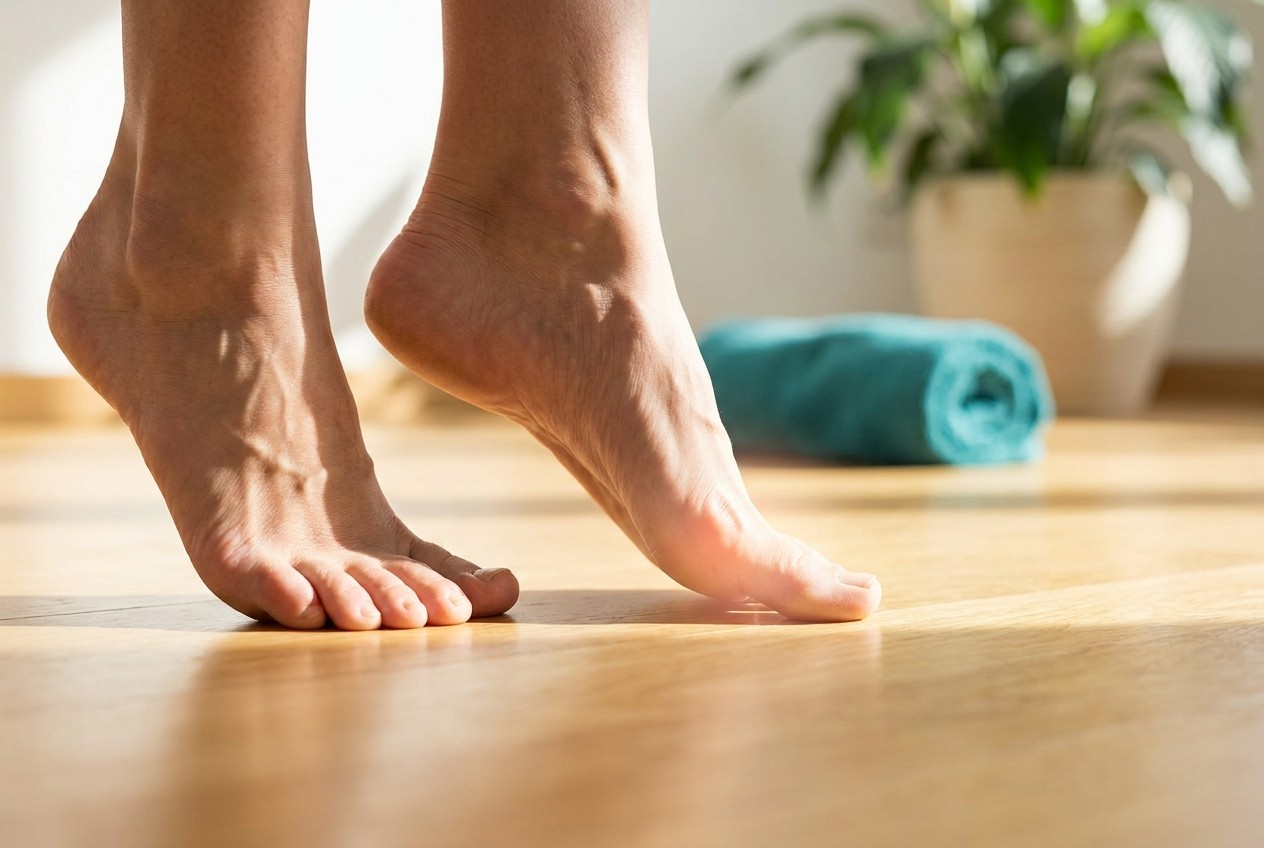
The final pillar involves functional movement. By rising onto the balls of the feet, the patient must ensure the weight is evenly distributed between the second and third toes, preventing the inward rolling—or pronation—that often accompanies bunion development. This exercise teaches the body to maintain a neutral ankle position under load, which is critical for preventing the secondary stress that aggravates existing deformities.
Broader Public Health Implications
The rising prevalence of foot pain is a significant, yet frequently overlooked, public health challenge. Data suggests that by the age of 50, roughly half of all Americans report some form of significant foot pain. This crisis is fueled by the modern environment, which restricts natural foot movement and imposes unnatural stressors on the joints.
From an orthopedic perspective, the implications are profound. If left untreated, severe bunions can lead to secondary issues, including hammertoes, chronic bursitis, and, in extreme cases, the inability to walk comfortably without assistance. While orthopedic shoes—which prioritize function, cushioning, and space—are an essential tool for those suffering from discomfort, they are only one part of a comprehensive strategy.
Professional guidance remains the gold standard for those with rapidly progressing deformities, numbness, or diabetes, as these conditions require specialized oversight to avoid complications. A multidisciplinary approach, often involving podiatrists, physical therapists, and, in severe cases, orthopedic surgeons, is essential for maintaining long-term mobility.
Analysis: Moving Toward Conservative Care
The growing reliance on conservative management for bunions reflects a broader shift in physical medicine toward preventative and restorative care. Rather than viewing the bunion as a fixed, inevitable condition, the medical community is increasingly viewing it as a mechanical issue that can be managed through lifestyle modification and dedicated training.
However, it is crucial for patients to manage their expectations. While exercises provide a foundation for stability, they do not constitute a "cure" for advanced bony growths. The objective of such therapy is to maximize the functional lifespan of the joint and improve the patient’s quality of life. For many, this means the difference between a lifetime of pain and a manageable, active lifestyle.
As research continues to evolve, the medical community remains clear on one point: the health of the feet is inextricably linked to the health of the entire kinetic chain. By neglecting the small muscles of the foot, individuals risk cascading issues that affect the ankles, knees, and even the lower back. Therefore, the adoption of foot-control exercises should be viewed not just as a remedy for bunions, but as a standard practice for maintaining structural integrity as one ages.
In conclusion, while the statistics regarding bunion prevalence are daunting, they provide a roadmap for change. By prioritizing footwear with adequate toe boxes, committing to consistent muscle-strengthening routines, and seeking early professional evaluation, adults can take significant steps toward mitigating the impact of hallux valgus. The path to better foot health is defined by patience, mindful practice, and a shift away from the restrictive habits that have allowed this common deformity to become a modern epidemic.