Navigating Medicaid Home Care: A National Examination of Self-Direction, Family Caregiver Compensation, and Emerging Policy Pressures

The landscape of long-term care in the United States relies heavily on Medicaid home- and community-based services (HCBS), a vital system providing medical and supportive care to approximately 5.3 million enrollees. Unlike Medicare, which maintains strict limitations on long-term home health coverage, Medicaid accounted for roughly two-thirds of all national home care spending in 2023. As states head into fiscal year 2027, this critical infrastructure faces mounting financial pressures, shifting federal program integrity mandates, and evolving state revenue constraints. New data from the 24th annual KFF survey of state Medicaid officials, administered between April and August 2026, sheds light on how state programs are navigating these headwinds while managing self-directed care models, family caregiver compensation, and essential supportive services.
Background and Evolution of Medicaid Home Care and Self-Direction
Medicaid home care encompasses a wide spectrum of assistance, ranging from hands-on medical services to support with activities of daily living (ADLs)—such as eating, bathing, and dressing—and instrumental activities of daily living (IADLs), including meal preparation and medication management. For decades, the delivery of these services has been influenced by the "consumer-directed" movement, which originated from Robert Wood Johnson Foundation demonstration grants across 19 states. This framework eventually evolved into modern "self-direction," a policy paradigm giving enrollees autonomy over the types of services they receive, the schedules they maintain, and the individuals they hire to provide care.
Self-direction operates primarily through two mechanisms: "employer authority," which grants participants the right to select, train, and dismiss their own workers, and "budget authority," which allows enrollees to manage a predetermined financial allotment to cover wages and authorized ancillary supports. Over time, these programs have served as a vital pressure valve against chronic, nationwide shortages of professional direct-care workers. By allowing enrollees to recruit independent providers—including friends and family members—states have expanded workforce capacity while offering financial relief to informal caregivers who might otherwise be forced to reduce their work hours or abandon their careers entirely.
Recent Survey Findings on Self-Direction Across States
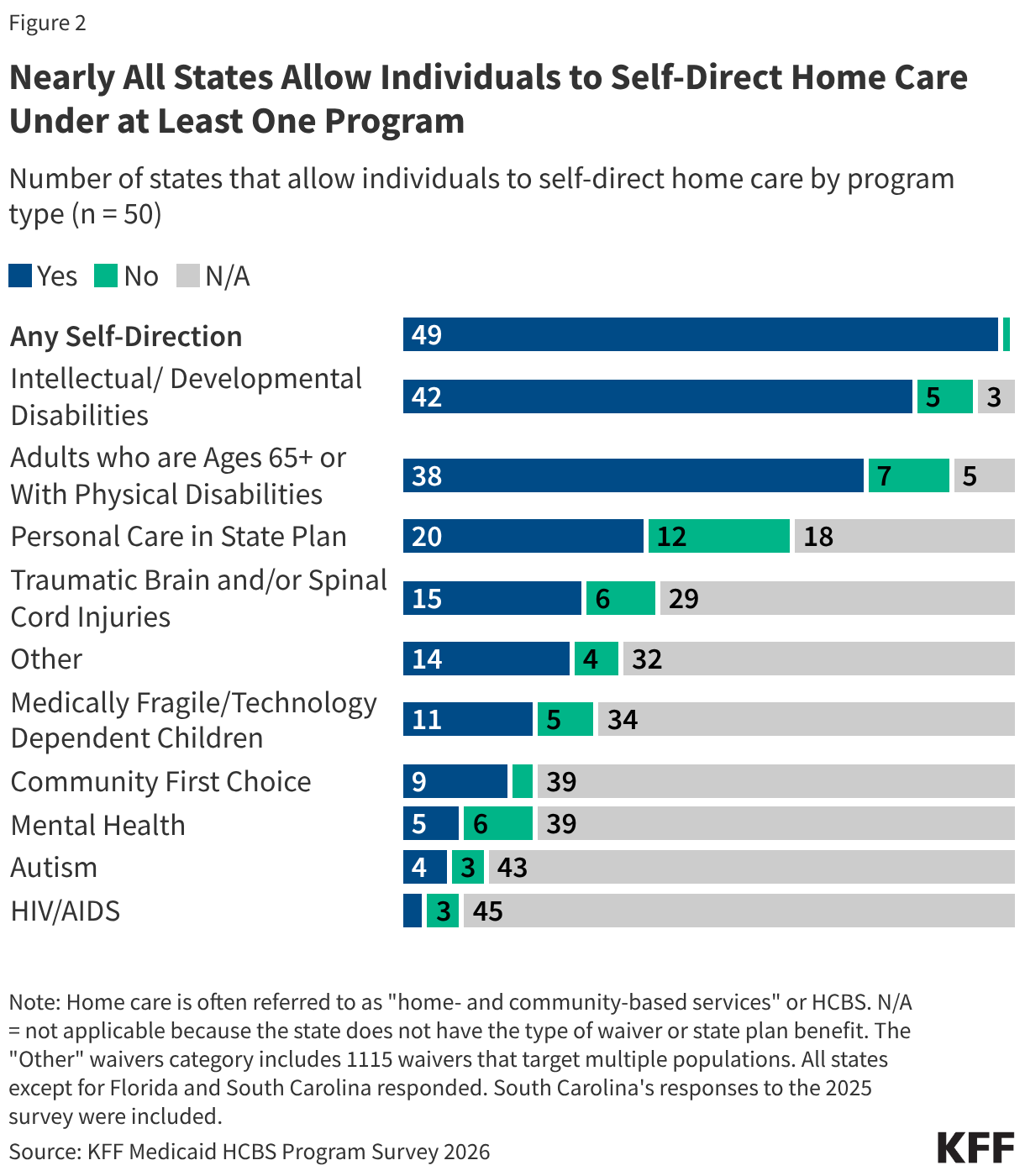
The 2026 KFF survey, which captured responses from 49 states and the District of Columbia (excluding Florida and South Carolina, with South Carolina incorporating 2025 data by permission), demonstrates that self-direction remains nearly universal in American long-term care policy.
According to the data, 49 responding states permit Medicaid enrollees to self-direct their home care under at least one program or waiver, with Alaska remaining the sole exception. States most frequently authorize self-direction within 1915(c) or 1115 waivers targeting individuals with intellectual or developmental disabilities (I/DD), followed closely by programs for adults aged 65 and older and individuals with physical disabilities.
Furthermore, programmatic adoption continued to grow between 2025 and 2026. Four jurisdictions newly introduced self-direction options:
- Indiana: Expanded self-direction into its waivers for individuals with I/DD and those with traumatic brain and/or spinal cord injuries.
- New York: Added self-direction options within its waivers for older adults and individuals with physical disabilities.
- New Mexico: Introduced self-direction for its medically fragile and technology-dependent children’s waiver.
- District of Columbia: Implemented self-direction under its state plan personal care benefit.
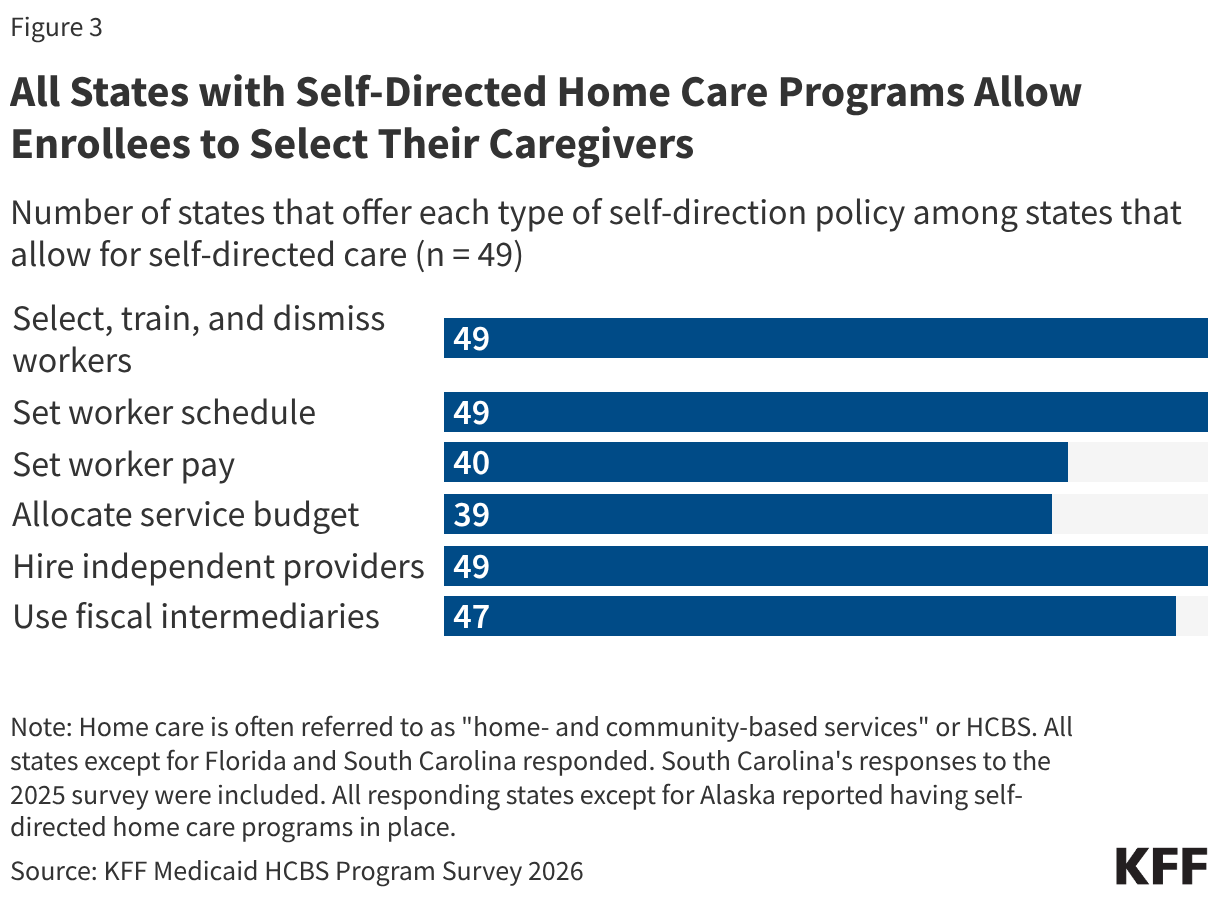
Among the states authorizing self-direction, uniformity exists regarding employer authority: every single state permits participants to select, train, and dismiss their workers, establish schedules, and hire independent providers who are not registered as traditional institutional Medicaid providers. Additionally, a significant majority of states empower enrollees with budget authority, allowing 40 states to let participants establish specific caregiver wage rates and 39 states to determine how funds are allocated across various authorized services.
To manage the complex administrative burdens associated with budget authority—such as tax withholding, payroll processing, and expenditure tracking—federal rules require states to offer financial management services. All states utilizing self-direction provide these services, with nearly all relying on external fiscal intermediaries. Notable exceptions include Mississippi, where the Department of Rehabilitation Services manages payroll and administrative functions directly, and Nebraska, where the state Medicaid agency acts as the direct fiscal agent.
Despite the broad availability of self-direction, precise utilization metrics remain elusive. When surveyed about the percentage of enrollees actively self-directing their care across various waivers, over half of responding states reported "unknown." Among states providing estimates, the vast majority reported that fewer than 25% of participants utilize self-direction options.
Compensating Family Caregivers: Policies, Pathways, and Structural Models
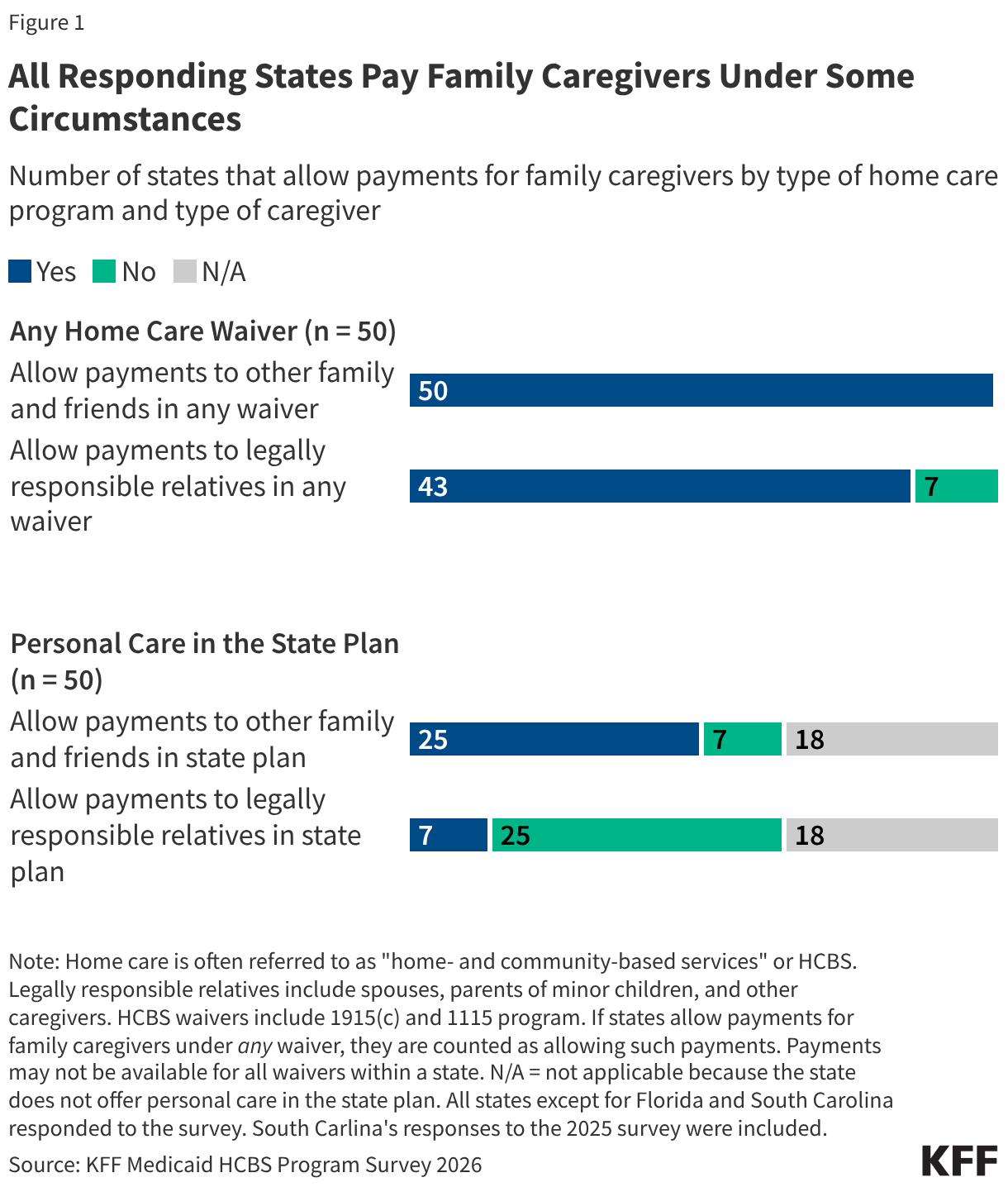
The economic strain on family caregivers has been well-documented. A 2026 AARP study on family caregiving out-of-pocket costs revealed that caregiving expenses consume nearly one-third of average household incomes, with disproportionate burdens placed on lower-income individuals and those managing complex medical needs. To mitigate these pressures, all responding states now permit payments to family caregivers under specific circumstances, though the pathways and legal requirements vary considerably.
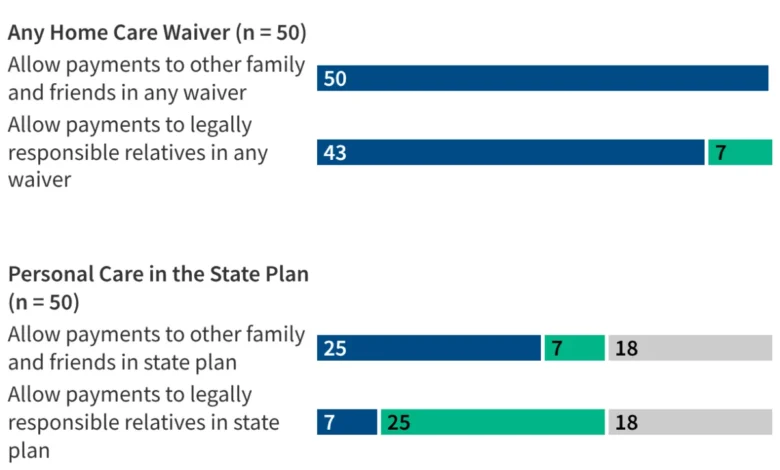
Medicaid delivers home care through two primary avenues: state plan benefits and waiver programs. While state plan services must generally be statewide and offer comparable benefits, waiver programs allow states to target specific populations, cap enrollment, and establish distinct service packages. Consequently, payments to family and friends are authorized through waiver programs in all responding states.
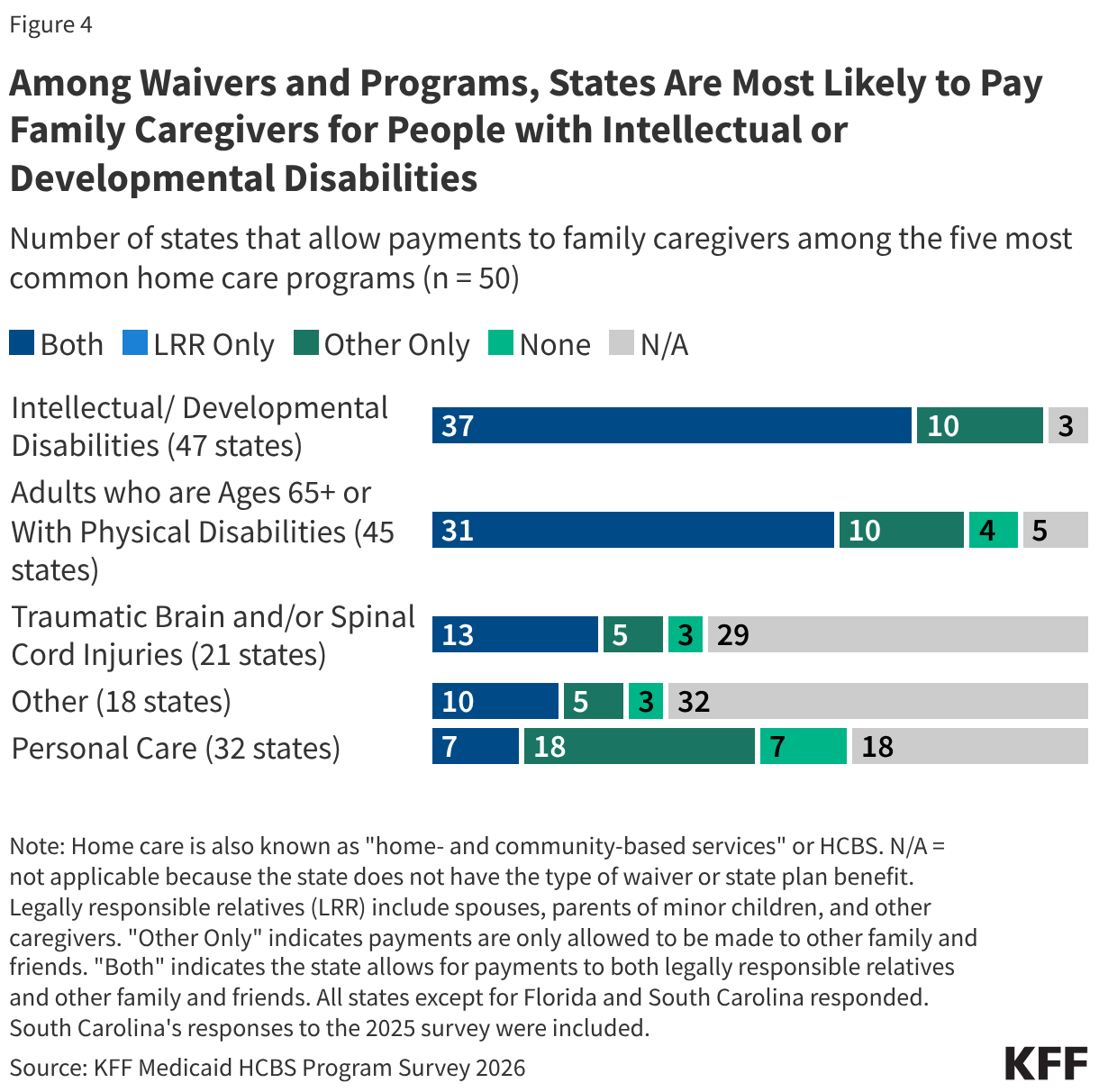
However, payments to legally responsible relatives—such as spouses and parents of minor children—face stricter federal oversight and are less universally available. In 2026, 44 states allowed payments to legally responsible relatives through waiver programs, while only 7 states permitted such payments through their standard state plans. Nebraska expanded its policies in 2026 by newly permitting payments to legally responsible relatives across both its I/DD and aging/physical disability waivers, as well as through its state plan.
Federal regulations governing these payments are rigorous. For personal care offered via section 1905 state plan authorities, federal rules traditionally prohibit payments to spouses and parents of minor children. Conversely, waiver programs permit payments to legally responsible relatives only when the care provided constitutes "extraordinary care"—defined as care that exceeds normal parental or spousal duties and is strictly necessary to prevent institutionalization and safeguard the enrollee’s health and welfare.
Family caregiver compensation is most prevalent in waivers serving individuals with intellectual or developmental disabilities, where all 47 responding states with such programs permit family payments. This is followed closely by waivers for older adults and individuals with physical disabilities (41 of 45 responding states) and traumatic brain injury waivers (18 of 21 responding states).
Beyond traditional hourly wages, 12 states have incorporated structured family caregiving programs. Under this model, Medicaid reimburses provider agencies a daily per diem rate (historically ranging between $40 and $70 per day, according to the American Council on Aging). The agency assigns a care coordinator, social worker, or nurse to oversee the family caregiver, conduct monthly home visits, and provide clinical guidance, while passing a fixed percentage of the daily stipend—typically 50% to 65%—directly to the family member. Nevada introduced a structured family caregiving program in 2026 under a newly launched waiver, while Kansas, Maryland, Michigan, and Oklahoma have announced plans to adopt similar structures to compensate family members who previously provided unpaid care.
Tracking, Data Gaps, and Upcoming Policy Challenges
A notable finding from the 2026 KFF survey is the widespread data deficit regarding the demographics and sheer volume of family caregivers. While nearly all states permit family caregiving, over half do not track the precise percentage of waiver participants receiving paid care from family members. Furthermore, only slightly more than half of states collect basic demographic data—such as names and ages—on paid family caregivers, and fewer than 15 states maintain comprehensive counts of total paid or unpaid caregivers providing services.
This data gap carries significant operational implications as states approach 2027. Only seven states reported knowing whether their paid family caregivers are enrolled in Medicaid via the Affordable Care Act (ACA) expansion. Beginning January 1, 2027, ACA expansion enrollees face strict community engagement and work requirements. While caring for a disabled family member can satisfy work hour minimums or qualify individuals for exemptions, the lack of integrated data systems means that family caregivers may face substantial administrative and paperwork burdens to prove compliance.
These administrative hurdles coincide with broader fiscal and regulatory pressures. Heading into fiscal year 2027, states face slower state revenue growth, substantial structural adjustments resulting from federal budget reconciliation legislation enacted in 2025, and heightened federal program integrity reviews. Although federal integrity efforts have primarily targeted institutional fraud, increased scrutiny over non-traditional providers—including family and friends delivering care in private homes—has prompted several states to reevaluate and trim home care supports.
Respite Care and Additional Family Support Services
In addition to financial compensation, state Medicaid programs continue to provide essential support infrastructure designed to prevent caregiver burnout. All responding states reported covering respite care, which offers short-term relief to primary caregivers through daily, weekly, or institutional placements.
Respite care is most frequently deployed under I/DD waivers (offered by 44 states) and aging and physical disability waivers (43 states). Daily respite care and institutional respite care are the most common formats, utilized by 44 and 43 states respectively. Additionally, 40 states provide formal caregiver training, and 25 states offer counseling and support groups. Several states expanded these offerings in 2026: Delaware, Missouri, Nevada, and Rhode Island newly incorporated caregiver training into their benefit packages, while Arizona rolled out a peer-to-peer family support initiative for both paid and unpaid caregivers.
Conclusion and Analytical Implications
The 2026 KFF survey data illustrates a mature yet strained Medicaid home care system. Self-direction and family caregiving compensation remain cornerstone strategies for addressing professional workforce shortages and honoring consumer autonomy. However, the convergence of tighter state budgets, federal integrity scrutiny, and impending workforce documentation requirements threatens to destabilize these programs.
As states balance fiscal constraints against the growing demands of an aging population and individuals with complex disabilities, the policy choices made throughout 2027 will determine whether family caregivers receive the sustained financial stability and systemic support necessary to prevent widespread institutionalization.
Related posts: