The landscape of abortion access in the United States remains a complex and rapidly evolving mosaic, heavily influenced by a dynamic interplay of state and federal policies. While federal efforts to limit abortion coverage emerged shortly after the landmark 1973 Supreme Court decision in Roe v. Wade, the overturning of that precedent in 2022 has dramatically intensified the divergence in access across the nation, placing the onus squarely on individual states to define the legal and financial parameters of abortion services. A recent update on July 24, 2026, including new policies in Pennsylvania, further underscores this ongoing flux, highlighting how legislative actions continue to shape the availability of abortion coverage for millions of Americans under Medicaid, private insurance, and Affordable Care Act (ACA) Marketplace plans.
A Decades-Long Battle: The Evolution of Coverage Restrictions
The journey to the current fragmented system began nearly five decades ago, long before the recent judicial seismic shift. Following Roe v. Wade, which established a constitutional right to abortion, political and social movements quickly mobilized to challenge or restrict this right. One of the most significant early legislative victories for abortion opponents was the passage of the Hyde Amendment in 1977. This federal rider, attached annually to appropriations bills, effectively banned the use of federal funds for abortion services. While it included narrow exceptions for pregnancies that endanger the life of the woman, or result from rape or incest, its impact was profound, primarily affecting low-income individuals who rely on Medicaid, a joint federal-state program.
The Hyde Amendment’s implementation created an immediate disparity. States were then faced with a choice: adhere strictly to the federal funding ban, thereby denying coverage for most abortions to their Medicaid enrollees, or utilize their own state funds to cover other "medically necessary" abortions. Some states, either by legislative choice or compelled by court orders, opted for the latter, establishing a precedent for state-level variation in Medicaid coverage that persists to this day. This early divergence set the stage for the more extensive state-by-state variations seen in the post-Dobbs era.
The passage of the Affordable Care Act (ACA) in 2010 introduced a new layer of complexity, extending the debate over abortion coverage into the realm of private insurance. While the ACA maintained the Hyde Amendment’s restrictions on federal funding, it also granted states significant authority regarding abortion coverage within their health insurance marketplaces. This provision allowed states to either permit or prohibit plans sold on their state Marketplaces from covering abortion services, often with similar exceptions to the Hyde Amendment. Consequently, many states seized this opportunity to enact new legislative efforts to limit abortion coverage, not just in Marketplace plans, but also in broader private insurance policies. These restrictions, in some instances, proved even more stringent than the Hyde limitations, further narrowing access for individuals with private insurance. Conversely, a handful of states moved in the opposite direction, enacting laws that mandated abortion coverage in private plans and ensuring state funds covered abortions for Medicaid enrollees beyond the federal exceptions.
The Dobbs Decision: A Turning Point in American Healthcare
The most significant shift in the landscape of abortion access occurred on June 24, 2022, when the Supreme Court issued its ruling in Dobbs v. Jackson Women’s Health Organization. This decision overturned Roe v. Wade, eliminating the nearly 50-year-old federal constitutional standard that had protected the right to abortion. The Dobbs ruling fundamentally reshaped the legal framework, effectively returning the authority to regulate or prohibit abortion to individual states. This judicial act immediately triggered a cascade of legislative actions, leading to a stark division across the country.
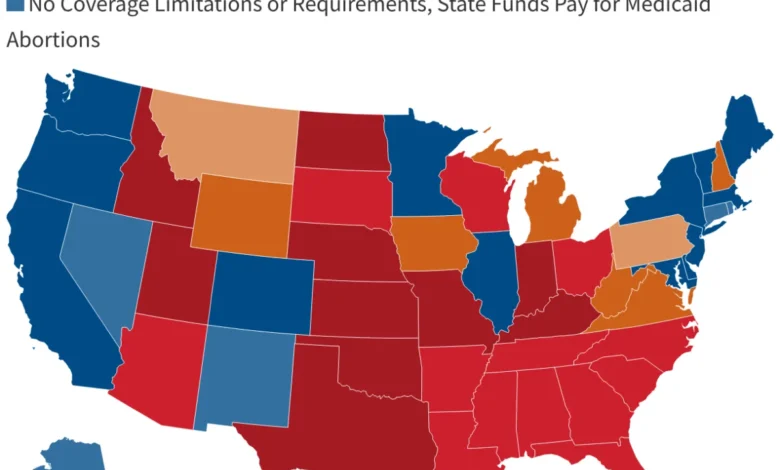
In the wake of Dobbs, states quickly moved to either ban abortion outright or enact robust protections for abortion access. As of January 6, 2026, a significant number of states have implemented near-total bans on abortion. These 13 states—Alabama, Arkansas, Idaho, Indiana, Kentucky, Louisiana, North Dakota, Mississippi, Oklahoma, South Dakota, Tennessee, Texas, and West Virginia—now prohibit abortion with very limited exceptions, often only to save the life of the pregnant person. These bans have led to the closure of clinics, a dramatic reduction in available services, and significant challenges for residents seeking care within their home states. The immediate consequence has been a surge in individuals traveling across state lines to access abortion services in states where it remains legal, creating an intricate web of logistical and financial burdens for those already facing difficult circumstances.
A Divergent Nation: State Policies on Abortion Coverage in 2026
The current state of abortion coverage in the U.S. is characterized by extreme divergence, reflecting a nation deeply divided on reproductive rights. The policies in place can be broadly categorized into several distinct approaches, each with profound implications for residents.
States with Outright Abortion Bans (13 states):
In these 13 states (Alabama, Arkansas, Idaho, Indiana, Kentucky, Louisiana, North Dakota, Mississippi, Oklahoma, South Dakota, Tennessee, Texas, and West Virginia), the legal status of abortion itself takes precedence over coverage concerns. With abortion largely or entirely prohibited, questions of insurance coverage become moot for most cases. The primary challenge in these states is accessing the procedure at all, regardless of insurance status. Even in cases where narrow exceptions (e.g., to save the life of the pregnant person) might apply, the scarcity of providers willing or able to perform abortions under such restrictive legal frameworks presents immense barriers. For residents of these states, accessing care often necessitates travel to other states, incurring significant costs for transportation, accommodation, and the procedure itself, which may or may not be covered by their insurance depending on the plan’s provisions and the state where the service is rendered.
Medicaid Coverage Limitations (29 states & DC):
A substantial majority of states, 29 plus the District of Columbia, limit Medicaid coverage of abortion strictly to the parameters of the Hyde Amendment. This means that Medicaid will only cover abortions in cases of rape, incest, or when the pregnancy endangers the life of the woman. For low-income individuals, who disproportionately rely on Medicaid for healthcare, this limitation effectively bars them from accessing abortion for most other medically necessary reasons, including severe fetal anomalies, mental health concerns, or socioeconomic hardship. These individuals are often forced to seek care from abortion funds or pay out-of-pocket, creating significant financial barriers that can delay or prevent access to timely care. This policy disparity underscores the enduring impact of federal restrictions on state-level healthcare access.
Private Insurance Coverage Limitations (10 states):
Beyond Medicaid, ten states have enacted laws that prohibit abortion coverage from being included in private insurance policies sold within their borders. This applies across individual, small group, and large group plans, impacting a broad spectrum of the privately insured population. While some of these states may allow for abortion coverage to be purchased as a separate rider, this often comes at an additional cost and requires proactive action from policyholders, which can be an accessibility barrier. These restrictions mean that even individuals with otherwise comprehensive health insurance plans may find themselves without coverage for abortion services, leading to unexpected out-of-pocket expenses. The rationale behind these laws often stems from legislative efforts to reduce abortion access through financial means, reflecting a broader anti-abortion stance.
State Marketplace Coverage Limitations (25 states):
A significant number of states, 25 in total, have utilized the flexibility afforded by the Affordable Care Act to prohibit plans sold on their state Marketplaces from covering abortion, again with certain exceptions similar to the Hyde Amendment. These Marketplaces, established by the ACA, are crucial for individuals and small businesses to purchase health insurance. By restricting abortion coverage in these plans, states limit options for consumers seeking comprehensive reproductive healthcare. This forces individuals to either choose plans that explicitly exclude abortion coverage or seek care outside their insurance network, potentially incurring the full cost of the procedure. The impact is particularly acute for those who rely on the Marketplaces for affordable health coverage, as it directly curtails their access to a full range of reproductive health services.
No Coverage Limitations (6 states):
In stark contrast, a small group of six states has chosen a different path, opting not to impose limitations on abortion coverage. These states do not restrict coverage in private insurance or state Marketplace plans, and crucially, they do not ban the use of state funds (non-federal) to pay for abortions for Medicaid enrollees in circumstances beyond those allowed by the Hyde Amendment. These states represent a commitment to broad access to reproductive healthcare, ensuring that financial barriers are minimized for their residents. They often reflect a political environment that prioritizes reproductive autonomy and equitable access to healthcare services.
States Requiring Abortion Coverage (13 states):
Further demonstrating the nation’s fragmentation, 13 states have gone a step further by mandating abortion coverage. These states require all fully-insured group plans and individual plans to include abortion coverage. Furthermore, they ensure that state funds are used to cover abortions for Medicaid enrollees, thereby expanding access beyond the restrictive Hyde Amendment exceptions. This proactive approach reflects a legislative commitment to protecting and expanding abortion access. Notably, ten of these states require no cost-sharing for abortion services, effectively eliminating out-of-pocket expenses for the procedure. Illinois and Minnesota allow cost-sharing if similar services in the plan also have cost-sharing, while Delaware prohibits cost-sharing for abortions up to $750, showcasing slight variations in implementation but a shared goal of financial accessibility. These states stand as bulwarks for reproductive rights, directly counteracting the trend of restrictions seen elsewhere.
Broader Implications and Ongoing Challenges
The current patchwork of state policies has far-reaching implications for individuals, healthcare providers, and the nation’s public health infrastructure.
Healthcare Disparities: The most immediate impact is the exacerbation of healthcare disparities. Low-income individuals, people of color, and those in rural areas are disproportionately affected by coverage restrictions and outright bans. They often lack the financial resources and logistical support needed to travel to states where abortion is legal and covered, leading to delayed care, unsafe procedures, or forced continuation of unwanted pregnancies.
Economic Burden: The lack of insurance coverage for abortion places a significant economic burden on individuals. The cost of an abortion can range from several hundred to several thousand dollars, depending on the stage of pregnancy and the method used. When insurance does not cover these costs, individuals must bear the full financial responsibility, often at a time of emotional and physical stress.
Interstate Travel and Legal Challenges: The rise of abortion bans has spurred an increase in interstate travel for care, creating complex legal and ethical questions. States that protect abortion access have become "safe havens" for residents of restrictive states, leading to increased demand on their healthcare systems. This also raises questions about the legality of aiding such travel and the potential for legal challenges across state lines.
Provider Landscape: The restrictive policies have also led to a significant shift in the provider landscape. Clinics in states with bans have closed, and healthcare professionals are increasingly hesitant to provide abortion services due to fear of legal repercussions. This "chilling effect" further limits access, even in states where abortion remains technically legal but providers are scarce.
Political and Judicial Battlegrounds: The issue of abortion coverage remains a highly charged political battleground. State legislatures are continuously introducing and debating new bills, and court cases challenging existing laws are frequent. The upcoming elections at both state and federal levels are likely to continue to be heavily influenced by this issue, with advocates on both sides pushing for their respective agendas. The KFF Abortion in the United States Dashboard serves as a vital resource for tracking these dynamic legal and policy shifts.
Conclusion
The evolving landscape of abortion coverage in the United States, as highlighted by the latest updates including Pennsylvania’s policies, paints a picture of a nation deeply divided and increasingly fragmented. From the foundational restrictions of the Hyde Amendment to the sweeping changes ushered in by the Dobbs decision, state policies have become the primary determinants of abortion access. While some states actively work to expand and protect coverage, others have moved to severely restrict or outright ban it. This divergence creates significant inequities, affecting millions of Americans and underscoring the urgent need for comprehensive, fact-based understanding of the complex interplay between law, policy, and individual healthcare access. The journey for equitable abortion coverage is far from over, marked by ongoing legislative battles, judicial challenges, and the profound personal stories of those navigating this intricate system.
Related posts: