Medicaid Work Requirements: States Grapple with Complex Outreach and Implementation Ahead of 2027 Deadline

The 2025 reconciliation law mandates that 44 states condition Medicaid eligibility for adults in the Affordable Care Act (ACA) Medicaid expansion group and certain enrollees in 1115 waiver programs on meeting work requirements, with implementation slated for January 1, 2027. This sweeping policy shift, which also impacts non-expansion states like Georgia, Tennessee, and Wisconsin through their waiver programs, necessitates profound and intricate modifications to existing eligibility and enrollment systems and processes. Crucially, states face the formidable task of conducting extensive and highly targeted outreach and education campaigns to inform enrollees, potential applicants, healthcare providers, and managed care plans about these impending changes. Guiding this monumental undertaking, the Centers for Medicare and Medicaid Services (CMS) issued a long-anticipated interim final rule on June 1, 2026, setting forth the framework for state implementation, particularly emphasizing outreach efforts.
Background and Legislative Context
The concept of tying work requirements to Medicaid eligibility has a contentious history, with proponents arguing it promotes self-sufficiency and responsible use of public funds, while critics warn of increased administrative burden and potential loss of healthcare coverage for vulnerable populations. Prior attempts to implement such requirements at the state level, often through 1115 waivers, faced legal challenges and varying degrees of success, with some ultimately being blocked by courts. The 2025 reconciliation law, however, codifies these requirements at a federal level, creating a more uniform and widespread mandate across a significant majority of states.
The affected populations primarily include adults aged 19-64 who gained Medicaid eligibility through the ACA’s expansion, which extended coverage to individuals earning up to 138% of the federal poverty level. Additionally, certain enrollees in 1115 demonstration waiver programs, which allow states to experiment with innovative approaches to Medicaid, will also be subject to these new rules. The inclusion of these waiver programs means that even states that have not expanded Medicaid under the ACA will need to navigate the implementation of work requirements for some beneficiaries.
Lessons from Medicaid Unwinding: A Precedent for Outreach Challenges
As states gear up for the January 2027 deadline, many are drawing critical lessons from their recent experience with "Medicaid unwinding." This period, following the expiration of the COVID-19 public health emergency, saw states resume eligibility redeterminations for all Medicaid enrollees after a three-year continuous enrollment provision. The unwinding process, which began in 2023, resulted in millions of individuals being disenrolled, many for procedural reasons such as failing to complete renewal paperwork, rather than being definitively ineligible.
Interviews conducted by KFF with state officials, managed care plans, primary care associations, and advocacy organizations involved in the unwinding, alongside findings from the 23rd annual budget survey of Medicaid officials, illuminated both successful outreach and communication strategies and significant pitfalls. These insights underscore the immense challenge of explaining complex program changes to a diverse beneficiary population, many of whom may have limited literacy, language barriers, or inconsistent access to reliable communication channels. The unwinding experience highlighted the crucial role of multi-modal communication, partnerships with trusted community organizations, and the need for clear, accessible language in official notices. States learned that simply sending a letter is often insufficient to ensure beneficiaries understand and act on eligibility requirements.
The CMS Interim Final Rule and Implementation Timeline
The interim final rule issued by CMS on June 1, 2026, provides essential guidance on how states must operationalize the new work requirements, particularly regarding outreach. This rule clarifies several ambiguities and sets firm deadlines, intensifying the pressure on state agencies.
States are required to send targeted outreach notices to enrollees who may be subject to work requirements. While the reconciliation law initially focused on notifying only those subject to the requirements, the CMS rule broadens this, mandating notices to all expansion adults and all enrollees in applicable 1115 waiver programs. CMS justifies this broader approach by acknowledging that states may not have complete information to pre-screen all individuals for exemptions and because an enrollee’s circumstances, and thus their exemption status, can change between the time a notice is sent and the requirements take effect.
A critical timeline established by the law dictates that notices must be sent three months prior to the first "lookback month" for compliance verification. For states that opt for a one-month lookback period at application, the first lookback month would be December 2026, requiring initial outreach notices to be dispatched in September 2026. However, for states electing a three-month lookback period at application, such as Idaho and Indiana (as reported in a January-March 2026 KFF survey), notices must begin as early as July 2026. The rule further stipulates that states must also send outreach notices to new enrollees who enroll after the initial outreach period but before the requirements are implemented.
Core Challenges: Navigating Complexity and Ensuring Effective Communication
The inherent complexity of the new requirements, coupled with tight implementation timelines and unexpected changes introduced by the final rule (potentially necessitating revisions to existing outreach materials), presents significant hurdles. Work requirements represent a shift in eligibility criteria that will apply to only a subset of Medicaid enrollees, making message development particularly challenging. States must clearly delineate who is subject to the requirements, how to comply, and the consequences of noncompliance, while simultaneously clarifying who is exempt without creating widespread confusion or anxiety among those unaffected.
Beyond these specific challenges, states face long-standing issues in Medicaid eligibility outreach:
- Clarity and Accessibility: Translating intricate eligibility processes into clear, accessible language for notices and outreach materials remains a persistent struggle, especially for individuals with limited English proficiency (LEP) or disabilities, as federal regulations require.
- Resource Constraints: State Medicaid agencies often operate with limited financial resources and workforce capacity, hindering their ability to develop comprehensive, multi-modal outreach campaigns.
- Call Center Limitations: Call centers, a vital resource for enrollees with eligibility concerns, frequently operate with limited hours, making them inaccessible to many individuals who work during traditional business hours. An anticipated surge in call volume will necessitate increased staffing and specialized training for call center personnel.
- Managed Care Organization (MCO) Engagement: States must comply with federal rules regarding the extent to which MCOs can assist with work requirement outreach, requiring careful coordination and clear directives.
Mandated Outreach Strategies
The CMS rule outlines several non-negotiable elements for state outreach:
- Content of Notices: Notices must explicitly explain who is subject to work requirements, how to comply (including how many months the state will look back to verify compliance), and the consequences of noncompliance. Crucially, they must also clearly articulate who qualifies for an exception or is an excluded individual.
- Multi-modal Delivery: Notices must be shared with enrollees via at least two different modalities. This includes regular mail (or electronic format if elected by the individual) and one or more additional channels such as phone, text message, or online account notifications.
- Language and Accessibility: Notices must use plain language and be accessible for individuals with LEP and those with disabilities, aligning with existing federal regulations.
- Periodic Notices: Beyond the initial outreach, states are required to send additional notices in various situations, including following application, renewal, or a change in circumstance; when a hardship exception is adopted, terminated, or expires; if an enrollee is no longer exempt; and upon CMS request if monitoring data indicates problems.
- Website Information: States must also post comprehensive information about work requirements on their official websites, ensuring public accessibility to program details. While no other broad outreach is explicitly required, CMS encourages states to engage in additional community awareness campaigns.
State-Specific Innovations and Additional Outreach Strategies
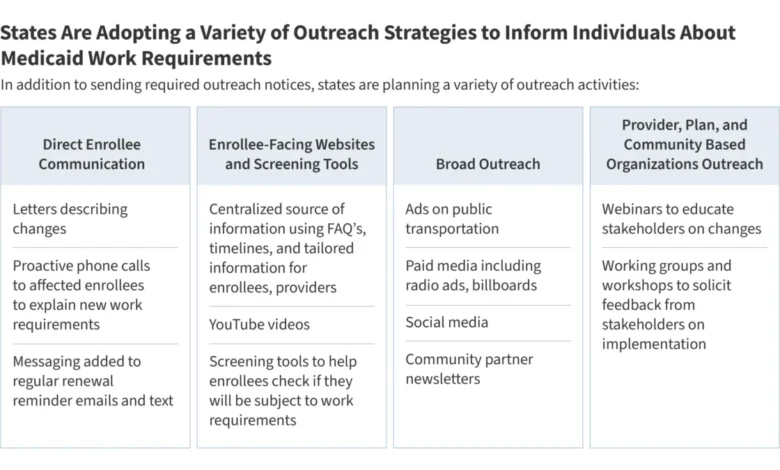
Despite the federal mandates, many states are proactively developing a wide range of additional outreach strategies, often building on lessons from the unwinding period. These typically fall into three categories: additional direct enrollee communications, broad public awareness campaigns, and extensive outreach to providers, health plans, and community-based organizations.
Direct Enrollee Communication:
- Draft Notices and Feedback: States like Nebraska and Montana, which have already implemented work requirements, have experience sending notices. Many other states are circulating draft notices among Medicaid Advisory Committee (MAC) members and other partners to solicit feedback on clarity, readability, and effectiveness before mass distribution.
- Supplemental Communications: Beyond the federally mandated formal notices, states plan to send additional direct outreach to enrollees. Some communications will be tailored specifically to those likely subject to work requirements, while others will be broader. These communications are not bound by the same strict formal requirements but aim to reinforce key messages.
- Call Centers: While required for application and renewal assistance, call centers will become critical hubs for work requirement inquiries. States are exploring increasing staffing and providing specialized training to help staff navigate complex exemption rules and direct callers to appropriate resources. The limited operating hours of many call centers, typically Monday-Friday during business hours, remain a concern for accessibility.
Enrollee Websites and Screening Tools:
- Centralized Information Hubs: Most states have launched dedicated websites to centralize information on eligibility changes stemming from the 2025 reconciliation law, including work requirements. These sites typically offer an overview of new requirements, timelines, FAQs, and links to community resources. They often encourage enrollees to keep contact information updated and check mail regularly.
- Interactive Screening Tools: Recognizing that not all Medicaid enrollees will be affected, some states are developing unofficial screening tools to help individuals determine if they are subject to or exempt from work requirements. New Jersey and West Virginia, for example, have created such tools, empowering enrollees to self-assess their status.
Broad Outreach:
- Mass Media Campaigns: Although not federally required, some states plan to conduct broader public outreach in the fall of 2026. This includes social media campaigns, paid media advertisements (e.g., radio, TV, digital), billboards, and ads on public transportation.
- Community Events: "Road shows" and in-person community events are also being planned to reach beneficiaries directly, particularly in underserved areas.
- Targeting Nuance: A significant challenge with broad outreach is effectively communicating who is subject to work requirements without causing confusion or alarm among the vast majority of Medicaid enrollees who are exempt. For example, while many parents are covered through mandatory parent eligibility pathways and are exempt, some parents with children over age 13 who are covered through the ACA expansion pathway will be subject to the new rules. Crafting messages that explain these distinctions without overwhelming or misinforming is paramount. Exempt groups typically include individuals who are pregnant or postpartum, medically frail, parents or caretakers of dependent children under age 14, and individuals with disabilities.
Leveraging Partnerships: Providers, Plans, and Community Organizations
Recognizing that state agencies cannot manage this extensive outreach alone, many are actively engaging with a network of partners who have direct, trusted interactions with enrollees. This includes healthcare providers, MCOs, and community-based organizations (CBOs). These partnerships were instrumental during the unwinding and are being leveraged again.
- Webinars and Toolkits: States are conducting webinars and developing comprehensive toolkits for partners to educate them on work requirement implementation, exemption categories, and how to assist enrollees. These resources often include one-pagers, FAQs, social media graphics, flyers, and posters for community spaces.
- Collaborative Feedback: Some states are conducting workshops and working groups to gather feedback from trusted partners on effective messaging and implementation issues. This collaborative approach helps ensure that outreach materials are culturally competent and resonate with the target audiences.
- MCO Role: The interim final rule explicitly allows MCOs to assist with outreach and education, particularly in helping enrollees participate in work programs administered by American Job Centers, which count towards compliance. MCOs can provide education on document preparation, assist with scheduling appointments, and coordinate with work programs for follow-up, thereby playing a critical role in facilitating compliance.
Potential Implications and Future Outlook
The implementation of Medicaid work requirements on a large scale carries significant implications. While proponents anticipate increased workforce participation and reduced program costs, critics express deep concerns about potential widespread disenrollment of eligible individuals due to procedural barriers rather than actual ineligibility. The administrative burden on states to track compliance, verify exemptions, and manage the complex outreach process will be substantial, requiring significant investment in technology and personnel.
The success of this transition hinges entirely on the effectiveness of state outreach and communication strategies. Without clear, consistent, and accessible information, millions of vulnerable individuals could lose access to essential healthcare coverage, impacting public health outcomes and increasing uncompensated care costs. CMS will likely closely monitor state compliance and disenrollment data, potentially intervening if significant problems arise, as indicated by the rule’s provision for CMS to request additional notices. The coming months, particularly leading up to the July and September 2026 notice deadlines, will be a critical test of state capacity and commitment to ensuring that those who need Medicaid can maintain their coverage while navigating these new requirements.
Related posts: