The universal human desire for a longer, healthier life has never been more pronounced, driving a rapidly expanding global industry promising not just health, but "optimization" and even indefinite longevity. As individuals increasingly seek ways to extend their lifespan and enhance their vitality, they are met with a deluge of information, products, and protocols, often championed by fitness influencers, best-selling authors, and popular podcasters. These claims frequently go beyond conventional health advice, advocating for ultra-specific, advanced methodologies that promise to reverse chronic disease, restore youthful vigor, and push the boundaries of human existence, potentially even to 115 years or beyond. However, amidst this fervent pursuit of peak health, a critical question emerges: Are these advanced protocols truly necessary, demonstrably effective, and, most importantly, are their purported benefits worth the significant trade-offs in terms of effort, time, and financial investment? This article delves into the complex landscape of health optimization, examining the underlying motivations, the burgeoning market, scientific perspectives, and the true cost—both tangible and intangible—of chasing an "optimal" existence, ultimately aiming to provide clarity on achieving desired health and longevity without sacrificing the joy of living.
The Global Pursuit of Longevity and Wellness
Humanity’s quest for extended life is as ancient as civilization itself, yet the modern era has seen this aspiration transform from a philosophical yearning into a scientific and commercial endeavor. Advances in medicine, sanitation, and public health over the last century have dramatically increased average life expectancy across the globe. According to the World Health Organization, global life expectancy at birth increased by over six years between 2000 and 2019, reaching 73.4 years. This success, however, has also brought into sharper focus the challenges of an aging population, including the rising prevalence of chronic diseases such as cardiovascular conditions, type 2 diabetes, and neurodegenerative disorders.
This backdrop has fueled a powerful cultural shift, moving beyond mere disease prevention towards a proactive pursuit of "wellness" and "optimization." The global wellness market, encompassing sectors from fitness and nutrition to beauty and mind-body practices, was estimated by the Global Wellness Institute to be a multi-trillion-dollar industry even before the recent health crises, which have only intensified consumer focus on personal well-being. This market is characterized by a constant influx of new trends, products, and philosophies, many of which promise revolutionary breakthroughs in human performance and longevity.
The Rise of the "Biohacking" and Optimization Movements
At the forefront of the contemporary longevity movement are concepts like "biohacking" and "health optimization," which advocate for a highly personalized and often technologically-driven approach to health. Proponents of these philosophies often encourage rigorous self-experimentation, utilizing advanced diagnostics, specialized supplements, restrictive diets, cutting-edge fitness regimens, and even experimental therapies to fine-tune biological processes. The narrative often suggests that conventional health advice is insufficient and that true longevity and peak performance require going beyond the basics.
This movement has been significantly amplified by digital platforms. Social media influencers, YouTube channels, and podcasts have become powerful conduits for disseminating information—and often, misinformation—about health optimization. Individuals with large followings frequently share their personal protocols, supplement stacks, and "hacks," presenting them as universally applicable solutions, often without robust scientific validation or consideration for individual variability. The appeal is strong: the promise of gaining an edge, reversing the aging process, or unlocking latent potential resonates deeply in a society that values achievement and control.
Distinguishing Science from Speculation: The Evidence Gap
While the enthusiasm for health optimization is palpable, a critical examination reveals a significant gap between many of the popular claims and established scientific consensus. Mainstream medical and public health organizations, such as the National Institutes of Health (NIH), the American Heart Association (AHA), and the Centers for Disease Control and Prevention (CDC), consistently emphasize foundational health principles: a balanced diet rich in whole foods, regular physical activity, adequate sleep, stress management, and avoidance of smoking and excessive alcohol consumption. These evidence-based practices are widely recognized as the cornerstones of disease prevention and healthy aging.
Conversely, many "optimization" protocols lack the rigorous, long-term clinical trials necessary to prove their efficacy and safety. For instance, while certain supplements may show promise in laboratory settings, their impact on human longevity or chronic disease reversal in healthy individuals is often unproven. Extreme dietary restrictions, complex supplement regimens, or unverified therapies can not only be ineffective but potentially harmful, leading to nutrient deficiencies, metabolic imbalances, or adverse drug interactions. The scientific community generally advocates for a cautious, evidence-first approach, warning against the adoption of unproven methods that divert resources and attention from established health strategies.
The Multifaceted Cost of "Optimal" Health
The pursuit of "optimal" health, especially through advanced or extreme protocols, carries a multifaceted cost that extends far beyond financial expenditure. Understanding these trade-offs is crucial for individuals weighing the potential benefits against the real-world implications.
Financial Cost:
The most obvious cost is monetary. Advanced diagnostics, which can include extensive blood panels, genetic testing, microbiome analysis, and advanced imaging, can run into thousands of dollars. Specialized supplements, often marketed as "bio-optimizers" or "anti-aging compounds," can be exorbitantly priced, with monthly expenses easily reaching hundreds or even thousands of dollars. High-tech fitness equipment, personalized coaching, membership to exclusive wellness clinics, and experimental therapies further inflate the bill. These expenses are rarely covered by standard health insurance, making them accessible primarily to those with significant disposable income. This creates a significant barrier to equitable health, potentially exacerbating health disparities.

Time Investment:
Beyond money, these protocols demand a substantial investment of time. Following highly specific dietary plans often requires meticulous meal preparation, tracking, and sourcing of specialized ingredients. Adhering to complex exercise regimens can consume hours daily. Managing supplement schedules, monitoring biometrics, and attending numerous appointments for specialized treatments or consultations can become a full-time commitment. For many individuals balancing work, family, and other responsibilities, such time demands are simply unsustainable.
Mental and Emotional Burden:
Perhaps the most overlooked cost is the mental and emotional toll. The constant vigilance required to maintain an "optimized" state can lead to significant stress, anxiety, and even obsessive behaviors. The pressure to adhere perfectly to a protocol, to continually track and measure every bodily function, and to always be striving for "more optimal" can foster an unhealthy preoccupation with health. This can manifest as orthorexia, an unhealthy obsession with eating "healthy" food, or body dysmorphia, where individuals perceive flaws in their physical appearance that are not apparent to others. The relentless pursuit of perfection can diminish the joy of eating, exercise, and social interactions, transforming health from a means to a better life into an all-consuming end in itself.
Social and Lifestyle Trade-offs:
Extreme health protocols can also lead to social isolation and lifestyle constraints. Strict dietary rules can make social dining challenging or impossible, potentially alienating friends and family. Demanding exercise schedules might preclude participation in spontaneous activities or travel. The focus on individual optimization can inadvertently lead to a narrow, self-centric existence, where personal health metrics take precedence over broader life experiences and relationships.
Opportunity Cost:
Every dollar and hour spent on complex optimization protocols is a dollar and hour not spent elsewhere. This "opportunity cost" could mean less investment in education, career development, family experiences, hobbies, or charitable causes. For many, the return on investment for these extreme measures, especially when compared to the benefits of foundational health practices, may not justify the significant sacrifices.
Expert Perspectives: Prioritizing Sustainable Health
Public health experts and medical professionals generally advocate for a more balanced and sustainable approach to longevity. Dr. Emily Jenkins, a leading researcher in preventive medicine (fictional name for illustrative purposes), stated in a recent symposium, "While the allure of quick fixes and extreme protocols is strong, the overwhelming body of evidence points to the consistent application of fundamental health behaviors as the most impactful strategy for long-term health and longevity. These are accessible, affordable, and, crucially, sustainable for the vast majority of people."
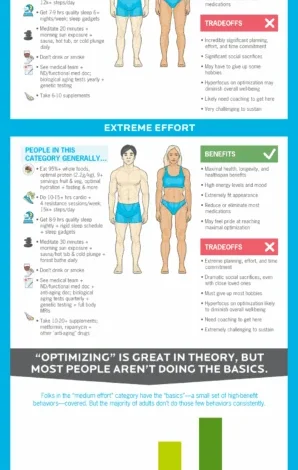
Organizations like Precision Nutrition, the source of the original infographic, echo this sentiment, emphasizing the importance of building sustainable nutrition and lifestyle habits. Their philosophy centers on making gradual, manageable changes that integrate seamlessly into an individual’s life, rather than imposing rigid, often temporary, restrictions. This approach recognizes that true health optimization is not about reaching an impossible peak, but about fostering resilience, adaptability, and well-being over a lifetime.
The Foundational Pillars of Longevity
Rather than chasing every new "hack," a consensus has emerged around several foundational pillars that consistently demonstrate significant positive impacts on health and longevity:
- Balanced Nutrition: Emphasizing whole, unprocessed foods, including plenty of fruits, vegetables, lean proteins, and healthy fats. Limiting processed foods, added sugars, and unhealthy fats.
- Regular Physical Activity: A combination of aerobic exercise (e.g., brisk walking, jogging, swimming) and strength training, tailored to individual capabilities and preferences.
- Adequate Sleep: Aiming for 7-9 hours of quality sleep per night, recognizing its critical role in cellular repair, hormone regulation, and cognitive function.
- Stress Management: Incorporating practices like mindfulness, meditation, yoga, spending time in nature, or engaging in hobbies to mitigate the detrimental effects of chronic stress.
- Strong Social Connections: Research increasingly highlights the importance of social support and community engagement for both mental and physical health.
- Avoidance of Harmful Substances: Limiting alcohol consumption and avoiding tobacco products are critical for disease prevention.
- Regular Medical Check-ups: Proactive screening and early intervention for potential health issues.
These strategies, while seemingly basic, form the bedrock of a long and healthy life. They are generally affordable, accessible, and adaptable, allowing individuals to integrate them into diverse lifestyles without excessive burden.
Broader Implications and the Path Forward
The intense focus on health optimization has broader societal implications. It raises questions about health equity, as many of the advanced protocols are inherently exclusive due to their cost. It also highlights the responsibility of media and health communicators to critically evaluate claims and promote evidence-based information. For consumers, the challenge lies in discerning credible advice from marketing hype and distinguishing between genuine health improvements and fleeting trends.
Ultimately, the quest for a longer, healthier life need not be a grueling, expensive, or socially isolating endeavor. By prioritizing sustainable, evidence-based habits, individuals can achieve significant improvements in their well-being and extend their healthy lifespan without sacrificing the richness and enjoyment of life itself. The true "optimization" lies not in reaching an elusive peak, but in cultivating habits that support consistent health and happiness over the long haul.
For those seeking to delve deeper into the nuanced discussion surrounding health optimization and its real-world implications, a comprehensive infographic and an accompanying article, titled "The True Cost of ‘Optimal’ Health—Here’s what it really takes to live as long and healthy as possible," offer a detailed review of the latest research and practical insights. These resources provide a valuable framework for understanding how to achieve desired health and longevity while living a life that is both vibrant and enjoyable. Additionally, individuals can assess their current health and longevity efforts through a dedicated Longevity Assessment, offering personalized insights into areas for most impactful improvement. The journey to a longer, healthier life is ultimately a personal one, but it is best navigated with clarity, balance, and a focus on what truly sustains well-being.