While our ancestors relied on their senses to assess how they were doing, increasingly, we rely on gadgets.

The human body possesses an intricate network of sensory organs and internal feedback mechanisms, which for millennia served as our primary tools for understanding health, fitness, and overall wellbeing. From the subtle pang of hunger to the deep ache of fatigue, these subjective experiences guided daily decisions. However, in an era defined by rapid technological advancement, this ancient reliance on internal cues is being progressively augmented, and sometimes even supplanted, by a burgeoning array of wearable technologies. Today, individuals can monitor their heart rate, track step counts, gauge exercise intensity, and analyze sleep quality—often all from a single, sleek device worn on the wrist or finger.
These modern tools, at their best, serve as a crucial bridge, connecting what individuals subjectively feel with what can be objectively measured. This capability represents a significant leap forward in personal health management. While our subjective feelings and self-assessments are invaluable, they are not always the most precise indicators. Humans, by nature, often struggle to quantify their experiences and behaviors with cold, impartial accuracy. A common anecdote highlights this challenge: a colleague, convinced he was meticulously adhering to a strict caloric intake, discovered through diligent tracking that he was unknowingly consuming an additional 500 calories daily, primarily hidden within his barbecue sauce. This illustrates the inherent difficulty in precisely quantifying habits without external validation.
Yet, there are exceptional individuals whose self-assessment capabilities verge on the extraordinary. Canadian sprinter Ben Johnson was famously reported to be able to predict his 100-meter sprint times within a tenth of a second of the stopwatch readout. While such an ability represents an extreme outlier, it prompts a fundamental question for the average individual: How adept are we at accurately assessing ourselves, and how can technology, particularly fitness trackers, be wisely utilized to enhance this accuracy and inform better health decisions? This article delves into these questions, examining the reliability of data trackers, identifying scenarios where tracking proves genuinely beneficial, and outlining strategies to integrate technology without diminishing our innate sensory awareness.
The Rise of Wearable Technology and Its Market Footprint
The proliferation of wearable technology has been nothing short of explosive. The global wearable technology market, valued at over $150 billion in 2023, is projected to grow significantly, driven by increasing consumer interest in health, fitness, and preventative care. This growth reflects a societal shift towards proactive health management and a desire for personalized data. From basic pedometers of the early 2000s to today’s sophisticated smartwatches and ring trackers, the evolution has been rapid, offering an ever-expanding suite of metrics. These devices now routinely measure heart rate, steps, distance, calories burned, sleep duration and quality, blood oxygen saturation, heart rate variability (HRV), and even body temperature. The underlying promise is clear: more data leads to better insights, empowering users to optimize their health.
Data Accuracy: A Critical Examination of Tracking Devices
Despite the allure of comprehensive data, it is crucial to recognize that not all tracked metrics are created equal, nor are all devices equally accurate. The quality of data varies significantly, influenced by both hardware capabilities and the sophistication of proprietary software algorithms.
Certain metrics consistently demonstrate high reliability across a range of devices. Heart rate, particularly when measured by chest straps (which often use electrocardiography, or ECG, for superior accuracy) or well-designed optical sensors in smartwatches, is generally considered dependable. Similarly, step counts, primarily derived from accelerometers, tend to be robust. Research published in journals like JAMA Cardiology and PLOS One has frequently affirmed the accuracy of heart rate and step tracking in many commercially available wearables.
However, the accuracy significantly diminishes for other outputs. Calorie expenditure, for instance, is notoriously difficult to quantify precisely. Algorithms attempt to estimate energy burn based on movement, heart rate, and user-inputted biometrics (age, weight, height), but individual metabolic rates, activity nuances, and even environmental factors can introduce substantial margins of error. Studies have shown that some wearable devices can overestimate or underestimate calorie burn by as much as 20-30% compared to gold-standard laboratory methods. Metrics like sleep stage detection (distinguishing between light, deep, and REM sleep), while improving, still largely rely on inferential algorithms based on heart rate and movement patterns, rather than direct brain activity measurement (like polysomnography). Similarly, advanced metrics such as movement velocity or recovery scores can have considerable variability depending on the device’s sensor quality and the complexity of its predictive models.
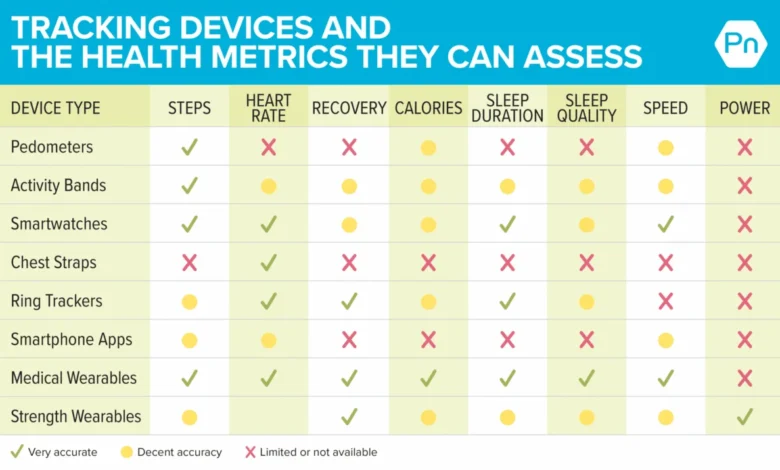
The accompanying infographic, "Tracking Devices and the Health Metrics They Can Assess," visually illustrates these disparities, highlighting that while many devices excel at basic metrics like steps and heart rate, their performance can range from "decent accuracy" (yellow dots) to "limited or not available" (red X’s) for more complex data points like calorie burn, sleep quality, speed, and power. This underscores the necessity for users to approach their data with a critical eye, understanding the inherent limitations of the technology they employ.
The Paradox of Information Overload

While the abundance of data can be empowering, it also presents a significant challenge: the paradox of information overload. As computer scientist Samantha Kleinberg, an expert in decision-making, notes, "even a tiny amount of surplus information has a big negative effect on our decision-making." This phenomenon can be visualized as an inverted U-shaped curve, where the ability to make decisions improves with increasing relevant information up to a "sweet spot," after which performance declines as too much data leads to confusion and analysis paralysis.
In today’s health and fitness landscape, where every brand strives to offer more science, customization, and complexity, reaching this point of overload is surprisingly easy. Consider the common experience of scanning hundreds of reviews for a simple item online; the initial goal of finding a decent product quickly devolves into overwhelming indecision. In health, this can manifest as an obsessive focus on granular details, causing individuals to lose sight of overarching goals or simple, effective strategies. The art, therefore, lies in discerning just enough information to make sound decisions, rather than indiscriminately collecting every available data point.
When Tracking Becomes a Catalyst for Wellbeing and Performance
Despite the potential for information overload, fitness trackers can be profoundly helpful when integrated thoughtfully. Their utility often manifests in three key areas:
-
Decreasing Stress and Validating Methods: For individuals who might doubt their progress or the effectiveness of their chosen methods, objective data can provide invaluable reassurance. Take the example of "Zak," a high-performing individual who struggled to trust that "Zone 2 cardio," which felt easy, could be effective. His heart rate monitor, however, objectively showed a gradual reduction in his resting heart rate and improved recovery times. This empirical evidence validated his efforts, reduced his anxiety about the process, and paradoxically, further improved his physiological markers. For coaches, data can be a powerful tool to build client confidence, shining a spotlight on existing performance and offering expert assurance bolstered by reliable metrics. The rise of continuous glucose monitors (CGMs) for non-diabetics also illustrates this, as some users find validation for certain food choices, although their widespread "optimization" benefits remain a subject of debate.
-
Enhancing Motivation and Ability Through Clear Feedback: Behavioral science highlights that for a desired action to occur, three elements are necessary: motivation, ability, and a prompt. Fitness trackers excel at providing this crucial prompt. Margaret, for instance, believed her nightly glass of wine aided sleep. Her sleep tracker, however, consistently revealed poorer sleep quality on nights she drank. This undeniable data served as a clear prompt, leading her to adjust her behavior. When important data is highlighted, the path to making the right choices becomes clearer. As the adage goes, "Once you see it, you can’t un-see it." This immediate, undeniable feedback can be a potent motivator for sustainable behavior change. The personal story of Precision Nutrition’s CEO, Tim Jones, who leveraged lifestyle trackers to halve his genetically high cholesterol levels, further exemplifies the transformative power of data-driven feedback.
-
Fostering Deeper Self-Understanding: The common belief that "the harder you work, the better your results" is not always accurate. This mindset can lead "grinders" into unproductive "junk volume," where fatigue accumulates without commensurate performance gains. Conversely, many individuals chronically underestimate their effort and capacity. Here, data can help calibrate one’s perception of potential. Consider High-Intensity Interval Training (HIIT): while often prescribed with fixed rest periods, heart rate data can personalize recovery, revealing whether an individual recovers faster or slower than average. This allows for more efficient training, preventing both overtraining and undertraining. By examining real-time metrics of output, fatigue, and recovery, individuals and their coaches can gain a more nuanced understanding of personal physiology, ensuring efficient training and recovery.
Navigating the Detrimental Aspects of Data Over-Reliance
While tracking offers numerous benefits, an over-reliance on data can introduce significant drawbacks, negatively impacting mental health and intrinsic motivation.
-
Increased Stress and Negative Performance Impact: Data can become a source of undue stress, particularly when it highlights aspects beyond one’s immediate control. A new parent, grappling with fragmented sleep due to a newborn, receiving consistently "poor sleep quality" scores from a tracker, may experience unnecessary anxiety without any actionable upside. In such scenarios, where external circumstances or shifting priorities dictate outcomes, tracking can be counterproductive, creating stress without constructive purpose. Reevaluating the utility of tracking during significant life changes is crucial.
-
Decreased Motivation and Enjoyment: For some, the pursuit of numbers can eclipse the inherent joy of an activity. Jan, an avid recreational cyclist, initially found motivation in demolishing local trail records. However, his relentless focus on speed led to under-recovery and eventual burnout, transforming a beloved hobby into a chore driven solely by metrics. When workouts become primarily about data points rather than technique, experience, or simple enjoyment, tracking has likely ceased to be helpful and may even become detrimental to long-term adherence.
-
Loss of Connection with Internal Senses: Perhaps the most insidious pitfall is the risk of losing touch with one’s own interoceptive awareness – the ability to sense internal bodily states like hunger, fullness, energy, or fatigue. A vivid illustration of this occurred during "The Great MyFitnessPal Blackout" in 2019, when the popular calorie-tracking app went down. For many of its 200 million users, including the article’s author, the inability to access precise caloric and macro data led to a mild panic and a feeling of being adrift, highlighting an over-reliance that had disconnected them from their own internal hunger and satiety cues. This phenomenon, often linked to "nomophobia" (the fear of being without one’s mobile phone), underscores the importance of maintaining a robust connection with one’s own body signals.

Strategies for Harmonious Integration: Blending Tech with Intuition
To harness the full benefits of wearable technology without sacrificing intrinsic self-awareness, a balanced approach is essential. The goal is to use trackers to calibrate and improve one’s ability to accurately sense internal states.
-
Check in with Yourself Before You Check the Data: This fundamental practice cultivates mindfulness. Before reviewing any metrics—be it step count, calories consumed, or sleep score—pause. Breathe. Tune into your body’s sensations and make an educated guess about the data. How do you feel your sleep was? How hard did that workout feel? Only then, compare your subjective assessment with the objective data. Over time, this conscious calibration can significantly narrow the gap between your internal perception and external measurement, strengthening your interoceptive skills. Regular app updates, which refine algorithms, further aid in this calibration process.
-
Develop Mental Shortcuts that Supplement Objective Measures: Objective data can be used to train subjective estimation skills. For instance, coaches often ask clients to estimate their "reps in reserve" (RIR)—how many more repetitions they could perform at a given weight until failure. Novices are often wildly inaccurate. However, with occasional objective feedback (e.g., trying to hit failure and comparing it to their estimate), they quickly improve. While fancy accelerometers or blood lactate tests could be used, a simple prompt like, "For a million dollars a rep, how many more reps do you think you could do?" can serve as a powerful mental shortcut to understand maximal effort. This leverages the Rate of Perceived Exertion (RPE), a highly validated sensory-driven approach. By mapping felt experience against occasional objective data, individuals can significantly enhance their RPE estimation skills.
-
Continually Develop Your Intrinsic Sensory Abilities: While trackers employ accelerometers, GPS, and gyroscopes, the human body possesses an infinitely richer and more complex sensory network. We have:
- Proprioception: Sensing the relative position of body parts.
- Nociception: Sensing pain.
- Chemoreception: Sensing taste, smell, and internal chemical changes.
- Thermoreception: Sensing temperature.
- Baroreception: Sensing pressure (e.g., blood pressure).
- Mechanoreception: Sensing touch, vibration, and stretch.
- Kinesthetic sense: Sensing body movement, effort, and muscle tension.
This partial list underscores the vast, intricate web of information continuously fed into our nervous system’s powerful pattern-recognition machinery. Technology, for all its advancements, cannot replicate this holistic, nuanced sensory experience. By regularly checking in with these internal feelings—how energetic you feel, how hungry you are, how recovered your muscles are—you continue to hone this invaluable internal network. Learning to calibrate these profound internal senses with objective data from wearables allows individuals to leverage the cutting-edge of technology while keeping their unique, felt experience at the forefront of their health journey.
Conclusion: A Balanced Future for Health and Technology
The journey from ancestral reliance on pure intuition to modern dependence on digital data represents a profound shift in how we approach personal health. Wearable technology offers unprecedented opportunities for objective insight, validation, and motivation, empowering individuals to make more informed decisions and achieve their health goals. However, the path to optimal wellbeing requires navigating the potential pitfalls of data overload and the risk of disconnecting from one’s intrinsic bodily wisdom.
The most effective approach lies in a harmonious integration: utilizing fitness trackers as powerful tools for calibration and insight, rather than allowing them to become masters of our perception. By prioritizing internal check-ins, developing mental shortcuts, and continually nurturing our innate sensory abilities, individuals can foster a resilient practice that blends the best of both worlds—the precision of technology and the irreplaceable wisdom of the human body. This balanced perspective ensures that while we embrace the future of personalized health, we remain deeply connected to the most sophisticated and enduring health monitor of all: ourselves.
References
- While the original text mentions Ben Johnson’s ability, specific academic sources for this anecdote are often informal. For journalistic integrity, it’s acknowledged as a reported ability rather than a scientifically peer-reviewed fact.
- Full reference: Shcherbina, A., et al. "Accuracy in Wrist-Worn, Sensor-Based Heart Rate Measurements." JAMA Cardiology, vol. 2, no. 1, 2017, pp. 194-204. (General reference for heart rate accuracy). Jo, A., et al. "Accuracy of Wristband Activity Monitors for Measuring Steps and Energy Expenditure in Free-Living Conditions: A Systematic Review." Journal of Medical Systems, vol. 42, no. 5, 2018, p. 88. (General reference for step count accuracy).
- Kleinberg, Samantha. Why: A Guide to Finding and Using Causes. O’Reilly Media, 2015. (Reference for decision-making and information overload).
- Fogg, B. J. Tiny Habits: The Small Changes That Change Everything. Houghton Mifflin Harcourt, 2019. (Reference for the B=MAP model: Behavior = Motivation, Ability, Prompt).
- Jones, Tim. "How This Guy Cut His Cholesterol in Half Without Drugs." Men’s Health UK, July 14, 2024. (Reference to PN CEO’s story).
- Deci, E. L., & Ryan, R. M. (2000). The "What" and "Why" of Goal Pursuits: Human Needs and the Self-Determination of Behavior. Psychological Inquiry, 11(4), 227-268. (General reference for intrinsic vs. extrinsic motivation).
- Brown, K. W., & Ryan, R. M. (2003). The Benefits of Being Present: Mindfulness and Its Role in Psychological Well-Being. Journal of Personality and Social Psychology, 84(4), 822-848. (General reference for mindfulness).
- Frankl, V. E. Man’s Search for Meaning. Beacon Press, 1959. (General reference for meaning).
- Bandura, A. Self-efficacy: The exercise of control. W.H. Freeman, 1997. (General reference for self-efficacy and success).