Tracking the Shift: U.S. Government Rolls Out America First Global Health Strategy and Bilateral Agreements


The United States government is fundamentally reshaping its international aid architecture through the rollout of its America First Global Health Strategy, a transformative initiative that alters how Washington engages in international medical and humanitarian assistance. Originally unveiled in late September 2025 and continuously updated through late 2026, the strategy marks a sharp departure from decades-old foreign assistance models. At the core of this new framework is the establishment of bilateral health cooperation agreements—primarily structured as Memorandums of Understanding (MOUs)—between the United States and recipient nations worldwide.
These binding five-year compacts, spanning the 2026 to 2030 period, are designed to transition foreign health systems away from permanent reliance on U.S. funding toward long-term domestic self-reliance. As the U.S. scales back its direct financial footprint, partner nations are required to commit to escalating domestic health spending and co-investing in their own healthcare infrastructure. While proponents argue the framework fosters sustainable, resilient national health systems, global health advocates and policy analysts are closely monitoring the implementation process amid notable funding reductions across multiple regions.
Background and Strategic Context
The introduction of the America First Global Health Strategy on September 18, 2025, represented a major pivot in American foreign policy. For decades, U.S. global health assistance—channeled largely through initiatives like the President’s Emergency Plan for AIDS Relief (PEPFAR) and the U.S. Agency for International Development (USAID)—relied heavily on sustained, direct American financing to combat infectious diseases, strengthen health systems, and support maternal and child health in low- and middle-income countries.
Under the new strategy, the U.S. Department of State and partner country Ministries of Health are negotiating bilateral compacts aimed at fostering "resilient and durable health systems." Rather than open-ended grant disbursements, these new agreements establish clear milestones for financial transition. As Washington gradually steps down its financial allocations, partner governments must pledge stepped-up domestic budget allocations for healthcare. The overarching rationale is to ensure that national health infrastructures can endure independently once American bilateral assistance winds down or pivots to new priorities.
Chronology of Implementation
The rollout of the America First Global Health Strategy has followed a carefully managed timeline, moving from policy formulation to diplomatic engagement and legislative alignment:

- September 18, 2025: The U.S. government officially releases the America First Global Health Strategy report, detailing the framework for bilateral health cooperation agreements and domestic co-investment mandates.
- Late 2025: U.S. diplomatic missions, the State Department, and partner Ministries of Health initiate formal negotiations. The first wave of bilateral MOUs is signed.
- January 13, 2026: Comprehensive tracking mechanisms and public resource pages are established to monitor the signing, funding structures, and program areas of the growing number of bilateral agreements.
- July 1, 2026: Data compilation points indicate that at least 34 countries have successfully concluded bilateral agreements or equivalent frameworks with the United States.
- September 11, 2026: The overarching resource tracker receives its latest major update to incorporate additional programmatic details, evolving financial commitments, and refined regional analyses.
- Late 2026 and Onward: Full-scale operational implementation of the five-year frameworks gets underway across the globe, with ongoing monitoring of domestic co-financing benchmarks.
Overview of Signed Agreements and Structural Variations
By mid-2026, data compiled from the U.S. Department of State, American embassies abroad, and partner country health ministries reveals that 34 nations have formalized agreements under the new strategy. While the standard template envisions a five-year bilateral framework spanning 2026 to 2030, structural adaptations have emerged based on regional negotiations and local legal frameworks.
For instance, global health MOU agreements for Bolivia, Botswana, Panama, and South Sudan are structured around a shorter three-year duration. Meanwhile, diplomatic arrangements have occasionally taken alternative legal forms; notably, the Philippines did not sign a traditional MOU but instead finalized a "Strategic Objective Agreement." While overarching funding figures for the Philippines have been made publicly available, granular details regarding domestic co-financing shares remain pending.
An examination of the financial mechanics embedded within these agreements highlights a deliberate contraction in overall U.S. financial exposure. A comparative analysis of historical funding—encompassing appropriated and planned amounts for Fiscal Years 2021 through 2023, alongside requested amounts for FY 2024 and FY 2025 within the Global Health Programs (GHP) account—against the newly proposed five-year MOU allocations reveals a notable net reduction. Among the 34 countries with signed agreements, the aggregate change in five-year global health funding reflects a decrease of approximately $7.3 billion, representing a 34 percent reduction compared to historical baselines. This calculation isolates direct U.S. funding contributions and excludes the parallel increases in domestic health spending pledged by partner governments.

Programmatic Focus and Sectoral Distribution
The bilateral MOUs encompass a diverse array of public health priorities, tailored to the specific epidemiological profile and systemic vulnerabilities of each partner nation. Programmatic areas captured through keyword analyses of available MOU texts and diplomatic press releases span several critical pillars of international health security:
- Global Health Security (GHS): A foundational component of nearly all agreements, GHS initiatives focus on outbreak preparedness, rapid response mechanisms, laboratory capacity building, and the containment of cross-border biological threats.
- Infectious Disease Control: Ongoing efforts targeting legacy burdens such as HIV/AIDS, tuberculosis, and malaria, transitioning from direct U.S. service delivery to integrated national disease surveillance and management.
- Maternal, Neonatal, and Child Health: Core primary healthcare interventions designed to reduce preventable mortality and strengthen community-level health service delivery.
- Health Systems Strengthening: Institutional reforms addressing supply chain management, healthcare workforce training, health management information systems, and domestic resource mobilization.
Because full legal texts for every signed MOU are not yet publicly accessible—with researchers often relying on summary press releases issued by foreign ministries and embassies—certain programmatic nuances remain under review. For countries where complete documentation is available, total funding figures are derived from the aggregate sum of annual allocations outlined in the formal text.
Methodological Framework and Data Tracking
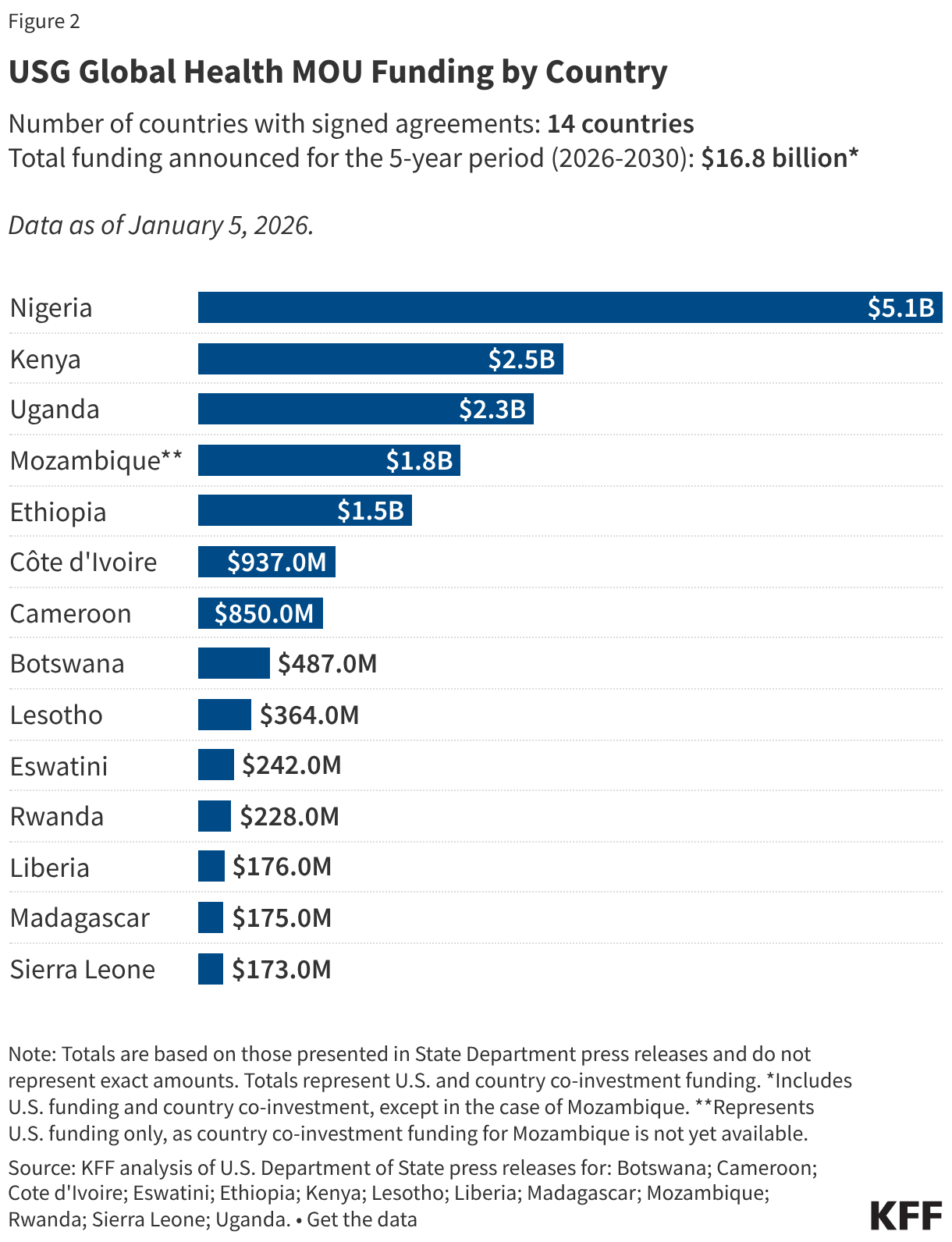
The quantitative and qualitative insights concerning these bilateral compacts are compiled through rigorous tracking methodologies. Analysts evaluate primary documentation—including official MOU texts where released, diplomatic cables, State Department announcements, and ministerial communiqués from partner capitals.
Specialized keyword algorithms are utilized to categorize program areas. For instance, global health security initiatives are identified when agreements explicitly reference GHS terminology or detail operational provisions for pathogen surveillance, emergency response logistics, and zoonotic disease monitoring. Because public communications vary in depth across different jurisdictions, analysts caution that current data may undercount specific niche programmatic activities embedded within localized execution plans.
Implications and Broader Analysis
The operationalization of the America First Global Health Strategy carries profound implications for the global health landscape. From a strategic perspective, the policy codifies a long-debated transition: shifting the financial burden of public health from international donors to sovereign states. Proponents of the strategy maintain that forcing increased domestic co-investment eliminates dependency loops, fosters genuine national ownership, and compels governments to prioritize healthcare within their national budgets.
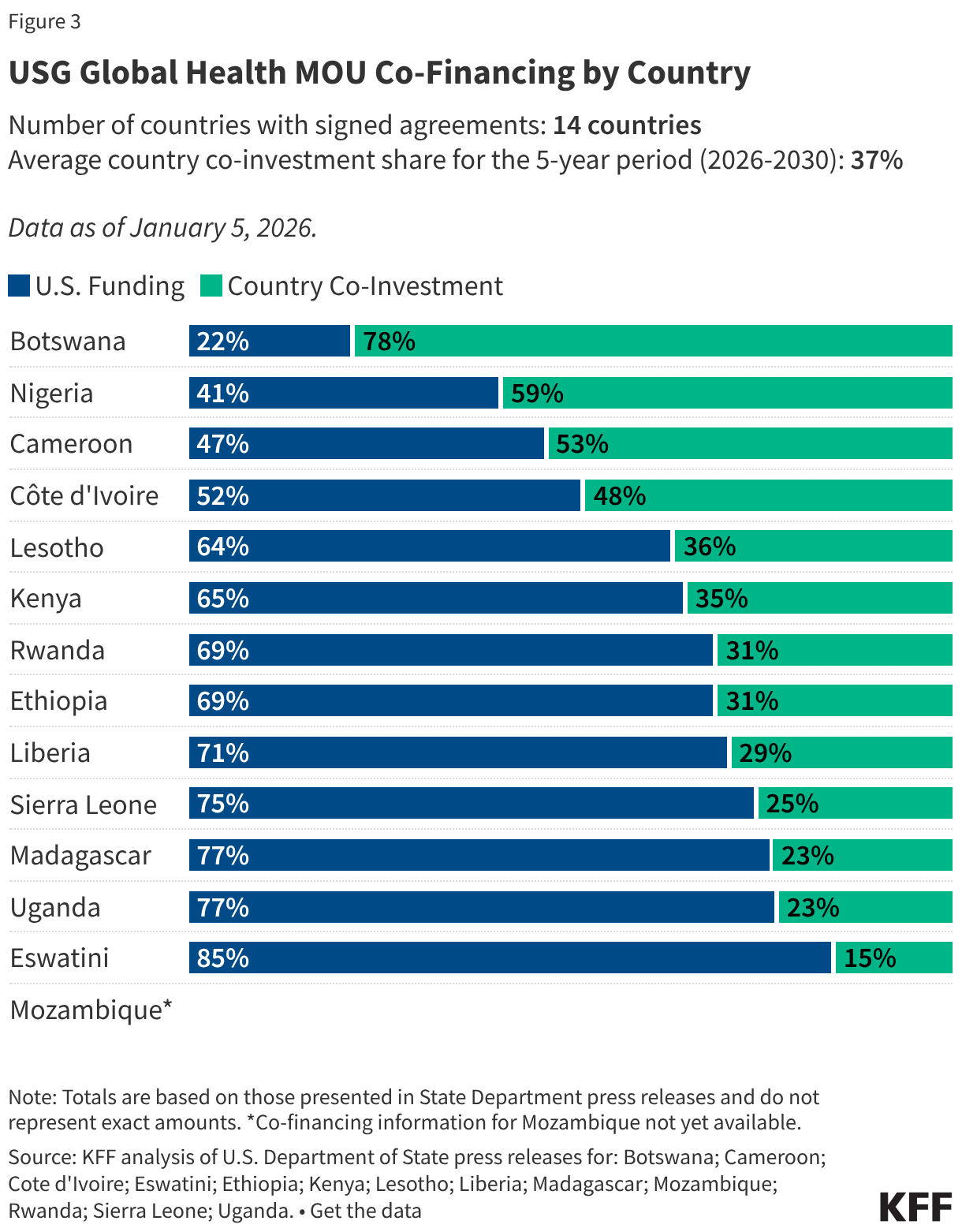
Conversely, public health experts and international development economists have raised significant concerns regarding the velocity and depth of the funding reductions. A 34 percent aggregate drop in U.S. bilateral health assistance across dozens of vulnerable nations could strain fragile health infrastructures, particularly in low-income settings where domestic revenue mobilization faces structural impediments. In countries grappling with high burdens of infectious disease and limited fiscal space, rapid transitions away from external support risk destabilizing ongoing treatment regimens and disease surveillance networks.
As the implementation phase continues through late 2026 and beyond, the success of the America First Global Health Strategy will largely depend on the capacity of partner nations to meet their co-financing commitments without compromising healthcare access for vulnerable populations. Continuous tracking and transparent reporting will remain essential for evaluating whether these bilateral compacts successfully achieve resilient, self-sustaining health systems or inadvertently create operational vacuums in global disease prevention.
Related posts: