The Fragile Foundation of Modern Life: Analyzing the Systemic Risks of Global Infrastructure and Economic Interdependence

The contemporary global order rests upon a complex, interlocking web of supply chains, energy corridors, and financial systems that, while highly efficient, possess a level of fragility unprecedented in human history. Experts in systemic risk analysis increasingly warn that the very mechanisms designed to provide modern convenience and economic growth—globalization, "just-in-time" logistics, and high-tech automation—have effectively eliminated the redundancies necessary to survive a major disruption. This vulnerability is not merely a theoretical concern but a present reality, as the interruption of a single narrow corridor, such as the Strait of Hormuz, could potentially propagate outward into a general crisis of civilization.
The Chokepoint Paradox: Energy and Global Stability
At the heart of modern industrial civilization is the uninterrupted flow of energy. The Strait of Hormuz, a narrow waterway between Oman and Iran, serves as the world’s most critical oil transit chokepoint. According to data from the U.S. Energy Information Administration (EIA), approximately 21 million barrels of oil per day—representing roughly 21% of global petroleum liquids consumption—pass through this corridor.
A systemic risk analysis of a potential closure or significant disruption in the Strait reveals a cascading effect that would transcend the energy sector. Unlike the energy crises of the 1970s, a modern disruption would occur in an era of extreme interdependence. If shipping lanes are compromised, the immediate impact would be a spike in global energy prices, followed rapidly by the cessation of international shipping for consumer goods, raw materials, and food. Analysts suggest that such a breakdown would not simply return society to the conditions of the 19th century; rather, it would leave a population dependent on high-tech infrastructure without the means to operate it.
The Haber-Bosch House of Cards: Agricultural Dependence
One of the most significant yet overlooked vulnerabilities of the modern world is the chemical foundation of the global food supply. The Haber-Bosch process, which synthesizes ammonia from nitrogen and hydrogen, is responsible for the production of the synthetic fertilizers that currently feed approximately 50% of the global population. This process is heavily energy-intensive, relying primarily on natural gas.
If energy supply chains are severed, the production of synthetic fertilizer would grind to a halt. Researcher David DuByne and other analysts of civilizational cycles warn that fertilizer shortages trigger a direct and rapid decline in crop yields. This "Haber-Bosch house of cards" supports nearly four billion people who would otherwise lack a food source. In this scenario, the transition from scarcity to social collapse is accelerated by the lack of fallback strategies. As David Holmgren notes in Future Scenarios, industrial civilization has largely failed to invest in redesign strategies that prioritize local resilience over global efficiency.
The Money Illusion and Ecological Reality
The economic framework supporting this fragile infrastructure is similarly under strain. In his seminal work Immoderate Greatness, William Ophuls describes the "money illusion"—a psychological and economic phenomenon where inflation and the expansion of fiat currency disconnect the artificial economy from ecological and physical realities.
For decades, the global economy has functioned on the assumption that resources are infinite and that financial engineering can solve physical shortages. However, as the cost of resource extraction rises and the purchasing power of currencies fluctuates, this illusion begins to shatter. The reliance on fiat currency, which is not backed by physical commodities, creates a system where the perceived value of assets can vanish overnight during a systemic shock.
Financial analysts like Andy Schectman, president of Miles Franklin, argue that physical assets such as gold and silver remain the only "honest currency" because they cannot be printed or counterfeited. In a period of systemic collapse, the transition from digital and paper wealth back to tangible commodities is often violent and chaotic, as the "money illusion" gives way to the harsh reality of supply and demand for basic necessities.
Chronology of a Systemic Cascade
To understand the scale of a potential civilizational crisis, it is necessary to examine the projected timeline of a systemic failure.
- Phase One: The Trigger Event. This could be a geopolitical conflict in the Persian Gulf, a global cyberattack on banking infrastructure, or a catastrophic failure of the electrical grid.
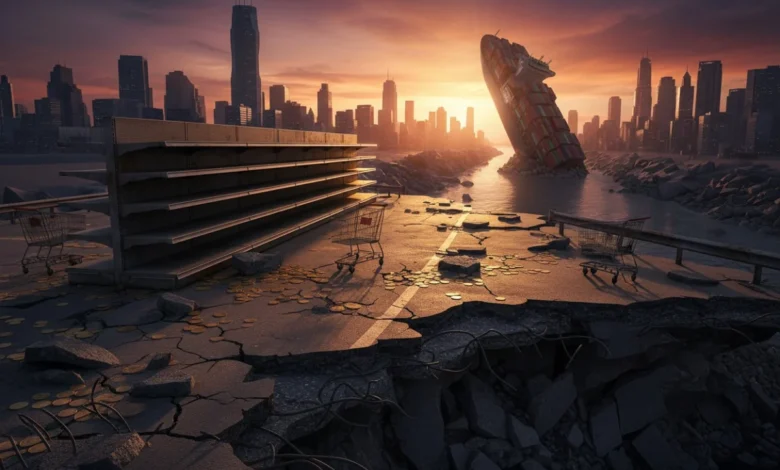
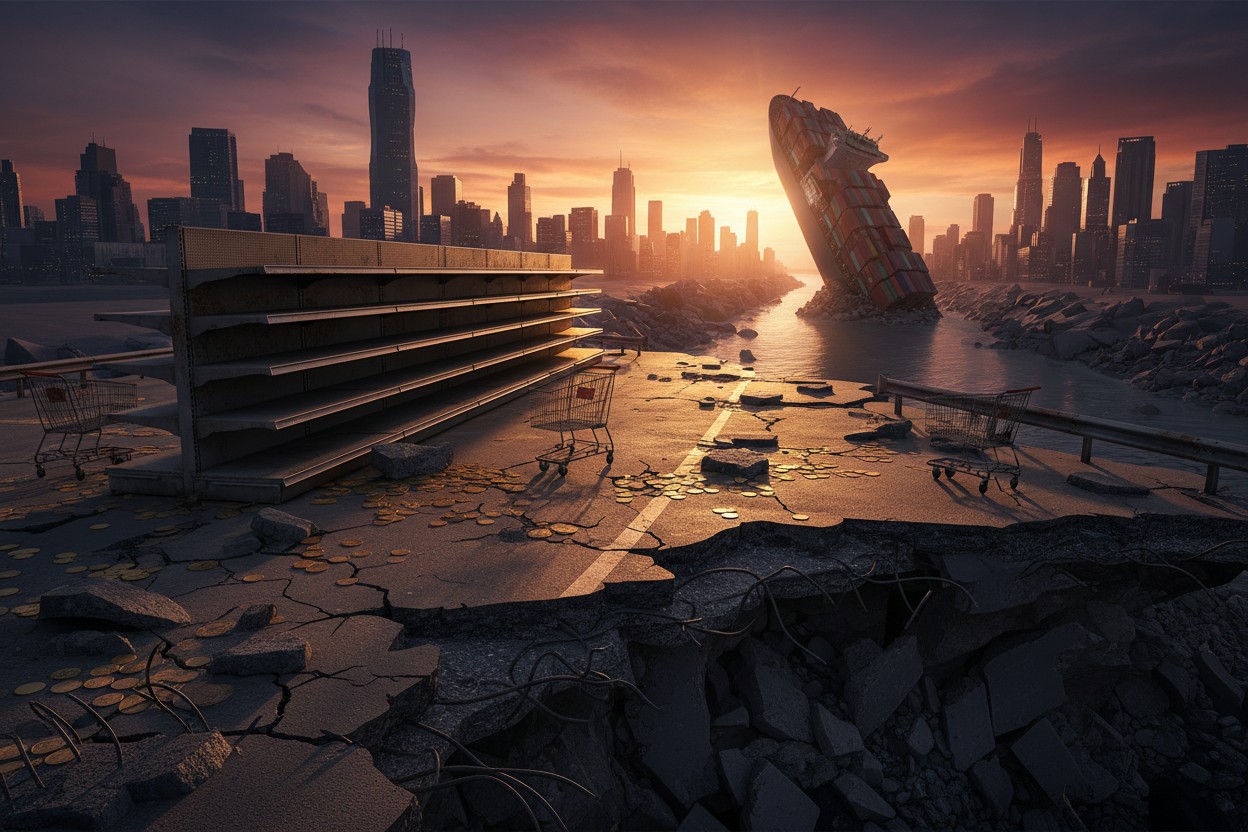
- Phase Two: Supply Chain Dissolution. Within 48 to 72 hours of a major disruption, "just-in-time" inventory systems fail. Grocery store shelves are emptied as panic buying sets in and replenishment trucks stop moving due to fuel shortages or civil unrest.
- Phase Three: Infrastructure Breakdown. As specialized technicians are unable to reach their posts and replacement parts become unavailable, critical utilities—water, electricity, and sewage—begin to fail. The loss of automated systems in steel mills, power plants, and water treatment facilities renders modern infrastructure inoperable.
- Phase Four: Social Fragmentation. As the government’s ability to provide security and basic services wanes, social order begins to deteriorate. Historical patterns suggest that the first visible signals are wholesale looting in urban centers, followed by the migration of desperate populations from cities to rural areas in search of food.
- Phase Five: Reconfiguration or Collapse. The final stage involves either a slow "civilizational death"—characterized by a manageable decline into localized, low-tech societies—or a catastrophic collapse where the death toll reaches hundreds of millions due to hunger, disease, and conflict.
The Loss of Survival Literacy
A critical factor that distinguishes the current era from previous historical declines is the profound loss of basic survival skills among the general population. In earlier centuries, a majority of the population possessed knowledge of agriculture, animal husbandry, manual tool repair, and basic medicine. Today, the specialization of labor has created a society where few individuals can maintain a water pump, operate a manual lathe, or grow enough food to sustain a household without external inputs.
This "skills gap" serves as a force multiplier for any systemic crisis. When the automated systems that manage modern life go offline, the population is left without the cognitive or physical tools to adapt. The reliance on AI and digital assistants for basic problem-solving has further eroded human self-reliance, making the prospect of a "return to basics" significantly more lethal than it was for previous generations.
Broader Impact: Nuclear and Environmental Risks
The implications of a systemic collapse extend beyond human social structures to the environment itself. Modern civilization is dotted with high-risk infrastructure that requires constant, high-tech maintenance. There are currently over 400 nuclear power reactors operating globally. These facilities require a continuous supply of electricity and water to cool spent fuel rods. In a scenario of total grid failure and social collapse, the risk of multiple meltdowns becomes a mathematical probability rather than a remote possibility.
Furthermore, regions that rely heavily on desalination for fresh water, particularly in the Middle East, face an immediate existential threat. The destruction or abandonment of desalination plants would render vast areas uninhabitable within days, triggering some of the largest mass migrations in human history. The resulting geopolitical reconfiguration would likely be characterized by a "warlord era," where localized power structures compete for dwindling resources.
Analysis of Global Responses and Mitigation
While the outlook remains grim for a globalized system without redundancies, some nations and decentralized groups are beginning to implement resilience strategies. The move toward decentralized finance (DeFi) and encrypted communications represents an attempt to preserve the ability to organize outside of centralized surveillance and vulnerable banking grids.
On an individual level, the trend toward "homesteading" and the acquisition of manual trade skills reflects a growing awareness of the fragile foundation of modern life. Strategic stockpiling of storable food, the installation of off-grid solar arrays, and the securing of backup communication methods are no longer viewed solely as the province of fringe "preppers" but as a rational response to documented systemic risks.
The systemic risk analysis of our current civilization reveals a machinery of dependence so extreme that the interruption of one narrow corridor can propagate outward into a general crisis. As the water recedes before the inevitable tsunami of a civilizational shift, the window for preparation is narrowing. The transition from a globalized, high-efficiency world to one defined by local resilience and physical reality will likely be the defining challenge of the 21st century. The stability of the modern world is not a guaranteed constant, but a delicate balance that requires a level of maintenance and resource abundance that may no longer be sustainable. Deciding to act while the shelves are still full and the lights are still on remains the only viable strategy for navigating the coming volatility.