Comprehensive New KFF Survey Reveals Severe Healthcare Affordability and Access Crises Facing Chronically Ill and Uninsured Americans

A groundbreaking national study released by KFF has cast a stark light on the profound systemic failures confronting adults managing multiple or complex health conditions in the United States. Based on an expansive survey of more than 25,000 individuals, the findings demonstrate that patients dealing with serious ailments—ranging from cancer and cardiovascular disease to severe mental health conditions—face immense, often insurmountable barriers to securing basic medical care, necessary treatments, and vital prescriptions. While the broader American political and economic discourse frequently touches upon the skyrocketing cost of living, this latest empirical data suggests that the unique and devastating plight of chronically ill, uninsured patients remains largely obscured from the national spotlight.
Dr. Drew Altman, the founding president and CEO of KFF, encapsulated the gravity of the data in a companion analysis. "If the first obligation of a health care system is to take care of the sick, we are failing that test," Dr. Altman stated. "Cost and access problems are hitting the chronically ill hard, and the chronically ill and uninsured especially hard." The comprehensive research sheds light on a vulnerable demographic that is routinely forced to choose between managing life-threatening medical conditions and fulfilling basic household survival needs.
The Scope of the Crisis: Methodology and Demographics
To uncover the granular realities of patient experiences, KFF executed its Survey of Health Access and Caregiving between May 4 and May 26. Administered both online and via telephone in English and Spanish, the survey engaged a nationally representative sample of 25,873 adults. Crucially, the exceptionally large sample size allowed researchers to isolate and closely examine the experiences of 16,677 respondents who reported receiving treatment for at least one serious or complex health condition within the past year. This included individuals battling cancer, chronic lung disease, diabetes, cardiovascular illness, and various mental health disorders, as well as those navigating the compounding complexities of multiple concurrent diagnoses.
The survey’s margin of sampling error stands at plus or minus one percentage point for the full sample, lending considerable statistical weight to its alarming conclusions. By capturing the direct testimonies of those living with chronic diseases, the survey moves beyond macro-level economic abstractions to reveal the human cost of a fragmented healthcare market.
Financial Strain and Medical Debt Among the Chronically Ill
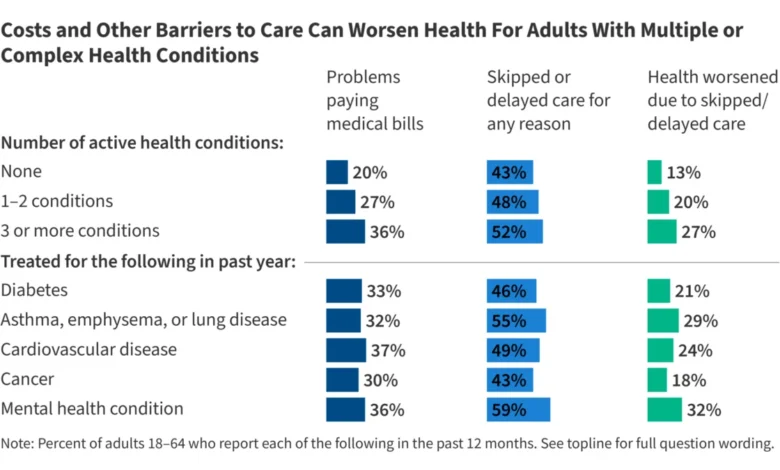
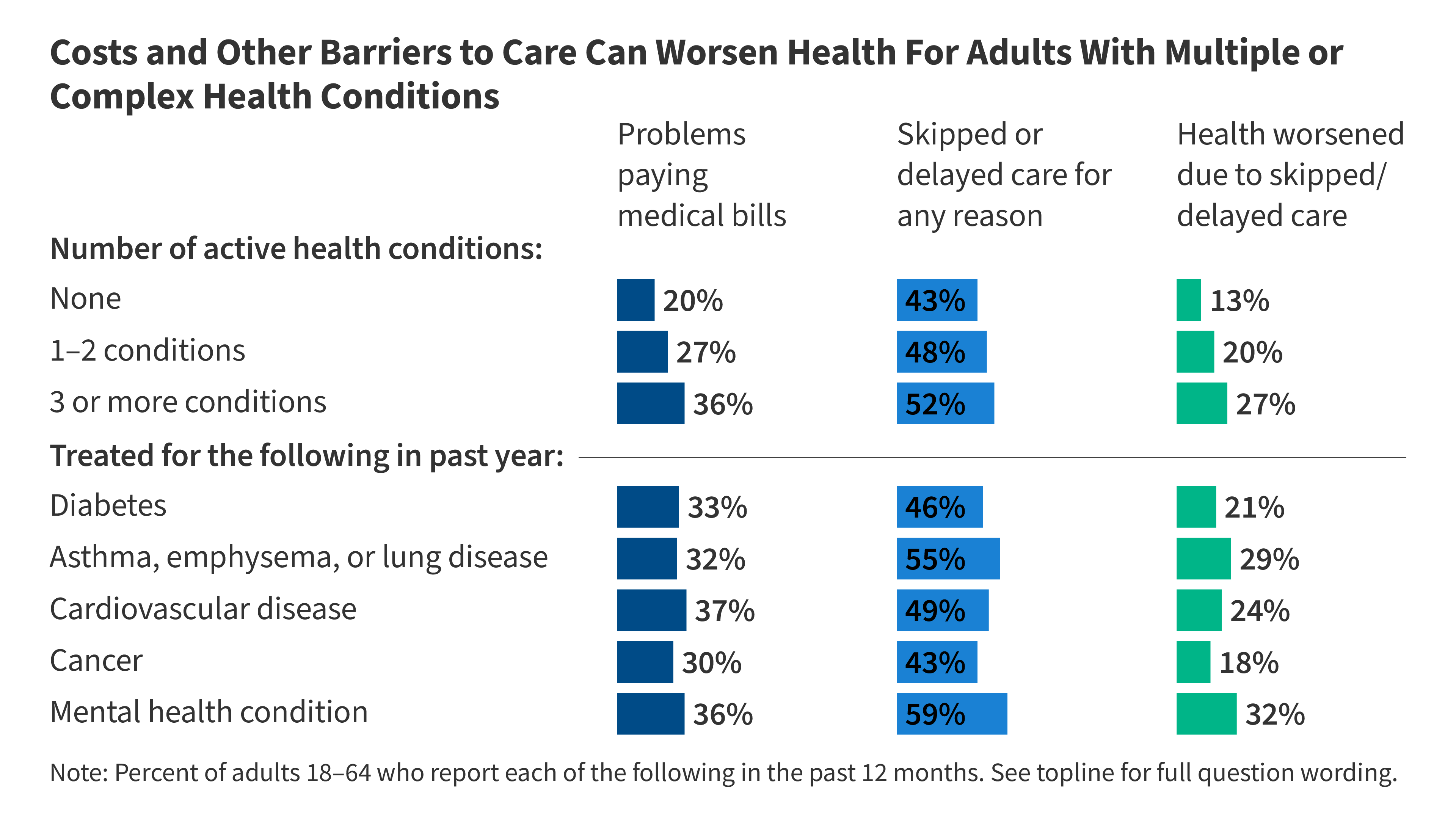
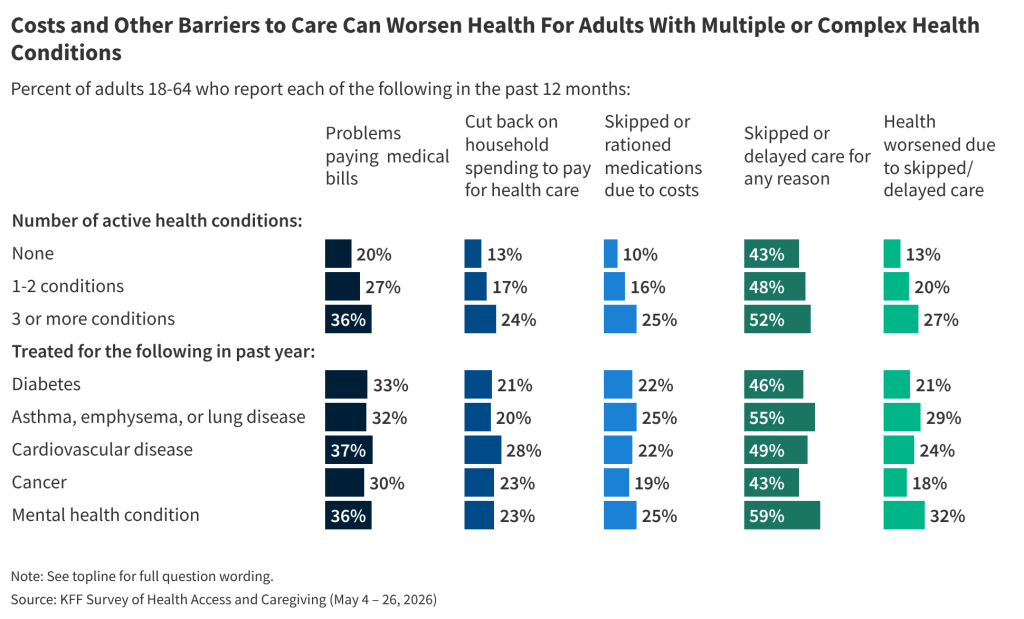
For millions of working-age adults—specifically those aged 18 to 64—managing a complex medical profile is synonymous with overwhelming financial distress. Approximately one-third of adults in this age bracket with multiple or complex health conditions reported struggling to pay, or being entirely unable to pay, their medical bills over the preceding year.
The financial burden escalates in direct correlation with the number of concurrent diagnoses. For instance, 36 percent of adults managing three or more chronic conditions reported severe medical debt struggles. The exact same proportion—36 percent—was observed among individuals coping with mental health conditions, while 37 percent of those suffering from cardiovascular disease reported similar hardships.
This financial bleeding inevitably spills over into other sectors of everyday life. Approximately one-quarter of adults juggling three or more health conditions stated they were forced to cut back on essential household expenses—such as groceries, utilities, and housing costs—just to keep pace with mounting medical invoices. In stark contrast, only about one in ten individuals without active health conditions reported making similar sacrifices.
Barriers to Care and Direct Health Consequences
The prohibitive cost of medical intervention frequently translates into catastrophic delays or complete avoidance of necessary treatment. The KFF survey found that roughly half of all adults with three or more health conditions skipped or delayed receiving medical care in the past year. Of that group, approximately one in three explicitly pointed to prohibitive costs as the primary deterrent. Furthermore, at least one in five respondents with multiple or complex health conditions admitted to rationing their prescription medications—taking less than prescribed or skipping doses entirely—because they simply could not afford the out-of-pocket expenses.
The physical ramifications of deferred care are both immediate and profound. Substantial proportions of respondents across various disease categories reported that their health visibly deteriorated as a direct result of skipped or delayed treatments. Specifically, roughly three in ten individuals with mental health conditions (32 percent) and lung disease (29 percent) reported a worsening of their condition. A quarter of those with cardiovascular disease (24 percent), alongside roughly one in five patients battling diabetes (21 percent) or cancer (18 percent), experienced similar health declines.
Insured Patients Also Face Bureaucratic Obstacles
While uninsured individuals bear the brunt of the affordability crisis, possessing health insurance is by no means a guarantee of seamless access. Insured adults aged 18 to 64 with greater health needs frequently encounter rigid administrative hurdles, including coverage delays and outright denials from their insurance providers.
These bureaucratic impediments cut across all major disease categories. Among insured working-age adults with three or more health conditions, approximately half reported that their insurer either delayed or denied coverage for a specific medical service, treatment, or medication prescribed by their physician. High denial and delay rates were similarly reported by insured individuals managing specific complex conditions:
- Mental health conditions: 47 percent
- Cardiovascular disease: 45 percent
- Cancer: 43 percent
- Lung disease: 43 percent
- Diabetes: 38 percent
These systemic friction points demonstrate that even those who successfully navigate the private insurance market or public coverage options are regularly forced to fight administrative battles to receive evidence-based care.
The Deep Vulnerability of Uninsured Patients
The most alarming narrative emerging from the KFF data concerns uninsured adults living with chronic illnesses. As Dr. Altman details in his accompanying "Beyond the Data" column, this specific cohort experiences a compounding matrix of poverty, disease, and systemic neglect that places them at the absolute bottom of the American healthcare hierarchy.
Among uninsured adults with multiple health conditions, an overwhelming 72 percent reported struggling with medical bills, and half admitted to slashing essential household spending to cover acute medical expenses. The gap in care-seeking behavior between insured and uninsured chronically ill patients is startlingly wide: uninsured adults with three or more health conditions are twenty percentage points more likely than their insured peers to have skipped or delayed needed care over the past year (71 percent versus 51 percent).
When it comes to prescription drug adherence, the divide is even starker. Uninsured respondents are approximately twice as likely as insured individuals to report rationing or abandoning their medication regimens due to cost (51 percent versus 24 percent).
This profound lack of access inevitably accelerates physical decline. Untreated chronic conditions inherently worsen over time, culminating in medical emergencies that are vastly more difficult and expensive to treat. Among uninsured adults with multiple conditions, 43 percent reported that their health deteriorated after skipping or delaying care. For uninsured individuals managing mental health conditions, that figure climbs to 47 percent. Consequently, uninsured chronically ill patients are roughly one and a half times as likely as their insured counterparts to suffer a measurable decline in their overall health status.
Policy Implications and Future Outlook
The release of the KFF survey arrives at a critical juncture in American health policy. Despite intense public discourse regarding inflation, the cost of living, and healthcare affordability, policymakers and political campaigns have frequently focused on broad, generalized metrics rather than the acute, compounding crises experienced by the multi-chronically ill and the uninsured.
By detailing how administrative denials, high out-of-pocket costs, and complete lack of insurance coverage actively erode the health of vulnerable populations, the survey challenges lawmakers, healthcare executives, and insurance providers to re-evaluate system priorities. The data suggests that incremental reforms failing to address the specific vulnerabilities of patients with complex multi-morbidities will continue to leave millions behind.
Dr. Altman is scheduled to expand upon these findings and contextualize them within the broader health policy landscape during his keynote address at the National Academy of Medicine’s Annual Meeting. There, public health experts, clinicians, and policy architects will dissect the survey’s implications as they search for structural solutions to an affordability crisis that continues to penalize the sickest and most economically precarious members of society.
Related posts: