Rethinking Longevity: Why Simple, Consistent Habits Outperform Extreme Optimization

The widespread desire to extend healthspan and lifespan, pushing well beyond conventional age expectancies, resonates deeply within modern society. Many aspire not merely to age gracefully but to actively maximize their vitality, fending off disease and maintaining fitness, leanness, and a youthful demeanor well into their nineties and beyond. This compelling vision, however, often encounters a significant hurdle: the prevailing narrative of longevity advice frequently suggests an extraordinary commitment of effort, time, financial resources, and intricate protocols. This raises critical questions: Is such extensive effort truly necessary? Does the investment yield proportional returns? And, perhaps most importantly, is it genuinely effective?

This article aims to explore the myths and realities surrounding "optimizing" one’s health, offering a balanced perspective on the efficacy and tradeoffs of various health strategies. It will delve into the most impactful foundational health behaviors, their optimal "doses," and the inherent challenges in their consistent application. Ultimately, it seeks to empower individuals to make informed decisions about their health, body, and life by weighing the pros and cons of different approaches.
Contextualizing the Longevity Movement: The Rise of "Optimization" Culture

In recent years, the discourse around health and longevity has exploded, permeating podcasts, best-selling books, social media feeds, and even casual gym conversations. This surge has been amplified by influential figures—from popular podcasters and health experts like Dr. Peter Attia, Dr. Andrew Huberman, and Dr. Rhonda Patrick, to prominent biohackers such as Bryan Johnson—who have brought unprecedented attention to the movement. The appeal is undeniable: the promise of a longer, healthier life, coupled with the comforting sense of control derived from meticulously designing and executing a "perfect" health plan.
However, for organizations like Precision Nutrition (PN), which has collectively coached hundreds of thousands of individuals navigating real-life complexities, the concept of "optimal" often proves unrealistic. More critically, their extensive experience suggests that "optimal" is rarely necessary to achieve substantial health improvements. Instead, the data indicates that modest, consistent efforts toward fundamental health and well-being frequently deliver superior results compared to intense, highly "optimized" protocols. This perspective challenges the prevailing notion that complex, cutting-edge strategies are indispensable for extending healthspan and lifespan.

The Problem with "Optimal": Unpacking Common Myths
The pervasive "optimization" culture has fostered several misconceptions that can deter individuals or lead them down resource-intensive paths with diminishing returns. It’s crucial to dissect these myths to understand a more pragmatic approach to lasting health.

Myth 1: The "Basics" Aren’t Enough.
A common belief is that achieving superior health and outliving average life expectancies demands a sophisticated array of complex, "cutting-edge" strategies. This perspective often dismisses fundamental health practices as insufficient. In reality, foundational behaviors—such as regular exercise, a nutrient-rich diet, adequate sleep, effective stress management, and strong social connections—are profoundly effective. The primary challenge isn’t their inadequacy but rather the widespread inconsistency in their application. Most people fail to consistently implement these relatively simple habits. The true barrier to longer, healthier lives is not a lack of access to ice baths or vitamin C infusions, but a failure to adhere to these basic, proven principles. Individuals who consistently practice a well-rounded set of health-promoting behaviors with 80-90% consistency are likely already operating near peak optimization.
Myth 2: More Is Always Better.
The logic often follows: if basic behaviors yield results, then performing them perfectly and to the maximum extent possible must lead to even greater health. This, however, overlooks the law of diminishing returns in health and fitness. Beyond a certain point, increasing effort yields progressively smaller benefits. Furthermore, an overly aggressive or complex health regimen can lead to burnout, injury, social isolation, and an unsustainable lifestyle. The ultimate goal of living longer should be to live a full, well-rounded, and enjoyable life. Past a certain threshold, excessive focus on health can detract from overall life satisfaction, making the pursuit counterproductive.

Myth 3: Cutting-Edge Strategies Offer Significant Benefits.
Even if one could flawlessly execute advanced strategies without sacrificing consistency or life enjoyment, their promised benefits are often overstated. Much of the research supporting these "longevity optimization" methods is preliminary, conducted on animal models, observational, theoretical, or tested on small human cohorts over short durations. Many fringe methods and supplements promoted by influencers lack robust scientific validation and can even pose safety risks. Prioritizing foundational, evidence-based health behaviors with a proven track record is a far more prudent investment of time and resources than chasing unverified, trend-driven interventions.
Myth 4: It’s All or Nothing.
The sheer perceived scale of "health optimization" can be overwhelming, leading some to adopt an "all or nothing" mentality. Feeling unable to commit to extreme routines (e.g., 5 AM daily 90-minute runs to optimize VO2 max), they may conclude that a healthy life is unattainable and abandon efforts altogether. This perspective is demonstrably false. Internal data from programs like PN Coaching shows that even clients who practiced basic habits with less than 50% consistency still achieved measurable results, including significant weight loss and girth reduction. Great health is not an exclusive domain for the "perfect"; incremental improvements and consistent, though imperfect, efforts yield tangible benefits.

The Cornerstone of Health: Foundational Behaviors
For those genuinely seeking to reduce chronic disease risk and extend their healthy years, the focus should shift from elaborate protocols to consistently mastering fundamental behaviors. The issue is not the lack of effective strategies, but the widespread failure to implement them. Data consistently reveals low adherence rates to basic health tenets across populations.

Foundational Health Behavior #1: Exercise Regularly
Physical activity is universally recognized as critical for health and longevity. Beyond maintaining lean mass, improving mood, energy, and physical function, exercise significantly reduces the risk of all-cause mortality. Studies, including those involving Harvard alumni, confirm that any level of physical activity extends lifespan, irrespective of body weight, blood pressure, smoking habits, or genetic predisposition. Significant risk reduction in cancer, cardiovascular disease, and all-cause mortality occurs with as little as 7.5 to 15 MET-hours of activity per week, with diminishing returns beyond this range. Even modest increases in daily steps (e.g., 1,000 additional steps) correlate with a 12% lower risk of death, with benefits seen from 2,500 up to 17,000 steps. For cognitive health, just 3,826 daily steps are linked to a 25% reduced risk of dementia, increasing to 50% with 9,826 steps.
Crucially, cardiovascular activity should be complemented by resistance or weight-bearing exercise. Resistance training preserves muscle mass, enhances mental sharpness, improves cancer survival odds, supports metabolic health, and prevents falls, a leading cause of death among older adults, by improving balance and bone density. Conversely, a sedentary lifestyle doubles the risk of premature death and significantly increases the risk of cardiovascular disease, diabetes, hypertension, and various cancers.

- Optimal Dose: Standard recommendations suggest 150-300 minutes per week of moderate-intensity aerobic activity or 75-150 minutes of vigorous-intensity activity, alongside two strength training sessions per week. Further benefits accrue up to 300 minutes of moderate or 150 minutes of vigorous aerobic activity, combined with three resistance training sessions.
- Current Adherence: Only 24% of Americans meet both aerobic and resistance exercise recommendations, with fewer than 47% meeting aerobic activity guidelines alone.
- Diminishing Returns/Risks: While more exercise generally offers benefits, extreme levels can lead to overtraining, hormone disruption, sleep and mood disturbances, chronic fatigue, injuries, and potentially adverse cardiac effects, illustrating the "Extreme Exercise Hypothesis" where risks are lowest at moderate to high activity levels, but increase at very high levels.
Foundational Health Behavior #2: Eat a Nourishing, Nutrient-Rich Diet
Simple dietary principles form the bedrock of long-term health.
- Nutritional Key #1: Prioritize Whole and Minimally-Processed Foods. These foods are naturally rich in fiber, healthy fats, vitamins, minerals, and phytochemicals, and are less calorie-dense than ultra-processed foods (UPFs). They contain less added sugar, sodium, and trans fats, which are linked to increased risks of cardiovascular disease, cancer, diabetes, and obesity. Diets rich in whole foods correlate with lower rates of depression, heart disease, type 2 diabetes, cancer, and improved longevity. Conversely, UPFs are associated with 32 harmful health outcomes, with higher consumption dramatically increasing all-cause mortality risk.
- Optimal Dose: Aim for 70-80% of your diet from whole or minimally-processed foods for significant health improvements and satisfaction. Reaching 90% may maximize benefits, but beyond that, returns diminish, and some processed foods (like protein powder) can be beneficial.
- Current Adherence: Americans derive only 28.5% of calories from whole/minimally-processed foods, with 56% from UPFs.
- Nutritional Key #2: Consume Five Servings of Fruits and Vegetables. Extensive research, including a study of 1.8 million people, shows a significant inverse relationship between fruit and vegetable intake and mortality risk, plateauing at five servings daily. This intake reduces the risk of hypertension, coronary heart disease, stroke, and possibly cancer and weight gain.
- Optimal Dose: A healthy target is five fist-sized servings daily (ideally three vegetables, two fruits), aiming for a variety of colors to maximize phytochemical intake.
- Current Adherence: Americans average only 2.5 servings of produce daily, with only 10% meeting the five-serving combined recommendation.
- Diminishing Returns: Benefits for disease risk reduction plateau at five servings; however, higher intake can still aid weight management and offers no harm.
- Nutritional Key #3: Ensure Adequate Protein Intake. Protein is crucial, especially with age, to combat sarcopenia (muscle loss), frailty, and neuromuscular decline. Plant protein is linked to reduced cardiovascular disease and all-cause mortality. While animal proteins offer benefits, minimally processed fish, poultry, and low-fat dairy are preferred. Processed red meats should be limited, and even unprocessed red meat intake should be moderated.
- Optimal Dose: A minimum of 1.2 g/kg body weight (0.55 g/lb) is recommended for most, particularly older adults. For muscle growth, recovery from vigorous exercise, or those on GLP-1 medications, 1.6 to 2.2 g/kg (0.75-1 g/lb) is optimal.
- Current Adherence: While most adults meet the lower 0.8 g/kg recommendation, a significant portion of young women and older adults do not. The ideal intake is often higher than what most consume.
- Diminishing Returns: Beyond 1.2 g/kg, additional protein offers diminishing returns for sedentary individuals, though higher intakes remain beneficial for specific goals like muscle building or recovery.
Foundational Health Behavior #3: Get Adequate Sleep
Quality sleep is a powerful determinant of longevity and health. Men who sleep adequately live nearly five years longer, and women two and a half years longer. Sleep is as vital for heart health as exercise, diet, and managing other risk factors. Reduced sleep duration (e.g., one hour less than 7 hours) significantly increases the risk of cardiovascular disease and type 2 diabetes. For older adults, less than six hours of sleep per night correlates with a higher risk of dementia and cognitive decline, as deep sleep is crucial for clearing brain toxins.

- Optimal Dose: 7 to 9 hours of sleep per night on average, with at least 7 hours on most nights, is ideal. Individual needs vary, but the goal is to wake feeling refreshed and maintain sustained energy throughout the day.
- Current Adherence: Approximately one-third of US adults do not meet the recommended 7-9 hours of sleep.
- Diminishing Returns/Risks: While critical, excessively long sleep (over 9 hours) is paradoxically associated with increased risks of cardiovascular disease, type 2 diabetes, and mortality. However, this may reflect underlying health issues (e.g., depression, sleep apnea) rather than being a direct causal effect of more sleep.
Foundational Health Behavior #4: Manage Stress Effectively
Chronic, unmanaged stress profoundly impacts nearly every physiological system, contributing to brain fog, frequent infections, poor recovery, weight gain, and an elevated risk of cardiovascular disease, anxiety, and depression. Stress can also lead to unhealthy coping mechanisms. However, stress itself is a natural and even beneficial part of life, providing motivation and engagement. The goal is not to eliminate stress but to develop resilience and effective coping strategies. This includes mindset shifts like self-compassion and a growth mindset, as well as practical self-regulation skills like emotional awareness and purposeful recovery practices (e.g., deep breathing, journaling, spending time in nature).
- Optimal Dose: Stress management should be proportional to life’s demands. Even short, consistent recovery practices (3-5 minutes daily) can significantly replenish mental and emotional reserves.
- Current Adherence: Over a quarter of people in the US and Canada report daily stress levels that impair function, and many lack effective coping strategies.
- Diminishing Returns/Risks: The aim is to find a "sweet spot" where stress is energizing and engaging, not overwhelming. Excessive focus on stress reduction can become another source of stress if it feels like an additional burden.
Foundational Health Behavior #5: Stay Socially Connected
Social connection is a fundamental health imperative. Strong social and emotional support correlates with improved well-being and a 50% increased likelihood of survival. The Harvard Study of Adult Development, spanning over 87 years, identified strong relationships as the greatest predictor of both life satisfaction and longevity, surpassing wealth, IQ, or genetics. Conversely, social isolation and loneliness are major public health concerns, increasing the risk of heart disease, stroke, type 2 diabetes, mental health disorders, dementia, and premature death. The impact of social isolation on mortality is comparable to smoking 15 cigarettes daily, exceeding the risks of obesity and physical inactivity.

- Optimal Dose: Research suggests having 3-5 close friends with whom one interacts regularly (1-3 times per week, in-person or via phone) provides the most social benefit. Quality over quantity is key, prioritizing authentic connection and a sense of belonging.
- Current Adherence: About one-third of adults report loneliness, and one-quarter lack social and emotional support. A significant portion has few or no close friends.
- Diminishing Returns/Risks: Excessive social engagement (daily or multiple times daily) might paradoxically increase mortality risk, possibly due to mental and physical fatigue, or engagement in risky behaviors. It can also divert time from other essential health and life-building activities.
Foundational Health Behavior #6: Minimize Known Harms
Actively avoiding known harmful substances and behaviors is a critical, yet often overlooked, aspect of long-term health.
- Harm Avoidance Key #1: Don’t Smoke. Tobacco use remains a leading cause of preventable death globally, responsible for over 8 million premature deaths annually. It is a major risk factor for coronary heart disease, stroke, emphysema, and various cancers, accounting for approximately a quarter of all cancer deaths. Despite widespread awareness of its dangers, smoking persists as a significant public health challenge.
- Harm Avoidance Key #2: Limit Alcohol Consumption. Extensive research unequivocally links alcohol consumption to negative health outcomes, particularly with regular, heavy use. Alcohol plays a causal role in over 200 diseases, including liver disease, heart disease, at least seven types of cancer, depression, anxiety, and dementia. Globally, 2.6 million deaths were attributable to alcohol in 2019, making it the leading risk factor for death among individuals aged 15-49.
- Optimal Dose: US guidelines suggest moderate intake: up to one drink per day for women and up to two drinks per day for men. A standard drink contains 14 grams of pure ethanol (e.g., 12 oz beer, 5 oz wine, 1.5 oz spirits).
- Current Adherence: Americans typically consume more than recommended guidelines, with estimates often underreported. Heavy drinking (5+ drinks on one occasion for men, 4+ for women) is common, and binge drinking is a significant concern.
- Diminishing Returns/Risks: While the WHO states no amount of alcohol is "safe," small doses are unlikely to have a significant impact on physical health. However, health risks rise exponentially with heavier consumption. The decision to drink, and how much, involves a personal assessment of risk tolerance versus perceived benefits. For physical health, less is generally better.
Foundational Health Behavior #7: Do Basic Preventive Health Measures
Beyond daily habits, consistent engagement in basic preventive health measures and risk avoidance practices is paramount. These often "boring" but essential actions significantly contribute to long-term health. This includes regular medical check-ups, appropriate vaccinations, screenings (e.g., cancer screenings), dental hygiene, vision and hearing care, and safety practices like wearing seatbelts and helmets.

- Optimal Dose: Consistency is key. Daily brushing and flossing, regular sunscreen use, safe driving practices, and addressing health concerns promptly (e.g., getting a suspicious mole checked) are crucial. Regular check-ups as per medical guidelines are also essential.
- Current Adherence: Adherence varies widely across different measures. While seatbelt usage is high, daily flossing rates are low. Helmet use among cyclists and motorcyclists is only about 50%. Hearing protection, critical given hearing loss is a modifiable risk factor for dementia, is often neglected.
- Diminishing Returns/Risks: The aim is not to eliminate all possible risks obsessively, but to make reasonable, consistent efforts. These practical measures, though not glamorous, are immeasurably more impactful than fleeting optimization fads.
Bonus Foundational Health Behavior: Foster a Sense of Purpose and Meaning
Research consistently demonstrates that a strong sense of purpose and meaning in life significantly enhances health, overall well-being, and longevity. This "purpose" extends beyond mere happiness, indicating clear goals and direction in life—whether through work, volunteering, family, creative pursuits, or community engagement. Purpose encourages health-promoting behaviors, improves mental health (e.g., reducing depression risk by 43%), and fosters a desire to live longer to fulfill that purpose.
Still Thinking About Optimizing? Consider These Additional Tradeoffs

It should be evident that robust health can be achieved through consistent application of foundational behaviors. Pursuing "optimization" beyond this level often demands exponentially greater effort for increasingly marginal and less certain gains.
Significant Time and Financial Investment.
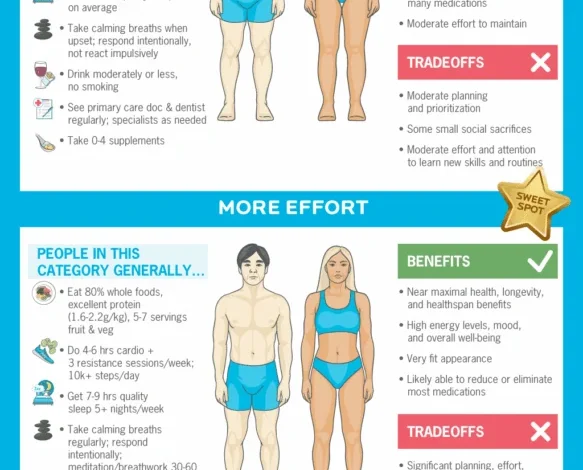
Consider the contrast between a "healthy" individual consistently meeting foundational recommendations and an "optimizer" who maxes out these recommendations and integrates numerous fringe practices. The "optimizer" lifestyle requires an estimated three to four times the time, effort, and financial investment. This includes extensive weekly commitments to specialized exercise, highly restrictive diets, elaborate self-care rituals, and a host of less frequent but costly assessments and therapies (e.g., advanced blood tests, genetic sequencing, specialized IV therapies, cryotherapy, hyperbaric chambers). These additional expenditures can easily amount to tens of thousands of dollars annually, often for marginal or unproven benefits beyond what the "healthy" individual achieves. The "healthy" lifestyle, with its medium effort, likely secures at least 80% of desired lifespan, healthspan, and quality of life benefits.

Negative Impact on Well-being and Quality of Life.
Extreme health regimens carry a high risk of burnout, potentially leading to abandonment of even basic healthy habits. More profoundly, an obsessive focus on health and longevity can severely compromise an individual’s ability to live a full, well-rounded, and meaningful life. Other critical dimensions of "deep health"—relational, existential, mental, and emotional well-being—can suffer. This hyper-focus can even mask underlying mental health conditions like disordered eating or orthorexia. True health encompasses not just physical vitality but also the capacity to enjoy life. Pursuing "optimal" at the expense of life satisfaction is a self-defeating endeavor, as enjoyment is intrinsically linked to overall health.
What to Do Next

- Clarify Your Goals: Reflect deeply on the kind of life you truly desire. How does maximizing healthspan and lifespan align with your other core priorities and values?
- Consider the Tradeoffs: Given your aspirations and available resources, what level of effort, time, and financial commitment is realistic and sustainable for you? What are you willing, and unwilling, to compromise?
- Start with the Basics: Review the foundational health behaviors outlined in this article. Honestly assess your current consistency. Prioritize improving these core areas before exploring faddish, "super-optimal" interventions. Even small, consistent improvements yield significant, tangible results.
- Tune Out the Noise: Recognize that external "experts" on podcasts or social media are not the ultimate arbiters of your personal health journey. You possess the agency to decide what is best for your life, making choices that genuinely align with your priorities and enhance your overall well-being.
Your life, your choices. Empower yourself with information and make decisions that truly work for you.
References
Click here to view the information sources referenced in this article. (Note: The original article includes a "Click here to view the information sources referenced in this article." link. In a real journalistic piece, these would be footnoted or listed at the end of the article directly.)