State Budgets Tighten as Medicaid Pressures Mount Following Federal Policy Changes and Slowing Revenue Growth

State fiscal landscapes across the United States are undergoing a significant transition, driven by moderating tax revenues, dwindling pandemic-era financial cushions, and impending federal policy shifts. According to recent data compiled by the National Association of State Budget Officers (NASBO) and health policy research organizations, states are confronting difficult budgetary trade-offs that threaten to reshape healthcare programs, public education, and essential social infrastructure.
At the center of these fiscal deliberations is Medicaid, the foundational health and long-term care program that currently provides comprehensive coverage to one in five Americans. Jointly funded by state and federal governments through an open-ended federal matching structure, Medicaid represents a massive fiscal footprint for local and state governments. On average, the federal government covers approximately two-thirds of total Medicaid costs, while states finance the remaining third, with matching rates varying by jurisdiction. Because states possess administrative flexibility within broad federal guidelines, eligibility criteria, covered benefits, and provider reimbursement rates differ widely from state to state.
The Macroeconomic Shift: From Pandemic Surpluses to Fiscal Tightening
The current fiscal friction marks a sharp departure from the immediate post-pandemic era, during which states enjoyed record-breaking revenue surges fueled by federal stimulus dollars, wage growth, and capital gains booms. These windfalls allowed states to accumulate unprecedented cash reserves, including robust rainy day funds that served as financial shock absorbers against economic volatility.
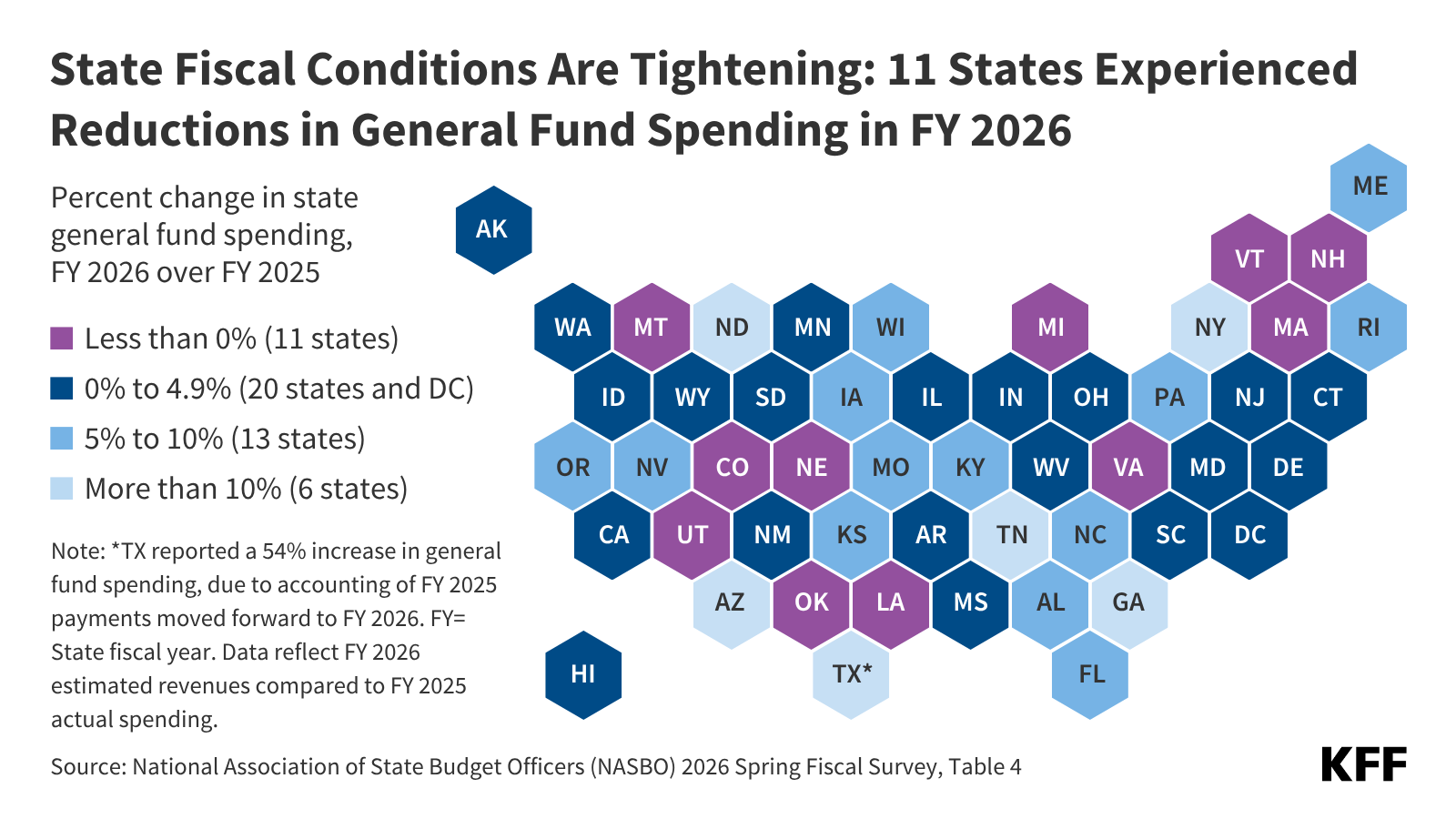
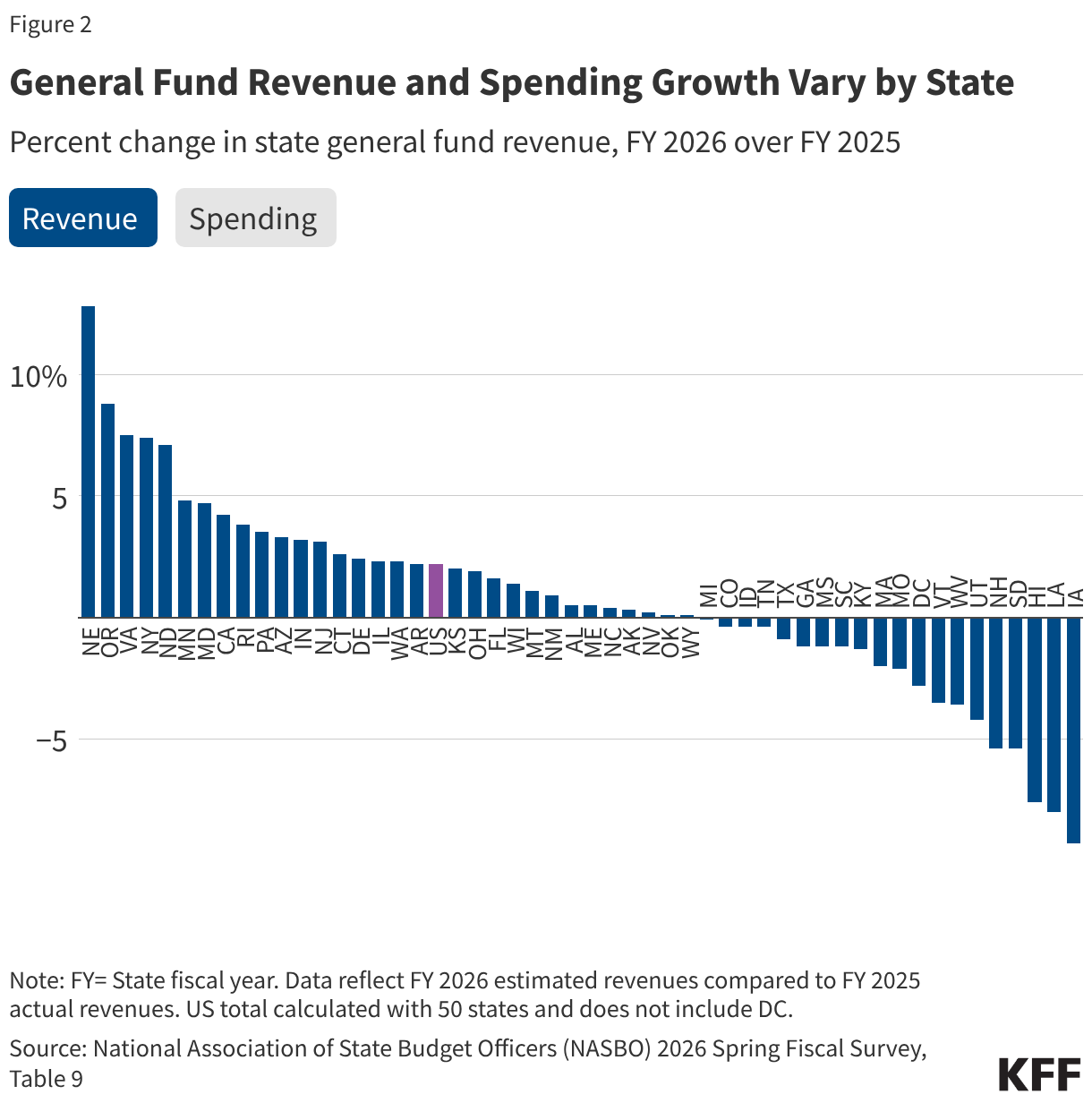
However, this era of abundance has steadily cooled. A combination of intentional state tax cuts—particularly reductions in personal and corporate income tax rates—alongside persistent inflationary pressures, volatile stock market activity, and shifting consumer spending patterns, has dampened revenue growth. By fiscal year (FY) 2026, estimated total state revenue growth had decelerated to roughly 2%, down significantly from the 5% growth recorded in FY 2025. National revenue projections for FY 2027 point toward continued sluggish growth in the range of 2% to 3%.
Expenditure trends have mirrored this revenue slowdown. Bound by constitutional or statutory balanced-budget requirements, state lawmakers have reined in general fund spending growth. After reaching a peak growth rate of 14% in FY 2022, general fund spending increases moderated steadily through FY 2026, landing at an estimated 8% growth rate, with newly enacted FY 2027 budgets averaging a restrained 2% to 3% expansion. Rather than committing to new programmatic initiatives or expanding long-term service arrays, state legislatures have increasingly pivoted toward preserving core operational services and deploying one-time budget maneuvers to maintain balance.
Disparities Across State Borders: Revenue Declines and Spending Cuts
National averages obscure a growing divergence in fiscal health among individual states. In FY 2026, revenue collections actually contracted in 20 states, highlighting deep regional and structural economic variances. While 30 states experienced modest revenue growth between 0% and 10%, and only one state registered growth exceeding 10%, the widespread deceleration has left little room for error.
General fund revenues rely heavily on personal income, corporate income, and sales taxes, leaving states vulnerable to policy shifts in tax code structures. While personal income tax collections provided a resilient anchor for revenues in recent years, newly enacted rate cuts in multiple states threaten to compress future inflows.
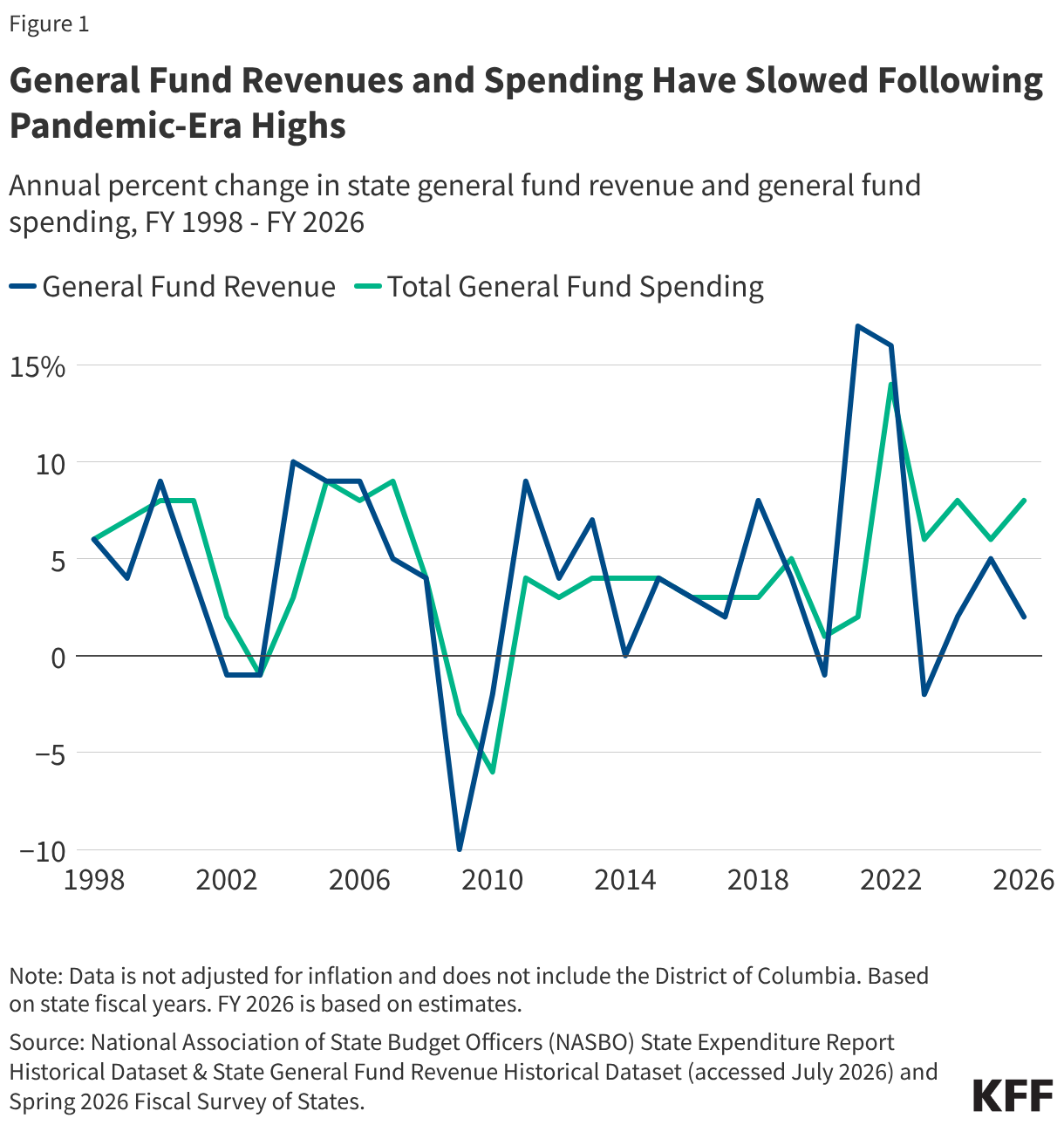
The strain has also manifested directly in state spending adjustments. Eleven states enacted outright reductions in general fund spending for FY 2026—a notable contraction given that inflationary pressures inherently drive up the baseline cost of government operations. Furthermore, five states were forced to execute mid-year budget cuts during FY 2026 to avert structural deficits, representing the highest frequency of mid-year adjustments since FY 2021. Enacted budgets for FY 2027 reveal an even heavier reliance on formal cost-containment measures and spending rollbacks.
The Role and Vulnerability of Rainy Day Funds
As operational revenues have slowed, states have increasingly turned to accumulated reserves to balance their ledgers. Pandemic-era surpluses allowed states to build rainy day fund balances to historic highs. However, these reserves have begun to recede as states draw down balances to finance one-time expenditures and plug recurring budget gaps.
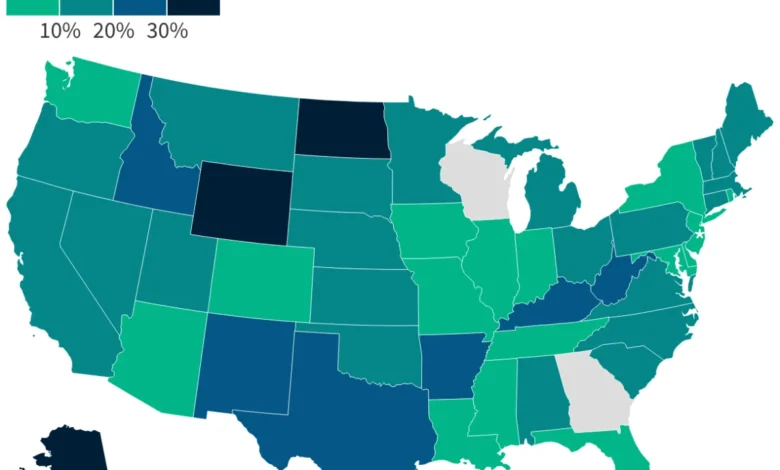
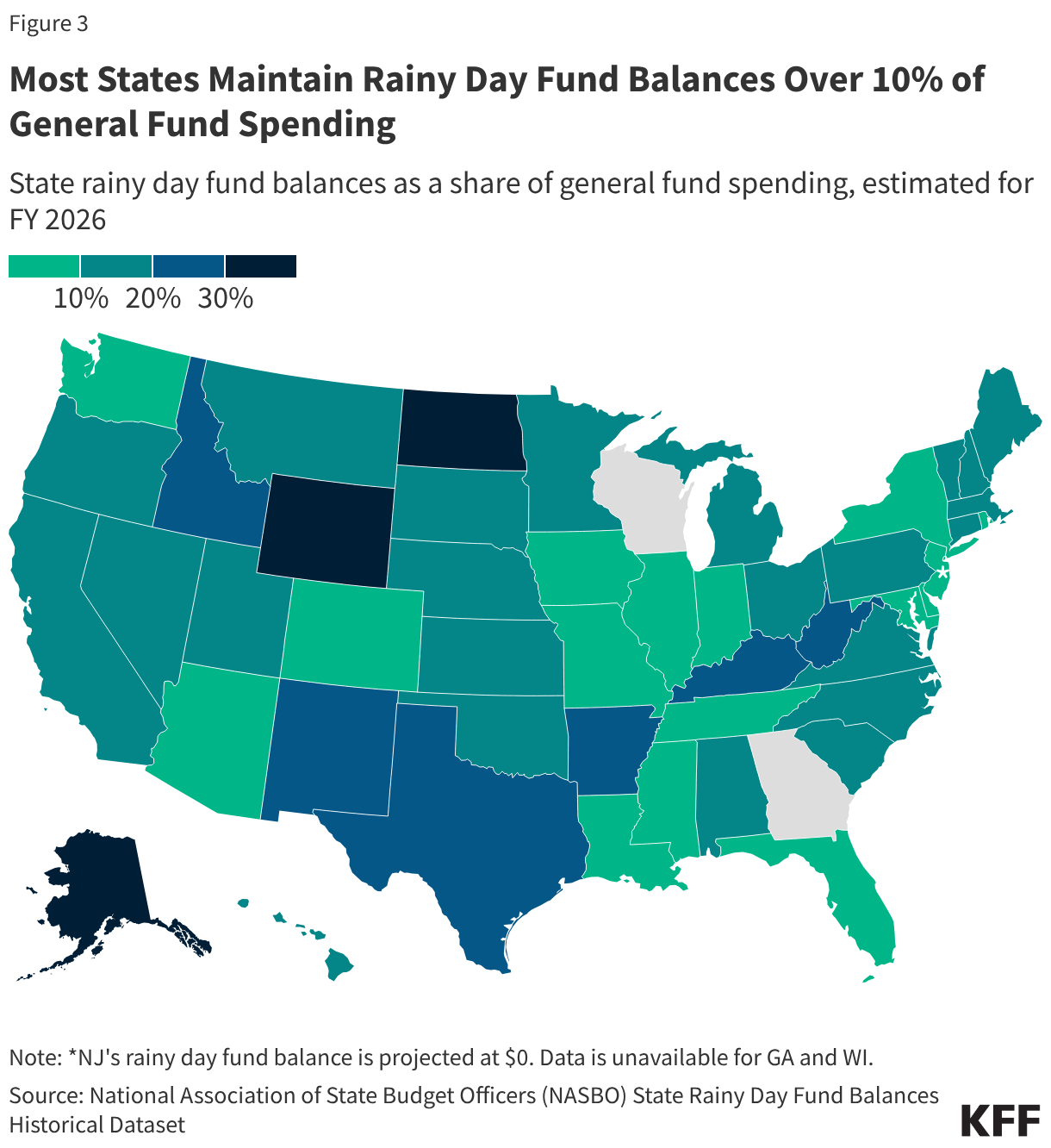
By FY 2026, rainy day fund balances remained relatively elevated across most states, yet they fell noticeably from their pandemic-era peaks. The distribution remains highly uneven: 17 states maintain rainy day reserves totaling less than 10% of their general fund spending, while three states report reserves exceeding 30%. General fund ending balances and total available liquidity have similarly trended downward, diminishing the capacity of states to rely on accumulated savings to weather future economic downturns. Although most states have expressed intent to maintain or marginally rebuild these funds in FY 2027, the depletion of prior-year surpluses signals a tightening financial runway.
Medicaid as a Budgetary Anchor and Vulnerability
For state budget directors, Medicaid occupies a uniquely dual role. It is simultaneously the largest expenditure item in state budgets and the single largest source of federal revenue flowing into state treasuries. NASBO data indicates that in FY 2025, Medicaid accounted for 31% of total state spending across all budget items. While it represented just 17% of expenditures derived from purely state-generated funds (such as general funds and dedicated state revenues), it accounted for a staggering 57% of all expenditures supported by federal funds.
This heavy reliance on federal matching dollars makes Medicaid exceptionally sensitive to federal policy developments. State fiscal stability is now directly threatened by the implementation of the 2025 federal reconciliation law, which introduced substantial policy overhauls alongside significant cuts to federal Medicaid and Supplemental Nutrition Assistance Program (SNAP) funding.
The reconciliation law’s impact is expected to vary widely depending on whether a state adopted Medicaid expansion under the Affordable Care Act and how heavily a state relies on alternative financing mechanisms, such as provider taxes and state-directed payments for hospital systems. Furthermore, complying with new federal mandates and structural adjustments requires complex, costly administrative and technological overhauls for state health agencies.
Policy Dilemmas and the Outlook for Medicaid Reductions
Faced with shrinking federal support, plateauing state revenues, and rising baseline costs in education, public infrastructure, corrections, and employee health benefits, state policymakers face difficult policy choices. Because raising broad-based taxes during an economic slowdown is politically difficult and economically fraught, states have limited options for absorbing federal funding cuts.
Consequently, policy analysts and fiscal watchdogs warn that states may increasingly resort to restricting Medicaid programs to achieve required budget balance. Potential containment strategies include tightening financial or procedural eligibility standards, narrowing covered health benefits, and lowering reimbursement rates paid to healthcare providers. A small number of states already implemented or proposed targeted Medicaid spending restrictions for FY 2025 and FY 2026, and these restrictive measures are widely expected to accelerate as the provisions of the 2025 federal reconciliation law take full effect.
Compounding these fiscal challenges are upcoming political transitions. With gubernatorial elections taking place in 37 states—including 19 races where the incumbent is not seeking re-election—new executive administrations will take office with distinct policy priorities, administrative approaches, and budgetary philosophies. How these incoming leadership teams navigate the collision between slowing revenues, constrained rainy day reserves, and federal healthcare cuts will define the operational health and social safety net landscape for years to come.