Navigating Care: Examining the Vital Role and Growing Oversight of Medicaid’s Non-Emergency Medical Transportation Benefit

For millions of low-income Americans, individuals with disabilities, and rural residents, the physical journey to a doctor’s office, pharmacy, or dialysis clinic is just as critical to their health outcomes as the medical care they receive once they arrive. To bridge this gap, state Medicaid programs across the United States utilize a vital yet often under-discussed resource known as the non-emergency medical transportation (NEMT) benefit. While it accounts for less than one percent of total federal and state Medicaid spending, NEMT serves as an indispensable lifeline for enrollees who lack reliable, affordable personal vehicles or adequate public transit options.
However, the benefit currently finds itself at a significant crossroads. As federal regulators and congressional committees intensify their scrutiny of program integrity and fraud prevention, state administrators face mounting administrative pressures. Balancing the imperative to safeguard taxpayer dollars against the risk of restricting access for vulnerable populations has ignited a complex policy debate over the future of how health care transit is delivered, monitored, and funded.
Structure, Administration, and Federal Guidelines
Under federal regulations, state Medicaid programs are universally required to provide NEMT services to eligible beneficiaries who would otherwise be unable to secure transport to covered medical appointments. Despite this federal mandate, individual states retain broad discretion regarding how they structure, manage, and finance these transportation networks.
States typically choose from three primary delivery models to administer their NEMT programs:
- Fee-For-Service (FFS): State agencies pay transportation providers directly for each trip rendered. While this model grants states the highest degree of direct operational control—facilitating coordination with non-Medicaid state transit programs—it can require intensive administrative oversight.
- Managed Care Models: States contract with managed care organizations (MCOs), paying them a set per-member-per-month rate to coordinate all health benefits, including transportation. This approach offers predictable budgeting and integrates transit smoothly with comprehensive medical care.
- Brokerage Models: States contract with specialized third-party entities—known as brokers—to manage the entire transportation network, utilizing specialized expertise to vet providers, schedule rides, and control utilization costs.
Data from 2024 highlights the diversity of these administrative choices across the country. Approximately 19 states utilized the FFS delivery model, 12 relied on managed care arrangements, and 30 employed a brokerage model in at least some capacity. Furthermore, states must decide how to claim federal matching funds for these expenditures. Expenses can be categorized either as medical service costs or administrative costs, with each path carrying distinct federal matching rates and regulatory requirements. In 2024, 32 states claimed NEMT exclusively as medical expenses, 3 utilized administrative classifications, and 16 split their claims across both categories.
Financial Growth and Utilization Trends
The financial footprint of NEMT, while modest relative to the broader multi-hundred-billion-dollar Medicaid program, has experienced steady expansion over recent years. According to federal expenditure data, national Medicaid spending on NEMT reached $4.65 billion by 2024.
This upward trajectory represents a rebound from the unprecedented disruptions of the COVID-19 pandemic. In 2020, widespread healthcare utilization drops—driven by lockdowns, fears of viral transmission, and postponed elective or routine procedures—caused a sharp contraction in NEMT spending and trip volumes. As healthcare systems normalized through 2021 and subsequent years, NEMT utilization rebounded sharply alongside a growing overall Medicaid enrollment population.
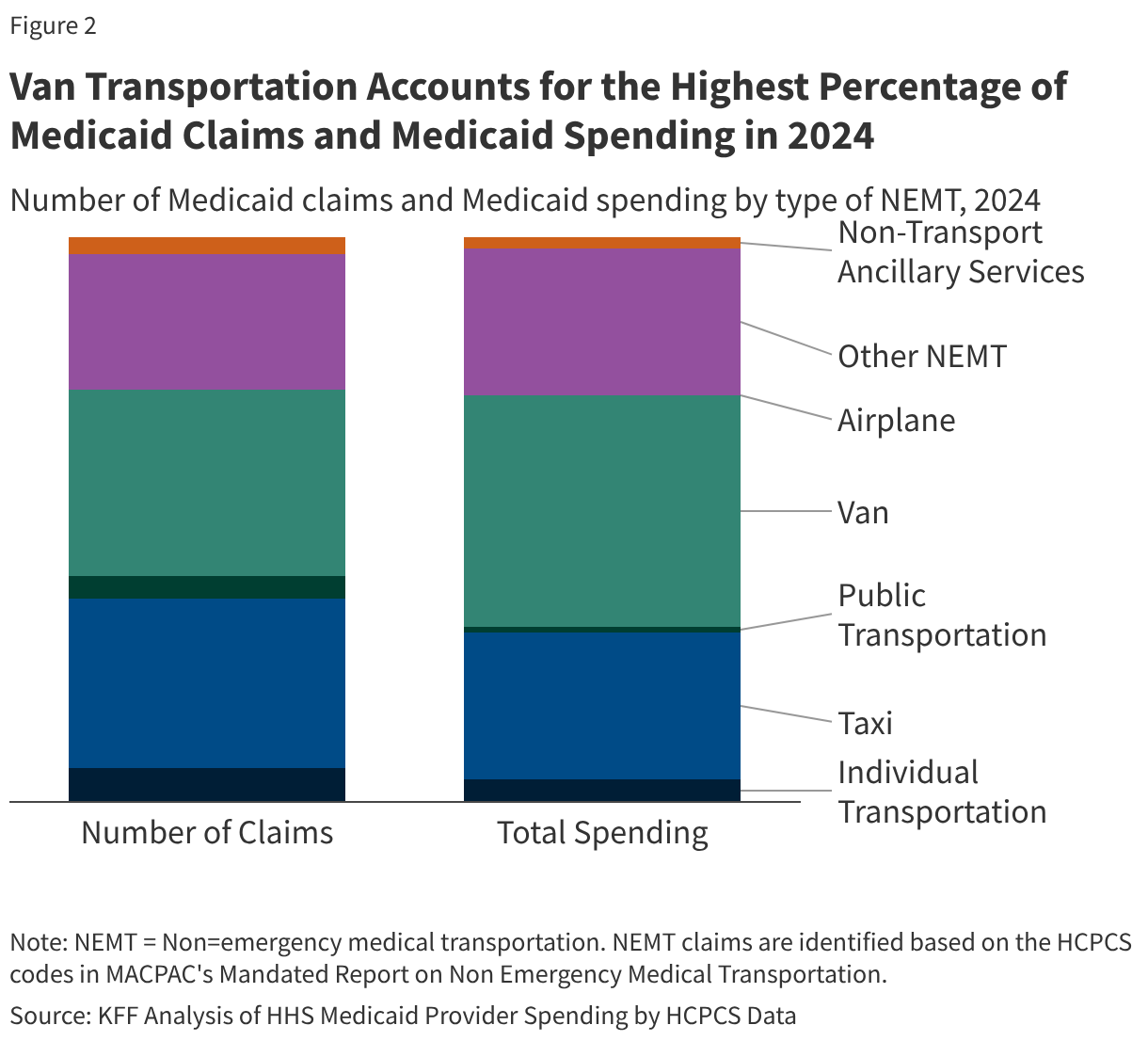
A granular look at service types reveals that van and taxi services dominate the utilization landscape. In 2024, specialized vans and taxis accounted for roughly 67 percent of total NEMT spending and 63 percent of overall utilization. Meanwhile, a broad category encompassing case workers, patient attendants, escorts, and daily travel stipends represented 26 percent of spending and 24 percent of utilization. Remaining options—including individual personal vehicle mileage reimbursements, public transit buses, commercial air travel, and ancillary non-transportation services—collectively comprised less than 10 percent of expenditures.
Demographic Realities: Who Relies on NEMT?
An analysis of 2024 Transformed Medicaid Statistical Information System (T-MSIS) claims data underscores that NEMT users are a highly distinct subset of the broader Medicaid population, characterized by significantly higher medical and support needs.
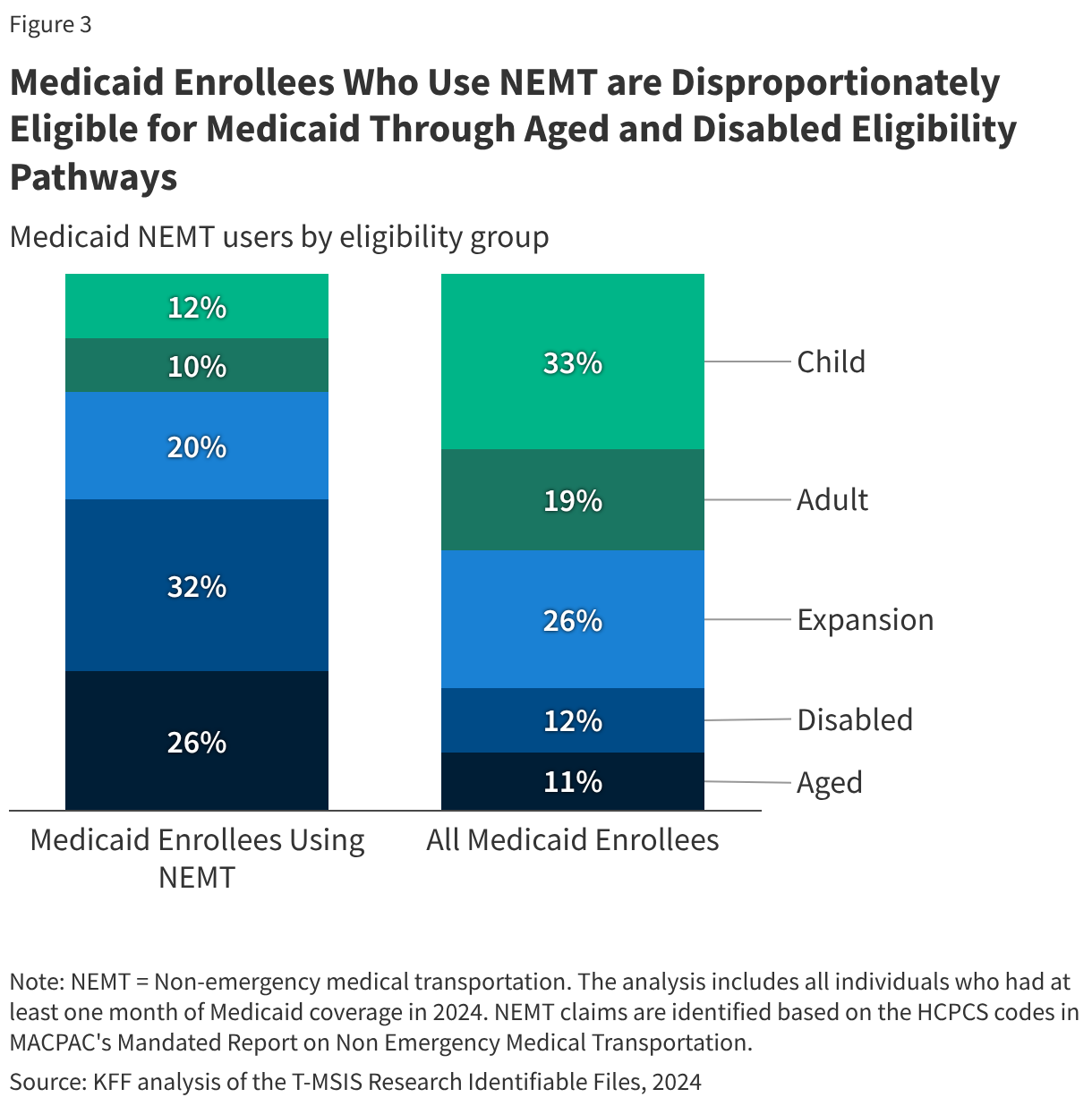
Most notably, individuals who qualify for Medicaid through aged or disabled pathways are vastly overrepresented among NEMT users. While seniors and individuals with long-term disabilities make up roughly 23 percent of the total Medicaid population, they account for 58 percent of all NEMT beneficiaries. Conversely, children constitute 33 percent of overall Medicaid enrollees but represent only 12 percent of NEMT users.
The data also highlights a profound overlap with Medicare. More than one in three (39 percent) NEMT users are dually eligible for Medicare and Medicaid, compared to just 14 percent of the general Medicaid population. Because traditional Medicare does not cover non-emergency transit, Medicaid serves as a crucial secondary payer, ensuring that dual-eligible seniors and individuals with disabilities can physically reach specialized medical appointments.
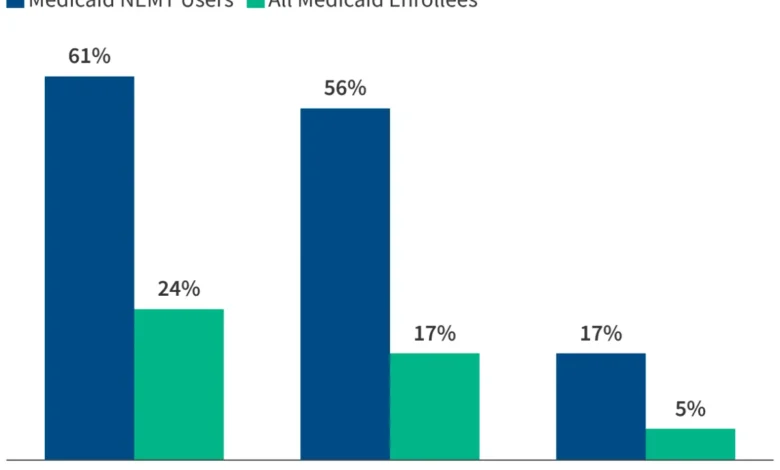
Furthermore, health status heavily influences transit dependency. Nearly 85 percent of Medicaid enrollees utilizing NEMT live with at least one chronic medical condition, compared to roughly 36 percent of Medicaid enrollees overall. Specific breakdowns reveal stark disparities: 61 percent of NEMT users manage physical health conditions (versus 24 percent overall), 56 percent navigate behavioral health conditions (versus 17 percent overall), and 17 percent cope with cognitive health conditions (versus 5 percent overall). Conditions such as end-stage renal disease requiring thrice-weekly dialysis or severe intellectual and developmental disabilities illustrate why uninterrupted, reliable transportation is a matter of clinical necessity rather than mere convenience.
The Rising Tide of Program Integrity and Oversight
Even as utilization data underscores the essential nature of the benefit, NEMT has increasingly drawn the attention of federal regulators and lawmakers concerned with program integrity, waste, and fraudulent billing practices.
The Centers for Medicare & Medicaid Services (CMS) has classified NEMT as a "high-risk" service, issuing targeted advisory letters to state programs in jurisdictions such as California, New York, and Minnesota. This federal posture has cascaded into legislative action. In September 2026, majority staff members of the House Energy and Commerce Committee released a comprehensive report identifying NEMT as a service category susceptible to elevated rates of fraudulent activity.
Simultaneously, House Republicans introduced a comprehensive package of program integrity bills aimed at tightening oversight across multiple safety-net programs. Among these measures, the Strengthening Tools for Oversight to Prevent (STOP) Medicaid Fraud Act proposes extending electronic visit verification (EVV) mandates directly to NEMT trips. Modeled after existing EVV requirements that utilize mobile and computer-based tracking systems for personal care and home health services, the proposed mandate would require real-time electronic confirmation of trip dispatch, arrival, and completion.
Policy Implications: Balancing Fraud Detection and Patient Access
The growing administrative focus on NEMT presents a delicate policy paradox for healthcare analysts, state officials, and advocacy groups. On one hand, enhanced oversight, rigorous provider screening, and advanced verification technologies are viewed as essential tools to protect taxpayer dollars, deter malicious actors, and ensure that public funds directly benefit eligible patients.
On the other hand, healthcare economists and patient advocates warn that overly burdensome administrative requirements could trigger unintended consequences. When states or federal mandates impose complex compliance hurdles, new reporting systems, and stringent credentialing processes on transportation providers, smaller independent operators—such as local taxi companies or non-profit volunteer driver networks—may exit the market. A shrinking pool of participating providers could directly translate into longer wait times, canceled trips, and restricted geographic coverage.
For the millions of vulnerable Americans who already face geographic isolation or severe chronic illness, a compromised transportation network risks compounding existing health disparities. Unmet transportation needs remain a primary driver of missed medical appointments, leading to unmanaged chronic diseases, delayed interventions, and preventable emergency room visits. As federal legislators advance new integrity packages and states refine their delivery models, policymakers face the enduring challenge of designing oversight mechanisms robust enough to eliminate fraud without erecting impassable barriers on the road to care.
Related posts: