Beyond the Numbers: How Dr. Gabrielle Fundaro Pioneered the RPE-Eating Scale to Escape Macro Tracking Exhaustion

For years, Dr. Gabrielle Fundaro stood as a pillar of precision nutrition and strength athletics. Boasting a PhD in Human Nutrition, more than a decade of specialized nutrition coaching experience, and a competitive background that included six powerlifting competitions, she appeared to be the ultimate authority on dietary discipline. Yet, behind the academic credentials and the carefully maintained physique, a private exhaustion was setting in. Like countless fitness enthusiasts and athletes, Dr. Fundaro had relied on meticulous macro tracking—counting proteins, fats, and carbohydrates down to the single gram—to maintain her weight and health. It was a system that delivered predictable results for years, until the psychological and emotional toll finally outweighed the physical benefits.
The tipping point arrived when the rigidity of tracking transformed from a useful tool into a psychological burden. Dr. Fundaro found herself trapped in a cycle of dietary hyper-vigilance, unable to enjoy a simple meal out or select a menu item without calculating its nutritional composition in her head. The mere prospect of abandoning her food-tracking app provoked acute anxiety. She was haunted by persistent, high-stakes questions: What if she failed to consume enough protein and suffered muscle atrophy? What if the absence of external monitoring led to unregulated fat gain? Most acutely, she worried about her professional identity. How could she remain a credible expert in human nutrition if she could no longer manage her own intake without digital oversight? Recognizing that traditional dietary paradigms were failing her mental well-being, Dr. Fundaro embarked on a quest to develop an alternative framework—one that could preserve her physical health while restoring personal autonomy and psychological peace.
The Evolution from Fitness Autonomy to Nutritional Mindfulness
To understand the birth of the RPE-Eating scale, one must examine the broader methodological shifts occurring within strength and conditioning over the past several decades. Historically, resistance training relied heavily on rigid, externally dictated prescriptions—prescribed percentages of a one-rep max, fixed sets, and unyielding rep schemes. However, modern exercise science increasingly favors autoregulation, a training philosophy that adjusts workout intensity based on daily readiness.
A cornerstone of this approach is the Rate of Perceived Exertion (RPE) scale, originally conceptualized by Swedish psychologist Gunnar Borg in the 1960s. Initially designed for clinical and physiotherapy settings using a 6-to-20 metric, the scale was later streamlined into a 0-to-10 range by contemporary fitness professionals. In modern powerlifting and general fitness, the RPE scale allows athletes to quantify their physical effort subjectively. For instance, a trainer might instruct an athlete to perform a set at an RPE of 7, indicating that the lifter feels they could have completed roughly three more repetitions before absolute failure. This framework accounts for daily fluctuations in sleep, stress, and nutrition, allowing individuals to train safely and effectively without blindly adhering to a static spreadsheet.
Dr. Fundaro observed remarkable improvements in her own strength training and physiological recovery when she fully integrated RPE-based lifting into her routine. The methodology bridged the gap between structure and intuition, granting her the autonomy to listen to her body while maintaining clear boundaries. This realization served as a major epiphany: if subjective exertion scaling could optimize physical output in the gym, a similar framework could theoretically regulate nutritional intake in the kitchen. Thus, the RPE-Eating scale was conceived, offering a bridge away from rigid digital tracking toward sustainable, self-regulated nourishment.
Deconstructing the RPE-Eating Framework
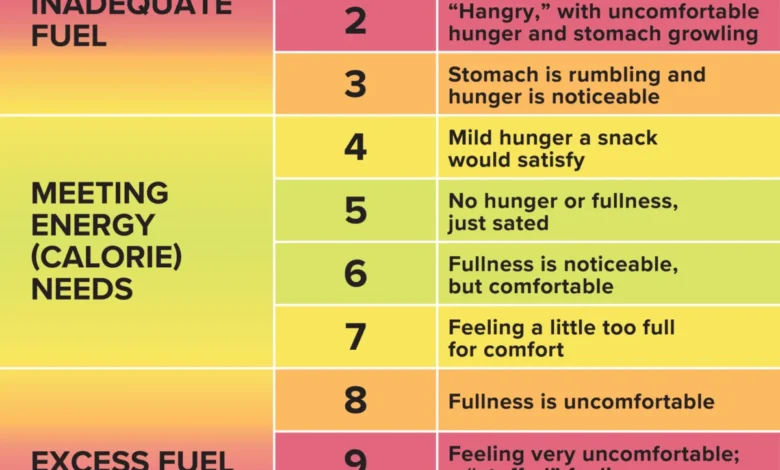
The RPE-Eating scale adapts the familiar 0-to-10 metric of physical exertion and applies it directly to internal hunger, fullness, and satisfaction cues. Rather than measuring how hard a muscle is working against a barbell, the scale evaluates how adequately an individual is being fueled by food.
At the bottom of the spectrum, ratings of 1 to 3 indicate inadequate fuel. A score of 1 represents extreme physiological distress, such as dizziness, lightheadedness, or feeling sick from hunger, while a 3 denotes noticeable stomach rumbling and clear physical emptiness. The middle tier, spanning from 4 to 7, represents the optimal zone of adequate fuel and comfort. A score of 5 reflects a neutral state of satiety with no acute hunger or fullness, whereas a 6 represents a comfortable, noticeable fullness. The upper tier, ranging from 8 to 10, categorizes excess fuel. An 8 indicates a point of discomfort, while a 10 signifies extreme overconsumption resulting in physical sickness.

Implementing this scale requires deliberate practice, particularly for individuals who have spent years overriding their internal signals in favor of external dietary rules. Dr. Fundaro outlines a four-step implementation process designed to gradually rebuild interoceptive awareness—the neurological capacity to perceive internal bodily sensations.
Step One requires practitioners to clarify their fundamental goals. RPE-Eating is explicitly not a rapid weight-loss diet or a rigid control mechanism designed to manipulate body composition. While it can be loosely adapted for weight modification, its primary objective is to cultivate internal trust and emotional resilience around food choices.
Step Two focuses on identifying true physical hunger versus psychological appetite. Physical hunger manifests as somatic cues, such as a hollow sensation or stomach contractions, signaling a genuine biological need for energy. Appetite, conversely, is the learned desire to eat driven by external sensory stimuli, such as the sight or aroma of palatable food, regardless of biological satiation. By recording hunger levels on a 10-point scale before, midway through, and after meals, practitioners gradually recalibrate their internal feedback loops.
Step Three involves mapping non-hunger triggers. Many individuals turn to food as an emotional coping mechanism to navigate stress, anxiety, or boredom. By utilizing behavioral psychology techniques such as "notice and name," practitioners learn to identify the emotional catalysts behind compulsive eating, ultimately developing a broader toolkit of non-food self-soothing behaviors, such as brief walks or intentional breathing exercises.
Step Four emphasizes the critical balance between satiety and satisfaction. True dietary sustainability requires meals to fulfill both physical calorie requirements and psychological pleasure. Restricting beloved foods entirely often triggers a pendulum swing toward binge eating; therefore, incorporating favorite foods mindfully within the RPE framework ensures long-term behavioral adherence.
Implications, Skepticism, and Broader Industry Impact
Unsurprisingly, the introduction of an intuition-based nutritional model has invited skepticism from traditionalists who argue that feelings are an inadequate substitute for hard data. Critics often contend that subjective scales lack the precision required for advanced physique management. However, proponents draw parallels to the early resistance against RPE-based training, which was initially dismissed by purists before clinical research validated autoregulation as a reliable and effective training methodology.
From a physiological perspective, RPE-Eating trains interoceptive pathways in a manner analogous to how lifting mechanics signal proximity to muscular failure. Just as a decelerating barbell indicates approaching fatigue, a waning stomach rumble signals impending satiation. While the method introduces a higher degree of initial cognitive labor—requiring practitioners to pause, reflect, and evaluate internal states—it offers a vital off-ramp for individuals trapped in the compulsive cycle of long-term macro tracking.
Public health analysts and behavioral nutritionists note that while macro tracking remains a valuable educational tool for beginners, its perpetual application can increase vulnerability to disordered eating patterns, body dissatisfaction, and weight cycling. By offering a structural safety net that avoids the psychological pitfalls of digital calorie counting, the RPE-Eating scale represents a significant evolution in non-restrictive nutritional coaching. Dr. Fundaro’s pioneering framework underscores a growing paradigm shift within the wellness industry: the ultimate goal of nutrition education is not lifelong digital surveillance, but the quiet, enduring confidence of trusting one’s own body.