Global COVID-19 Data and Policy Tracker Reaches Final Chapter as International Reporting Frameworks Wind Down

The landscape of global pandemic monitoring has undergone a significant transformation following the official conclusion of several primary data-tracking initiatives that guided international public health policy for years. For the past several years, public health officials, researchers, and policymakers relied heavily on aggregated digital dashboards to understand the transmission dynamics of SARS-CoV-2. These platforms synthesized millions of data points concerning infection rates, mortality statistics, and governmental interventions across diverse geopolitical landscapes. However, with the formal cessation of primary tracking mechanisms—most notably the discontinuation of active governmental response monitoring by foundational data providers—the international community is shifting from acute pandemic surveillance to long-term epidemiological monitoring and retrospective analysis.
The architecture of global pandemic tracking was built upon a complex coalition of academic institutions, international bodies, and public health agencies. Throughout the public health emergency, platforms such as the Johns Hopkins University (JHU) Coronavirus Resource Center and the World Health Organization’s (WHO) Coronavirus Dashboard served as the primary lenses through which the world viewed the spread of the virus. These resources bridged critical information gaps during the initial waves of the outbreak, offering standardized metrics that allowed comparison across different income levels, geographic regions, and national healthcare infrastructures.
The transition of these responsibilities marks a watershed moment in the management of global health data. While historical datasets remain accessible for academic research, long-term epidemiological studies, and retrospective policy evaluation, real-time tracking of non-pharmaceutical interventions has largely concluded. This shift reflects a broader global transition away from emergency-phase containment strategies toward endemic disease management, wherein viral surveillance is increasingly integrated into routine respiratory illness monitoring systems, much like seasonal influenza frameworks.
Evolution of Data Sources and Methodologies
The collection of global COVID-19 statistics experienced multiple iterations as testing capacities, reporting standards, and institutional mandates evolved. In the early phases of the pandemic, academic institutions stepped forward to fill a critical void in public health informatics. The Johns Hopkins University Coronavirus Resource Center established a benchmark for data aggregation, compiling daily case counts, mortality statistics, and testing metrics from hundreds of national and subnational health departments.

As the pandemic matured and standardized international reporting became more institutionalized, the responsibility for global aggregation shifted. On March 7, 2023, primary tracking responsibilities for confirmed cases and deaths transitioned fully to the World Health Organization’s Coronavirus Dashboard. This transition aligned global reporting with official member-state submissions, ensuring a centralized, standardized repository for international health data. Shortly thereafter, the JHU Coronavirus Resource Center officially concluded its mapping operations on March 10, 2023, leaving behind an invaluable historical archive for researchers studying the trajectory of the outbreak.
To maintain optimal system performance and prevent prolonged load times, major public platforms typically constrained real-time visualization interfaces to the preceding 200 days of data. Nevertheless, comprehensive historical archives remained available to researchers through decentralized repositories, such as dedicated GitHub data branches. Furthermore, institutional data maintainers implemented periodic corrections to ensure statistical accuracy. For instance, updates applied in early 2024 clarified that specific reporting metrics reflected cumulative totals over full weekly periods rather than daily averaged rates across a seven-day window, refining the precision of long-term epidemiological analyses.
Chronology of Institutional Phase-Outs
The gradual wind-down of pandemic tracking infrastructure occurred in distinct phases, reflecting the changing priorities of global public health organizations:
- Early 2023: Primary case and death reporting consolidated under the World Health Organization’s dashboard framework, superseding academic-led aggregation models like the Johns Hopkins Coronavirus Resource Center.
- Late 2022 to 2023: National governments increasingly scaled back mandatory reporting, dismantled emergency task forces, and reduced the frequency of public health updates. Consequently, primary repositories tracking non-pharmaceutical interventions began freezing data inputs.
- March 2024: Institutional data maintainers conducted retroactive data standardizations, ensuring that historical datasets accurately represented weekly totals rather than moving daily averages to preserve analytical integrity for future researchers.
- Post-2024: Active trackers monitoring government policy actions—such as social distancing mandates, economic support packages, and health system adjustments—officially ceased updates as their underlying data sources wound down their tracking operations.
Comprehensive Policy Actions and Government Responses
Beyond tracking infection and mortality rates, understanding the socioeconomic and administrative response to the pandemic required monitoring thousands of distinct policy actions enacted by national governments. These measures were traditionally categorized into three primary domains: social distancing and closure measures, economic support mechanisms, and health systems adjustments.
Social Distancing and Closure Measures
To suppress viral transmission rates, governments deployed an array of non-pharmaceutical interventions. These included legally mandated or recommended stay-at-home requirements, workplace closures, school suspensions, restrictions on public gatherings, and international travel controls.
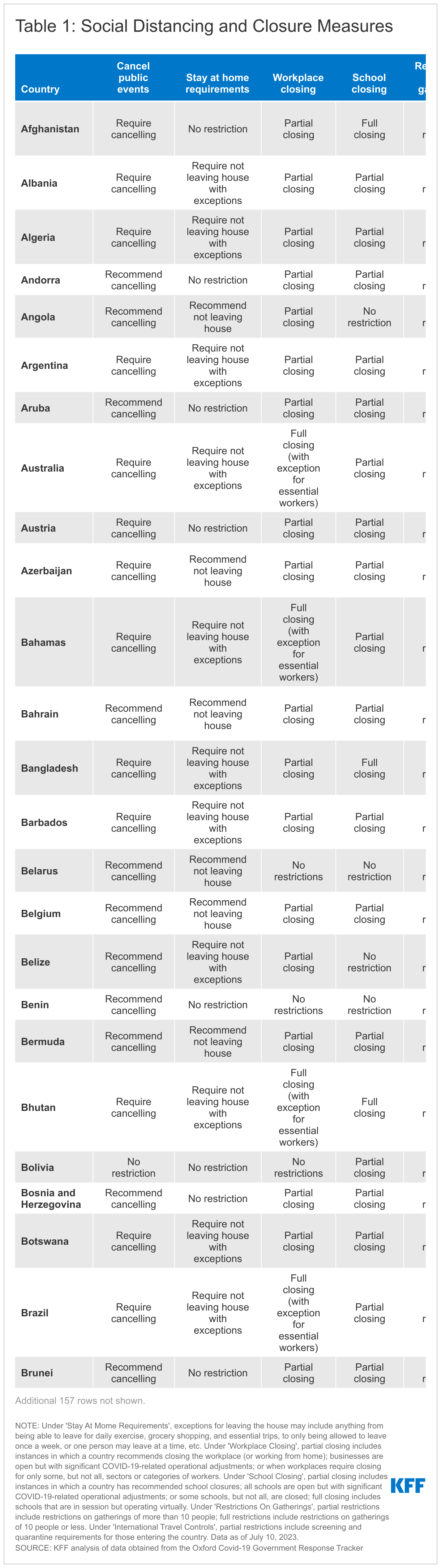
The implementation of these measures varied widely based on local epidemiological conditions and state capacities. For example, workplace closures ranged from total shutdowns of non-essential commerce to partial recommendations for remote work or sector-specific operational adjustments. Similarly, school closures encompassed everything from complete physical shutdowns with mandatory virtual instruction to hybrid models where specific age groups or educational tiers continued in-person learning under modified safety protocols. International travel restrictions similarly evolved from blanket border closures to targeted screening protocols, mandatory quarantine periods, and vaccination verification requirements for arriving travelers.
Economic Measures and Financial Relief
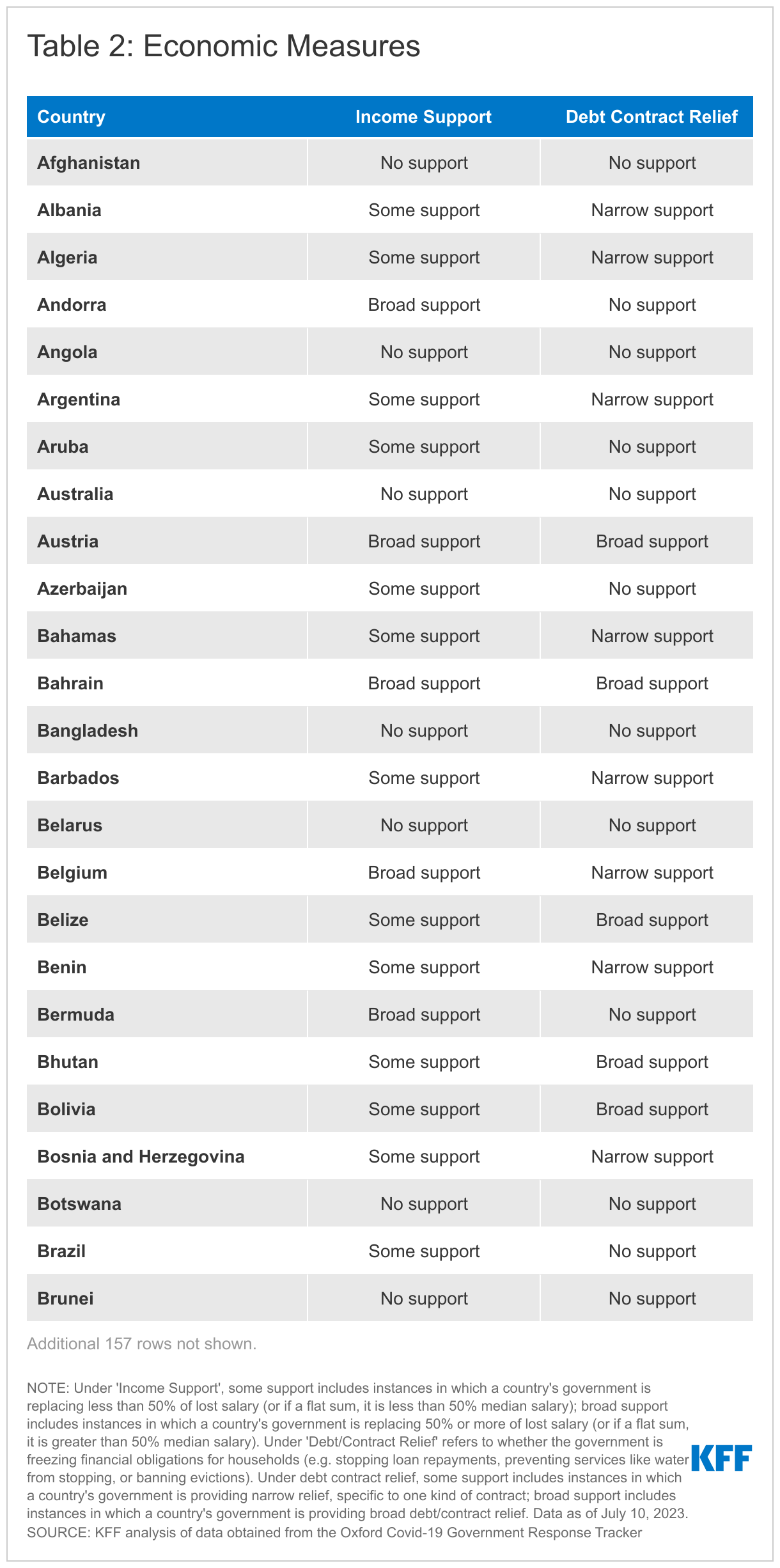
The imposition of widespread public health restrictions placed an unprecedented strain on national economies and individual livelihoods. To mitigate these economic shocks, governments introduced various fiscal intervention frameworks, broadly divided into income support programs and debt or contract relief initiatives.
Income support policies were evaluated based on their generosity and breadth. Narrow support mechanisms typically replaced less than 50 percent of lost salary or provided modest flat-sum payments below the median wage. Conversely, broad support frameworks replaced 50 percent or more of lost income, safeguarding household financial stability during extended lockdowns. Simultaneously, debt and contract relief measures—ranging from mortgage forbearance to commercial lease protections—helped prevent widespread insolvencies across vulnerable economic sectors.
Health Systems Measures
Healthcare infrastructure faced severe disruptions throughout the public health emergency, prompting extraordinary administrative adaptations. Tracking frameworks monitored vaccine eligibility expansions, prioritization schedules, and public health mandates concerning facial coverings.
Vaccine rollout strategies initially prioritized specific demographic and occupational cohorts, including elderly populations, clinically vulnerable individuals, and frontline healthcare workers, before expanding to broader age brackets. Meanwhile, facial covering policies ranged from universal indoor mandates to targeted requirements in high-risk settings or situations where social distancing was unachievable.
The Role of the Oxford Covid-19 Government Response Tracker
A cornerstone of global policy analysis was the Oxford Covid-19 Government Response Tracker (OxCGRT), maintained by the Blavatnik School of Government at the University of Oxford. The OxCGRT systematically collected information on policy measures enacted across more than 180 countries, providing researchers with a standardized coding system to quantify the stringency of government responses over time.
The data compiled by Oxford allowed epidemiologists, economists, and political scientists to evaluate the efficacy of specific containment policies, measure the economic trade-offs of prolonged closures, and assess the correlation between policy stringency and viral transmission rates. However, as governments dismantled emergency structures and transitioned to endemic disease management, the continuous tracking of these specific indicators became untenable. The eventual cessation of active data collection by OxCGRT signaled the natural conclusion of intensive, real-time government response monitoring.
Implications for Future Pandemic Preparedness
The wind-down of specialized COVID-19 policy and case trackers offers crucial lessons for global health security and future pandemic preparedness. The rapid mobilization of academic institutions, international organizations, and open-source data communities demonstrated the immense value of transparent, accessible public health informatics during a global crisis.
At the same time, the experience highlighted structural vulnerabilities in international data harmonization. Discrepancies in testing strategies, reporting frequencies, and diagnostic criteria across national borders frequently complicated comparative epidemiological analyses. Furthermore, the eventual tapering of data collection underscores the challenge of sustaining emergency-grade surveillance infrastructure during long-term public health transitions.
Public health experts emphasize that the datasets compiled over the course of the pandemic will serve as foundational resources for decades. Researchers will continue to utilize these historical archives to model viral evolution, evaluate the socio-economic impacts of non-pharmaceutical interventions, and design improved protocols for future biological threats. As routine surveillance absorbs the responsibilities of emergency-era trackers, the global health community remains focused on building resilient, integrated reporting systems capable of meeting future challenges with both agility and precision.
Related posts: