State Budgets Face Mounting Pressure as Slowing Revenue Growth, Federal Policy Shifts, and Medicaid Costs Threaten Fiscal Stability

State governments across the United States are facing a challenging fiscal environment characterized by decelerating revenue growth, tightening general fund budgets, and the impending pressure of significant federal funding cuts. According to recent data from the National Association of State Budget Officers (NASBO), states are transitioning away from the record-breaking revenue surpluses experienced during the pandemic era into an era defined by hard fiscal choices. At the center of these budgetary pressures is Medicaid, the foundational health care program that provides comprehensive coverage to one in five Americans and accounts for a massive share of state and federal expenditures.
The convergence of slowing state tax collections, inflationary pressures, shifting consumer spending patterns, and the implementation of federal legislation—specifically the 2025 reconciliation law—has left governors and state lawmakers scrambling to balance their ledgers. With Medicaid consuming nearly a third of total state budgets and over half of all federal funds received by states, any shifts in federal support or state-level revenue inevitably ripple through the entire apparatus of public administration, threatening everything from public education and transportation to the long-term viability of health care safety nets.
Understanding the Roots of Current State Budgetary Pressures
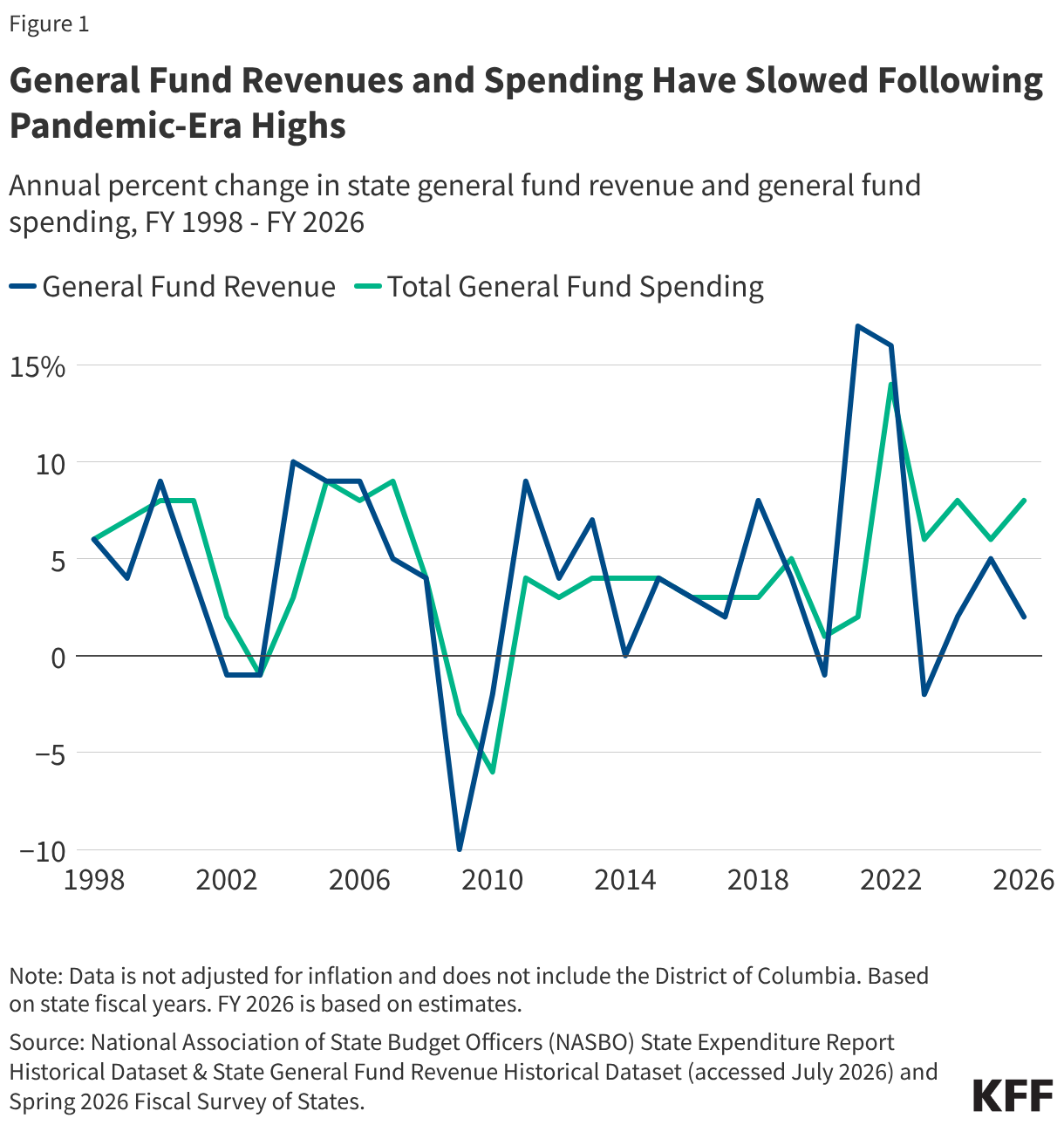
To comprehend the severity of the current fiscal landscape, one must examine the economic trajectory states have traversed since the onset of the COVID-19 pandemic. When the public health crisis initially struck, state economies suffered immediate disruptions, prompting severe initial contraction. However, unprecedented federal stimulus measures, rapid economic reopenings, and a booming stock market catalyzed a historic, albeit brief, period of economic recovery. Between fiscal years 2021 and 2022, state revenue growth reached unprecedented highs, with general fund spending growing by a dramatic 14 percent in FY 2022.
During this windfall, states accumulated massive revenue surpluses. Many jurisdictions transferred these extra funds into rainy day reserves, which subsequently swelled to record highs. Other funds were deployed toward one-time expenditures, infrastructure projects, or temporary tax relief measures. However, this high-water mark proved unsustainable. As federal stimulus funds tapered off, persistent inflation took hold, consumer habits shifted, and stock market volatility increased, state revenue growth began to slow markedly by fiscal year 2023.
Compounding these economic headwinds, numerous state legislatures enacted permanent income tax cuts during the peak surplus years, betting on sustained economic growth that ultimately failed to materialize at the same blistering pace. By fiscal years 2025 and 2026, total revenue growth had dropped to an estimated 2 percent, a sharp contrast to the 5 percent growth seen in FY 2025. Although many states managed to end FY 2026 with revenues slightly above initial conservative projections, collections in a significant number of states actually contracted. Enacted budgets for fiscal year 2027 reflect a continuation of this sluggish trajectory, with projected revenue growth hovering between a modest 2 and 3 percent.
General Fund Spending Trends and National Disparities
Because state constitutions and statutes almost universally mandate balanced budgets, state spending trends closely mirror revenue performance. As revenue growth moderated from FY 2023 through FY 2026, spending growth slowed in tandem. Estimated total general fund spending growth sat at 8 percent in FY 2026, while FY 2027 enacted budgets project spending growth of just 2 to 3 percent. Rather than expanding public services, launching new initiatives, or adding permanent staff, contemporary state budget discussions are laser-focused on maintaining core governmental operations and executing precise spending adjustments to preserve structural balance.
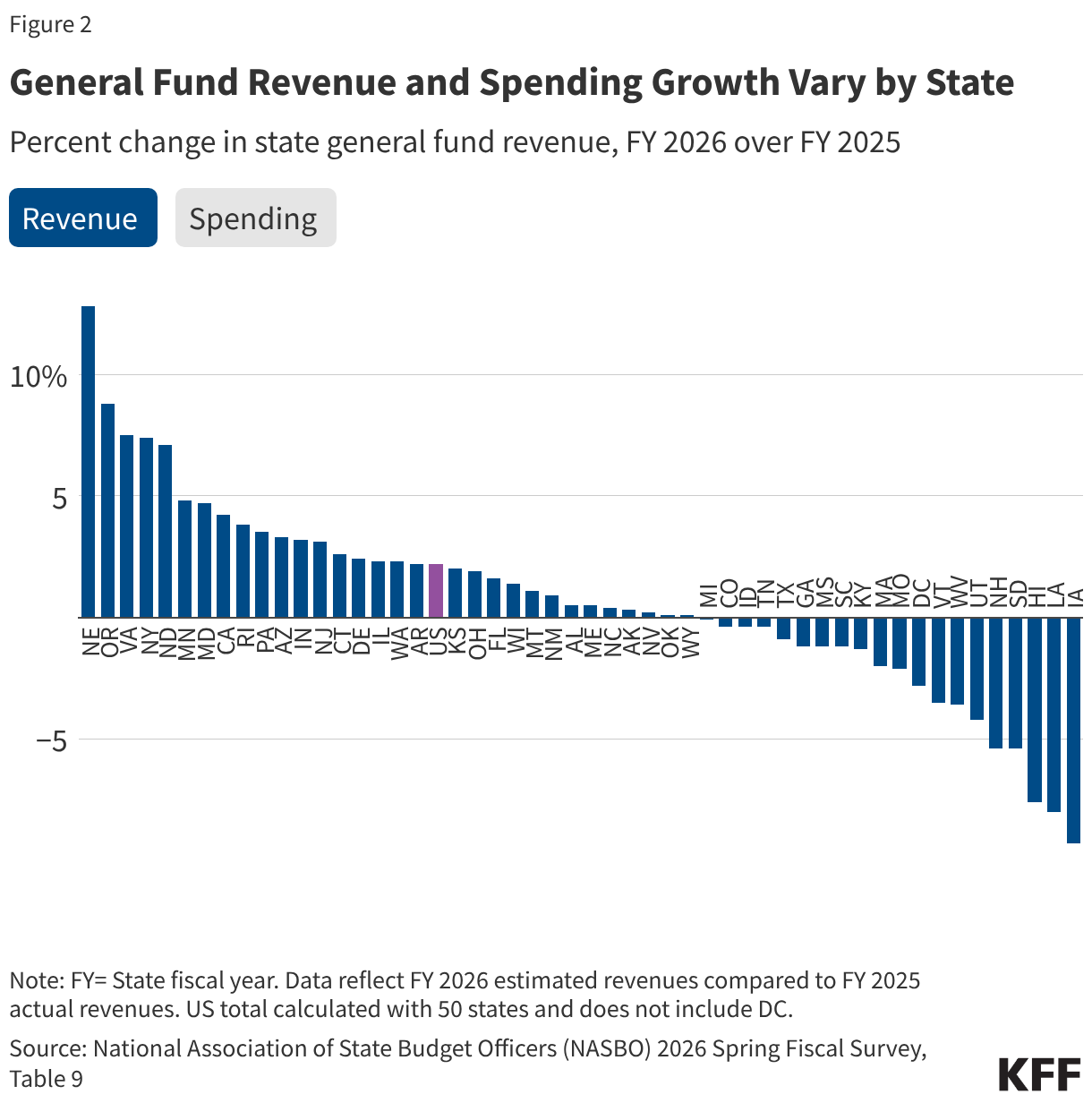
However, national averages obscure a stark divergence in fiscal health among individual states. Fiscal conditions vary wildly across the country, influenced by regional economic drivers, tax structures, and policy choices. In fiscal year 2026 alone, 20 states experienced outright revenue declines. While 30 states managed modest revenue increases ranging between 0 and 10 percent, and only one state saw growth exceeding 10 percent, the broader trend points toward stagnation. State general funds rely heavily on a combination of personal income taxes, corporate income taxes, and sales taxes. States heavily dependent on personal income taxes enjoyed strong collections during the capital gains peaks of recent years, but rate cuts implemented in several jurisdictions have begun to undercut those revenue streams.
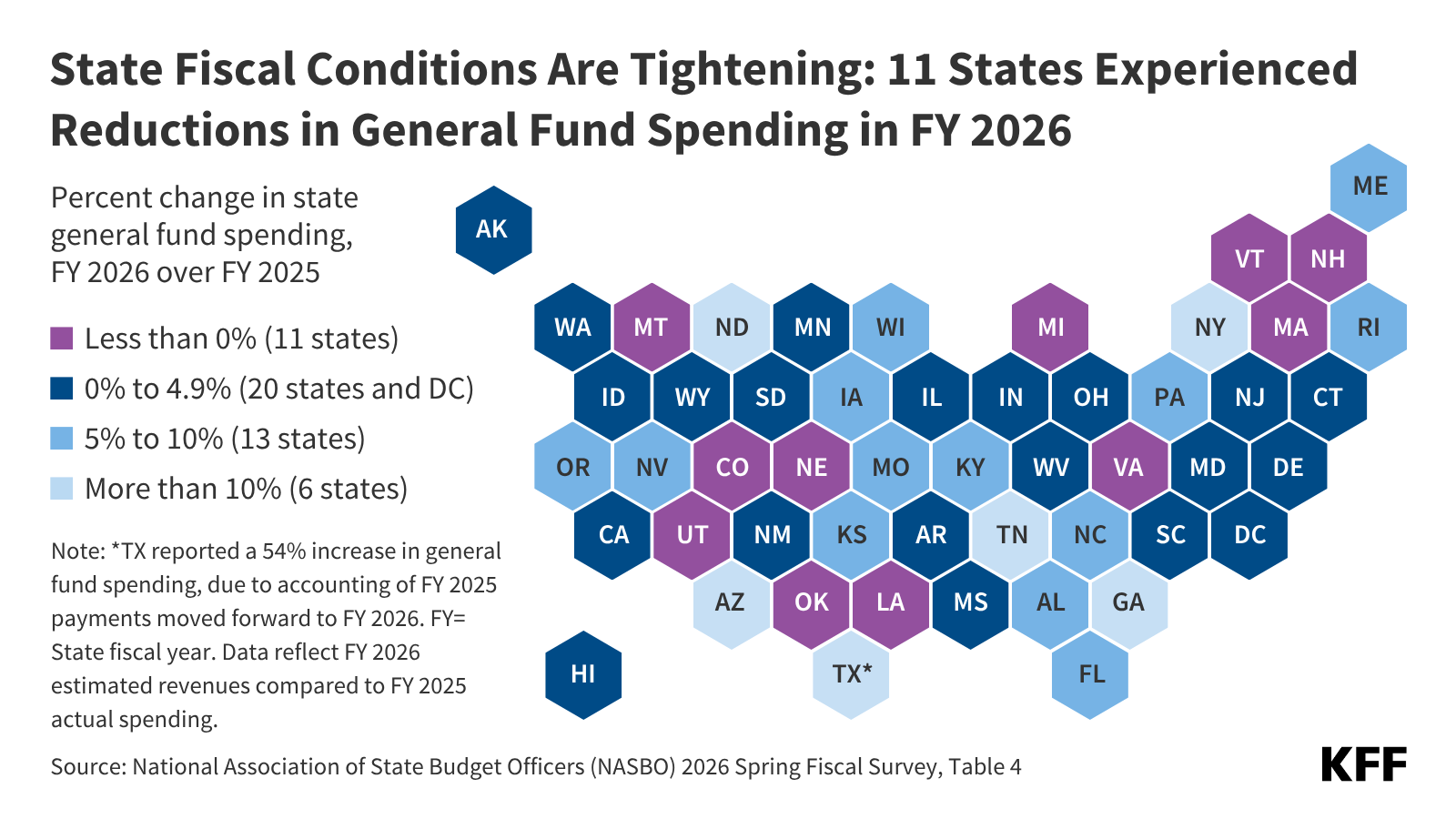
The spending side of the ledger reveals a similar story of fiscal distress. In FY 2026, 11 states enacted outright reductions in general fund spending—a notable development given that state expenditures must normally rise simply to keep pace with inflation and demographic shifts. To avoid catastrophic shortfalls, five states were forced to implement painful mid-year budget cuts during FY 2026, representing the highest frequency of mid-year corrections since the fiscal fallout of 2021. Meanwhile, 34 states maintained modest spending growth below 10 percent, and six states exceeded 10 percent growth. Enacted budgets for FY 2027 reflect an even greater reliance on defensive budgeting strategies, including aggressive cost containment and spending reductions designed to right-size state government.
Rainy Day Funds Provide a Diminishing Cushion
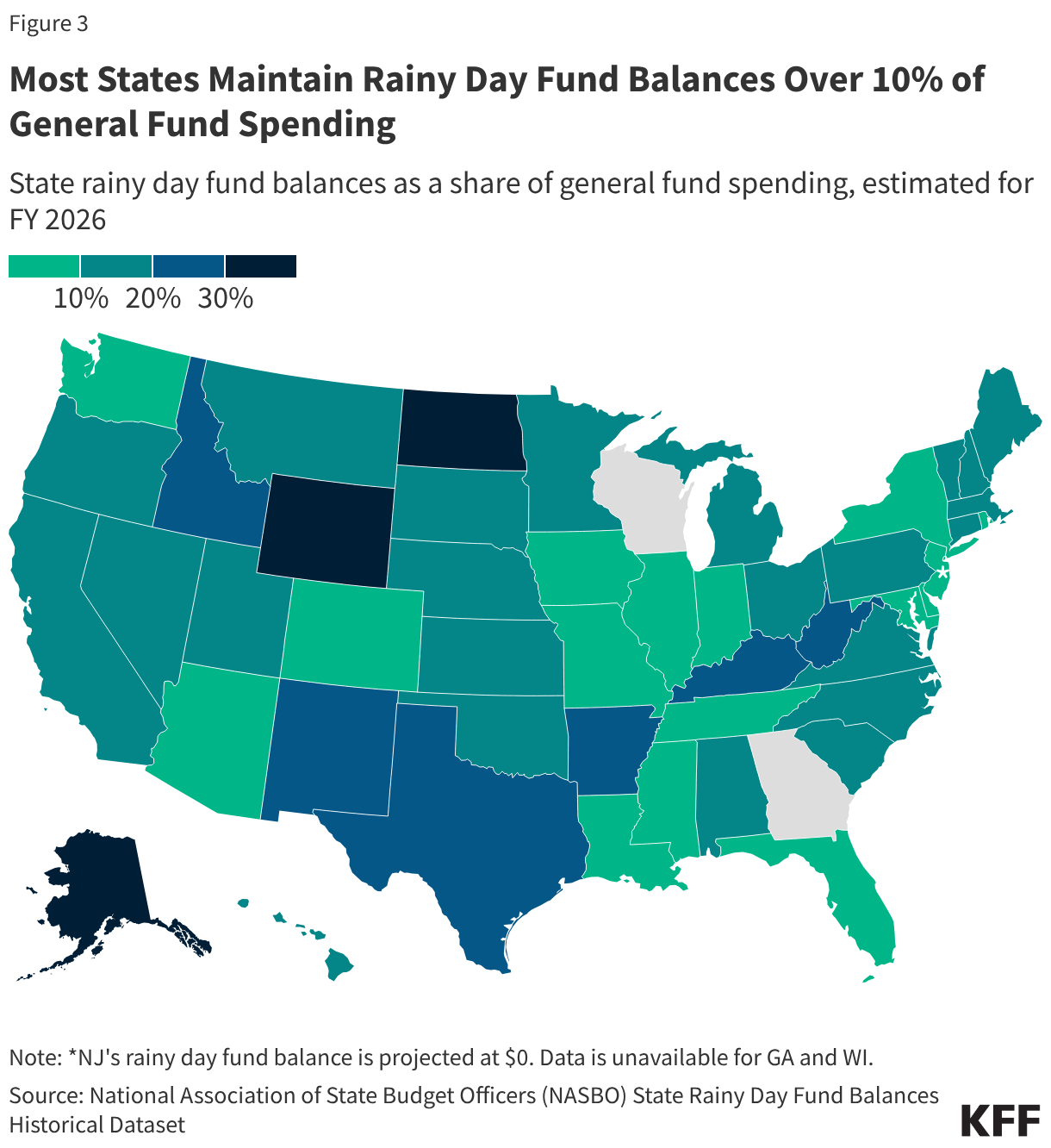
The primary cushion shielding states from immediate fiscal catastrophe has been their rainy day fund balances. Accumulated during the federal stimulus era, these reserves reached historic peaks, providing a vital buffer as tax collections slowed. However, as revenues flattened, states increasingly tapped these savings accounts to finance ongoing operations or balance their budgets through temporary maneuvers.
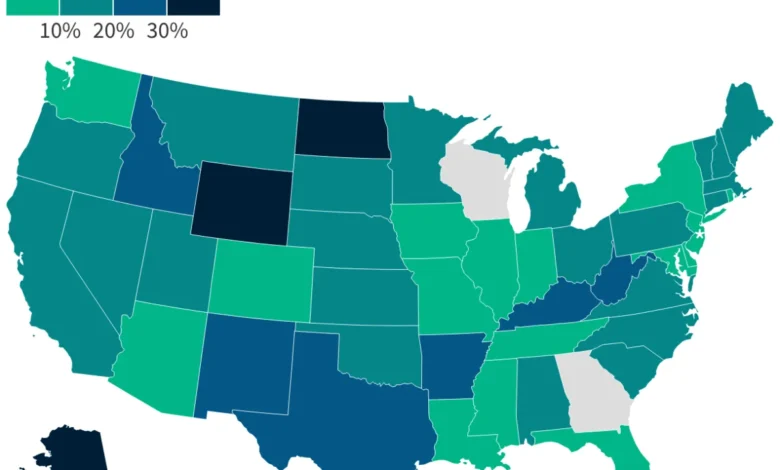
By fiscal year 2026, while rainy day balances remained elevated compared to pre-pandemic baselines, they had fallen noticeably from their historical peaks. The distribution of these reserves is highly uneven: 17 states maintain rainy day funds totaling less than 10 percent of their general fund spending, whereas only three states boast reserves exceeding 30 percent. Total general fund ending balances have likewise declined, severely limiting the capacity of state treasuries to rely on accumulated savings moving forward. Although NASBO surveys indicate that most states intend to maintain or modestly increase their rainy day allocations in FY 2027, the depletion of prior-year surpluses means states will have far less financial flexibility if economic conditions deteriorate further.
The Crucial Role of Medicaid in State Finances
Amid these broader budgetary trends, Medicaid occupies a uniquely monumental position. As the single largest provider of health insurance and long-term care in the United States, Medicaid covers roughly one in five Americans and accounts for nearly $1 out of every $5 spent nationally on health care.
The program is jointly financed by states and the federal government through an open-ended matching structure. The federal government typically covers roughly two-thirds of total Medicaid costs through the Federal Medical Assistance Percentage (FMAP), with individual states covering the remaining third, though this matching rate varies by state. Crucially, while federal rules dictate broad parameters, states retain substantial administrative flexibility regarding eligibility criteria, covered benefits, and provider reimbursement rates. They also utilize diverse financing mechanisms—such as provider taxes and state-directed payments—to fund their share of the program.
For state budget directors, Medicaid is a double-edged sword. On one hand, it represents the single largest expenditure item in state budgets, accounting for 31 percent of total state spending across all budget items in FY 2025, according to NASBO data. On the other hand, it serves as the largest source of federal revenue flowing into state treasuries. While Medicaid represented only 17 percent of expenditures drawn directly from state funds (such as general funds), it accounted for a staggering 57 percent of all expenditures financed by federal funds. This dynamic means that any federal policy change altering Medicaid funding streams or matching rates has an immediate, disproportionate impact on overall state fiscal health.
Policy Shifts, Economic Uncertainty, and the 2025 Reconciliation Law
Looking ahead to fiscal year 2027 and beyond, state policymakers face an exceptionally complex array of macroeconomic and political uncertainties. The political landscape is poised for potential shifts following the 2026 midterm elections. With 37 states holding gubernatorial elections—and 19 of those races featuring open seats where incumbents are not running—new executive administrations will soon take the reins. Incoming governors often bring distinct policy priorities, administrative approaches, and personnel, which will inevitably be reflected in upcoming state budget negotiations.
At the same time, state economies are navigating persistent inflationary pressures, sluggish consumer spending, fluctuating labor markets, and the potential downstream effects of national debt obligations and federal tariff policies. However, the most acute structural shock to state budgets stems from the federal level: the passage and implementation of the 2025 reconciliation law.
The 2025 reconciliation law introduced sweeping changes to federal tax codes and enacted significant reductions in federal funding for critical safety-net programs, including both Medicaid and the Supplemental Nutrition Assistance Program (SNAP). Furthermore, the operationalizing of these federal policy changes requires complex, costly administrative and technological system overhauls for state agencies, creating an additional financial burden precisely when state treasuries are least equipped to absorb them.
The Dilemma Facing State Medicaid Programs
The combination of tighter state fiscal conditions, slowing revenue growth, and the funding cuts embedded in the 2025 reconciliation law leaves states with extraordinarily difficult choices regarding their Medicaid programs. The severity of the impact will vary across states depending on their Medicaid expansion status under the Affordable Care Act and their historical reliance on provider taxes and state-directed hospital payments.
Because states must balance their budgets and have limited ability to generate new revenues in a slowing economy, their options for responding to federal Medicaid cuts are severely constrained. State leaders are generally left with three primary pathways to reduce state Medicaid spending: cutting provider reimbursement rates, scaling back optional health benefits, or restricting beneficiary eligibility.
Restricting provider rates risks alienating doctors, hospitals, and clinics, potentially exacerbating provider shortages and diminishing patient access to care. Reducing benefits or tightening eligibility criteria directly impacts vulnerable populations, limiting access to essential medical services and long-term care supports. A small number of states already implemented or proposed targeted Medicaid spending cuts for fiscal years 2026 and 2027. Budget analysts and policy experts warn that these restrictive measures are likely to accelerate significantly as the provisions of the 2025 reconciliation law are fully phased in.
Broader Implications for the Health Care Safety Net
The convergence of shrinking state revenues, depleted rainy day reserves, and federal retrenchment signals a turning point for state fiscal policy. For years following the pandemic, states enjoyed a period of fiscal expansion that cushioned them against economic shocks and allowed for investments in public health and social support systems. That era has officially closed.
As state legislatures convene to debate fiscal year 2027 budgets and beyond, lawmakers will be forced to weigh competing priorities against a backdrop of permanent fiscal constraint. With public demands for relief from the high cost of living running high, states face agonizing tradeoffs between funding education, infrastructure, and public employee health care, and preserving the comprehensive safety net upon which millions of low-income, elderly, and disabled Americans depend. Without intervention or unexpected economic revitalization, the pressure on state budgets threatens to permanently reshape the American health care landscape, shifting financial burdens onto states, providers, and the vulnerable patients who rely on Medicaid the most.
Related posts: