In an era dominated by wellness podcasts, high-profile biohackers, and an endless stream of digital health advice, the modern quest for eternal youth has become a multi-billion-dollar industry. Influential figures and medical commentators regularly promote intricate, highly demanding protocols designed to maximize human lifespan and healthspan well into a person’s nineties and hundreds. Yet, a comprehensive body of health and nutritional data suggests that the pursuit of clinical perfection may be entirely unnecessary. Instead, researchers and human performance experts emphasize that modest, consistent efforts focused on fundamental lifestyle habits yield vastly superior results compared to exhaustive and expensive optimization routines.

The Contemporary Longevity Movement and Its Appeal
The modern longevity culture has amplified the cultural obsession with anti-aging, drawing millions of followers to specialized supplements, rigorous exercise schedules, and cutting-edge medical assessments. This phenomenon is driven by prominent podcasters, longevity physicians, and public biohackers who advocate for meticulous biological tracking and preventative interventions. While the psychological appeal of designing a flawless health regime provides a comforting sense of control, empirical evidence from human coaching programs and large-scale epidemiological studies reveals a significant disparity between "optimal" and "realistic."

Historically, public health messaging has shifted from mere disease prevention to active physiological optimization. However, behavioral data gathered from hundreds of thousands of coaching clients demonstrates that rigid, all-or-nothing approaches frequently backfire. Individuals overwhelmed by complex regimens often abandon them entirely, whereas those maintaining modest adherence to core lifestyle behaviors achieve measurable, long-term improvements in body composition, metabolic health, and overall vitality.
Deconstructing the Core Myths of Health Optimization

Several persistent misconceptions continue to shape public perception regarding health and longevity. The first major myth is that foundational habits are insufficient for outliving average life expectancies. In practice, the primary barrier preventing populations from achieving optimal health is not a lack of access to advanced therapies, such as cryotherapy or intravenous nutrient infusions, but rather a widespread failure to execute basic health-promoting behaviors consistently. Data indicates that individuals who maintain a well-rounded set of fundamental habits with 80 to 90 percent consistency achieve results comparable to those employing extreme protocols.
A second prevailing fallacy is the notion that incremental effort yields linear returns—specifically, that more intervention is invariably better. Physiological systems are governed by the law of diminishing returns. Excessive time, financial expenditure, and psychological stress dedicated to hyper-optimization often trigger burnout, elevated stress hormones, and a deterioration of overall life satisfaction. Furthermore, many cutting-edge longevity strategies promoted across digital media platforms rely on preliminary animal models, observational studies, or extremely small sample sizes over short durations, leaving their long-term efficacy and safety unproven.

An Analysis of Foundational Health Behaviors
Public health research consistently points to a core set of foundational pillars that dictate both lifespan and healthspan. When evaluated through the lens of effort versus reward, these behaviors represent the most efficient return on investment for long-term well-being.

Regular Physical Activity and the U-Shaped Curve
Movement remains a primary determinant of reduced all-cause mortality. Harvard alumni studies and large-scale epidemiological evaluations of older adults demonstrate that physical activity significantly decreases the risk of cardiovascular disease, cancer, and metabolic disorders, regardless of baseline body weight or genetic predisposition. The greatest proportional health benefits accumulate when individuals achieve between 7.5 and 15 metabolic equivalent hours (MET-hours) per week.

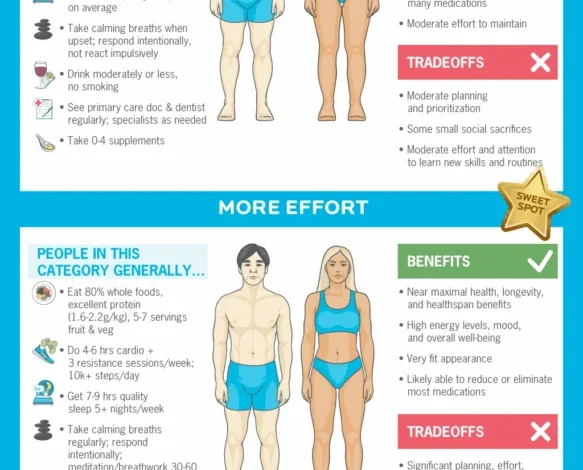
This translates practically into standard recommendations of 150 to 300 minutes of moderate-intensity aerobic exercise weekly, paired with two to three resistance training sessions to preserve muscle mass, support bone density, and prevent debilitating falls in older demographics. However, researchers caution against the "Extreme Exercise Hypothesis," a U-shaped curve indicating that while moderate to high activity is profoundly protective, extreme overtraining without adequate recovery can elevate the risk of myocardial fibrosis, immune dysfunction, and musculoskeletal injury.
Nutritional Foundations: Whole Foods, Produce, and Protein

Nutritional science emphasizes dietary patterns over restrictive perfectionism. Shifting focus toward whole and minimally processed foods—which comprise a low percentage of typical Western diets—is directly linked to decreased rates of type 2 diabetes, depressive disorders, and cardiovascular mortality. Large-scale global analyses indicate that consuming approximately five fist-sized servings of fruits and vegetables daily optimizes mortality risk reduction, driven by the protective cellular effects of diverse phytonutrients.
Protein intake is equally critical, particularly for preserving lean mass during aging or caloric restriction, such as the use of GLP-1 receptor agonists. While standard governmental guidelines suggest a minimum baseline of 0.8 grams per kilogram of body weight, contemporary nutritional research advocates for a minimum of 1.2 grams per kilogram for older adults, scaling up to 2.2 grams for individuals engaged in rigorous resistance training or muscle-building phases.

Sleep Architecture and Stress Regulation
Clinical data underscores the physiological necessity of consistent sleep patterns, with seven to nine hours per night serving as the optimal benchmark for cellular repair, metabolic regulation, and neurological health. Chronic sleep deprivation elevates systemic inflammation and accelerates cognitive decline by impairing the glymphatic system’s ability to clear neural metabolic waste.

Similarly, unmanaged chronic stress acts as a primary catalyst for cardiovascular strain and immune suppression. Rather than eliminating stress entirely, effective management requires balancing life demands with deliberate recovery practices, finding an equilibrium where individuals remain mentally engaged and energized without sliding into chronic anxiety or burnout.
Social Connectivity and Harm Minimization

The Harvard Study of Adult Development, spanning more than eight decades, has consistently identified strong social relationships as the single most powerful predictor of life satisfaction and longevity. Conversely, prolonged social isolation carries a physiological mortality risk comparable to smoking up to 15 cigarettes per day.
Complementing social health is the active minimization of known systemic harms, specifically tobacco use and excessive alcohol consumption. The World Health Organization identifies tobacco as a leading driver of preventable premature mortality, while comprehensive data on alcohol indicates that consumption operates as a causal factor in numerous oncological and neurological conditions. Public health frameworks increasingly emphasize moderation and informed risk assessment over rigid abstinence models, allowing individuals to navigate personal choices intentionally.

Economic and Lifestyle Trade-Offs of the Optimizer Lifestyle
For individuals pursuing extreme optimization, the economic and temporal costs escalate rapidly. Comparative tracking of a standard healthy lifestyle versus an advanced biohacking regimen reveals that "optimizers" frequently invest three to four times the weekly hours and thousands of annual dollars into specialized diagnostics, continuous glucose monitors, hyperbaric oxygen therapy, and specialized supplementation.

Beyond financial considerations, hyper-focusing on physical metrics often exacts a toll on other dimensions of deep health, including relational, emotional, and existential well-being. When health routines become an obsessive preoccupation, they risk cultivating orthorexia or social alienation, ultimately diminishing the very quality of life they aim to protect.
Strategic Implications and Public Health Conclusions

The overarching consensus within modern preventive medicine is that individuals achieve optimal longevity dividends not through elusive, high-cost interventions, but through the consistent execution of foundational health behaviors. By clarifying personal values, evaluating realistic resource allocation, and prioritizing consistency over intensity, individuals can successfully safeguard their long-term healthspan while preserving the capacity to enjoy a full and meaningful life.