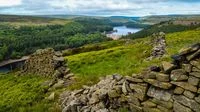
The prolonged and severe drought currently gripping the United Kingdom has unearthed a haunting piece of history in Derbyshire. The village of Derwent, which was intentionally submerged nearly eight decades ago to facilitate the construction of the Ladybower Reservoir, has re-emerged from the receding waters. This architectural ghost, consisting of stone foundations, remnants of cottages, and the skeletal structures of a church and farmhouses, has been exposed as water levels in the reservoir plummeted following six months of record-breaking low rainfall.
A Village Lost to Progress
The story of Derwent is one of sacrifice in the name of modernization. During the 1930s and 1940s, the United Kingdom was undergoing rapid industrialization. Cities such as Sheffield, Derby, Nottingham, and Leicester faced an escalating demand for water to support their growing populations and industrial output. To meet these needs, the Derwent Valley was selected as the site for a major water infrastructure project.
Construction of the Ladybower Reservoir began in 1935 and concluded in 1943. The project required the total displacement of two communities: the village of Derwent and its neighbor, Ashopton. At the time, the proposal sparked fierce resistance from local residents who were forced to abandon their ancestral homes, businesses, and places of worship. Despite the opposition, the valley was eventually flooded, consigning the history of these settlements to the bottom of the reservoir, where they remained largely undisturbed for eighty years.
The 2026 Drought Crisis: A Statistical Overview
The re-emergence of Derwent is not merely a historical curiosity; it is a stark indicator of an environmental crisis. According to reports from the Environment Agency, the period between April and September 2026 witnessed some of the lowest cumulative rainfall totals in over a century. The data is alarming: approximately 82 percent of the United Kingdom is currently classified as being in a state of drought.
The impact on infrastructure is severe. Currently, 18 major reservoir groups across the country are operating at less than 50 percent of their total capacity. Ladybower Reservoir itself has seen its water levels drop to slightly below 32 percent. This sustained lack of precipitation, coupled with above-average temperatures, has created a "perfect storm" for water scarcity that threatens not only the aesthetic landscape but the nation’s core utility stability.
Chronology of the Ladybower Reservoir
To understand the current situation, one must look at the timeline of the site:
- 1935: Construction of the Ladybower Reservoir project commences amidst significant local social unrest.
- 1940s: The final residents of Derwent and Ashopton are displaced, and the valley is successfully flooded to create the reservoir.
- 1943: The reservoir officially becomes operational, serving as a critical water supply for the industrial Midlands.
- 2026 (Spring/Summer): The UK experiences an unprecedented drought, with rainfall significantly below historical averages for six consecutive months.
- October 2026: Water levels in the Ladybower Reservoir reach a critical low, causing the remains of the submerged village to break the surface for the first time in recent history.
Official Responses and Public Safety Concerns
The sight of the stone ruins has drawn a steady stream of curious visitors to the Derbyshire countryside. While the historical significance is undeniable, the site has become a liability for Severn Trent Water, the utility company responsible for the reservoir.
"We recognize the immense historical interest that the re-emergence of Derwent holds for the public," a spokesperson for Severn Trent Water stated in a recent briefing. "However, we must emphasize that the exposed bed of the reservoir is not a public park or a tourist attraction. It is a hazardous, unstable environment."
The company has issued a strict warning to the public, urging them to remain on designated footpaths. The sediment left behind by the receding water is described as treacherous, deep, and highly unstable, posing a risk of entrapment or injury to those who attempt to walk among the ruins. The official stance is clear: while the history of the village is worth documenting, the safety of the public remains the priority, and trespassing on the exposed reservoir bed is strictly discouraged.
Technical Challenges and Water Management
Managing the water crisis requires a multi-faceted approach. Doug Clarke, the lead for water resources at Severn Trent, has provided insight into the logistical difficulties of the current situation.
"We have navigated six months of extreme weather—low rainfall and elevated temperatures—which has put immense pressure on our reservoirs," Clarke explained. "Reservoirs typically provide about one-third of our total water supply, with the remainder sourced from rivers and groundwater aquifers. When the reservoirs drop to these levels, the stress on the remaining infrastructure increases exponentially."
To mitigate the effects of the drought, Severn Trent has ramped up its operational efforts. The company is currently engaged in a massive leak detection and repair program, operating at a scale that exceeds previous historical efforts. "Our teams are working around the clock, both to process what water remains and to minimize wastage through pipe network repairs," said Clarke. He also noted that while autumn rainfall will eventually replenish the reservoirs, the process of recovery is slow, and the water table requires significant time to stabilize.
Broader Implications: Climate Change and Future Planning
The exposure of Derwent is a visual manifestation of a broader, systemic issue: climate change and its impact on the United Kingdom’s water security. The 2026 drought is not an isolated event; it is part of a trend of increasingly erratic and extreme weather patterns that test the limits of infrastructure designed in the early 20th century.
Experts suggest that the current crisis necessitates a fundamental rethink of water management. The existing infrastructure, while impressive for its time, was not designed to accommodate the prolonged, high-temperature, low-precipitation cycles now becoming more frequent.
From an economic perspective, the implications are significant. Agriculture, manufacturing, and municipal consumption are all competing for a shrinking resource. If the current trend of low rainfall persists into the winter months, the government may be forced to implement more stringent water usage restrictions, impacting both residential and industrial sectors.
Furthermore, the emergence of the "lost village" serves as a reminder of the environmental cost of development. The forced relocation of communities in the 1940s was a painful but necessary step to fuel the industrial revolution. Today, society faces a new, arguably more complex challenge: managing the limited resources of an increasingly crowded and climate-stressed planet without resorting to the displacement or destruction of local habitats.
Conclusion: A Lesson in Fragility
As the autumn air grows colder, there is hope that the rainfall will return to normal levels and eventually submerge the ruins of Derwent once again. However, the temporary appearance of the village serves as a poignant, physical reminder of the precariousness of modern life.
The ruins of stone cottages and churches are more than just archaeological remnants; they are markers of a time when the environment was seen as something to be tamed and controlled. The 2026 drought has signaled that nature still holds the upper hand. For the residents of the Midlands, and indeed the entire United Kingdom, the sight of Derwent rising from the silt is a call to action—an urgent reminder of the necessity to conserve water, invest in resilient infrastructure, and adapt to a changing climate before the next crisis turns a memory into a permanent reality.
As authorities continue to monitor the situation, the public is encouraged to heed the warnings regarding the reservoir’s condition. The history of Derwent is a story of the past, but the lesson it provides—that water is a finite, precious, and fragile resource—is one that remains vital for the future.