Comprehensive Medicaid and CHIP Enrollment Analysis: Historical Trends, Post-Pandemic Unwinding Outcomes, and the 2025 Federal Policy Shifts

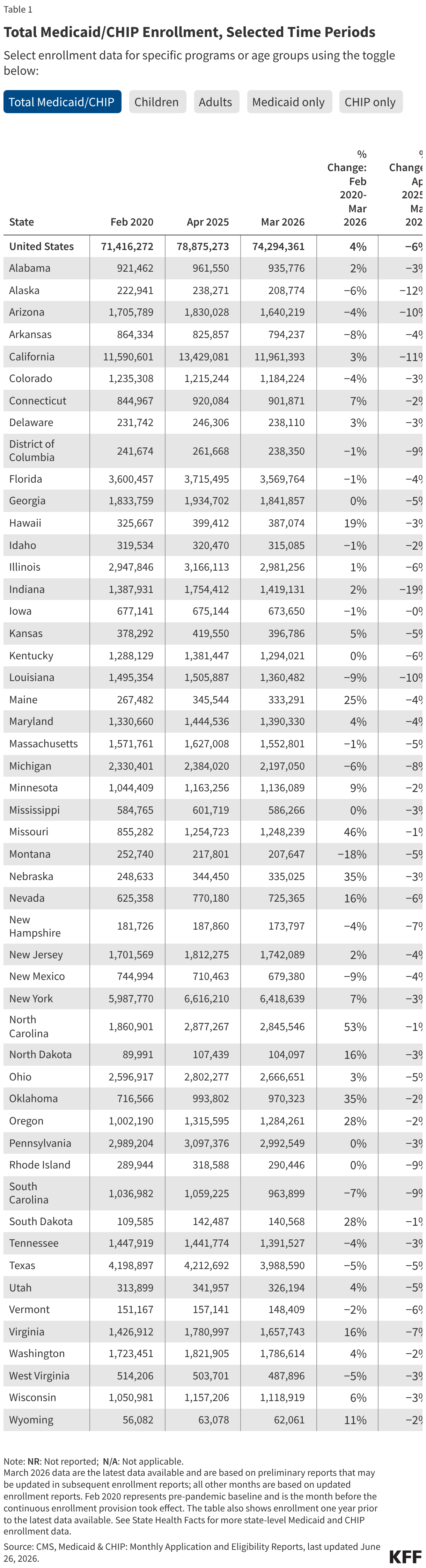
The landscape of public healthcare coverage in the United States has undergone unprecedented transformation over the past several years, shifting from pandemic-era continuous enrollment protections to a massive systemic realignment. According to the latest administrative reports and monthly data tracking provided by the Centers for Medicare & Medicaid Services (CMS) as part of its Performance Indicator Project, tracking metrics offer critical insights into the scope of full-benefit coverage for adults and children nationwide. While the immediate upheaval of the post-pandemic "unwinding" period has largely concluded across individual state agencies, new federal policy implementations are poised to reshape eligibility, participation rates, and administrative workflows through the remainder of the decade.
Historical Enrollment Trends and the Pandemic Baseline
To understand the current state of Medicaid and the Children’s Health Insurance Program (CHIP), analysts must look back to the structural baseline established prior to the global health crisis. In February 2020, just before the emergence of COVID-19 and the subsequent implementation of the Families First Coronavirus Response Act’s continuous enrollment provision, public health insurance enrollment stood at a specific pre-pandemic baseline. This statutory provision prohibited states from disenrolling most individuals from Medicaid during the federal public health emergency, regardless of changes in their financial or life circumstances.
As a direct result of these continuous enrollment protections, combined with widespread economic uncertainty, national Medicaid and CHIP rolls expanded exponentially between spring 2020 and early 2023. Millions of Americans who otherwise would have transitioned off the program due to wage increases, changes in household structure, or aging out of specific categories remained stably insured. This historical plateau established an unprecedented high-water mark for public program participation, covering tens of millions of low-income adults, children, pregnant individuals, and people with disabilities. However, this period of administrative stasis also created a massive backlog of pending renewals and deferred eligibility redeterminations that state health agencies would eventually be required to process once normal operations resumed.
Current Enrollment Trends and Post-Unwinding Metrics
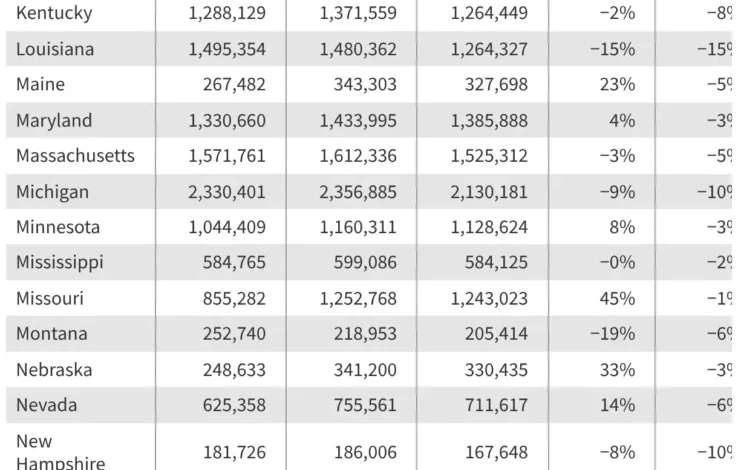
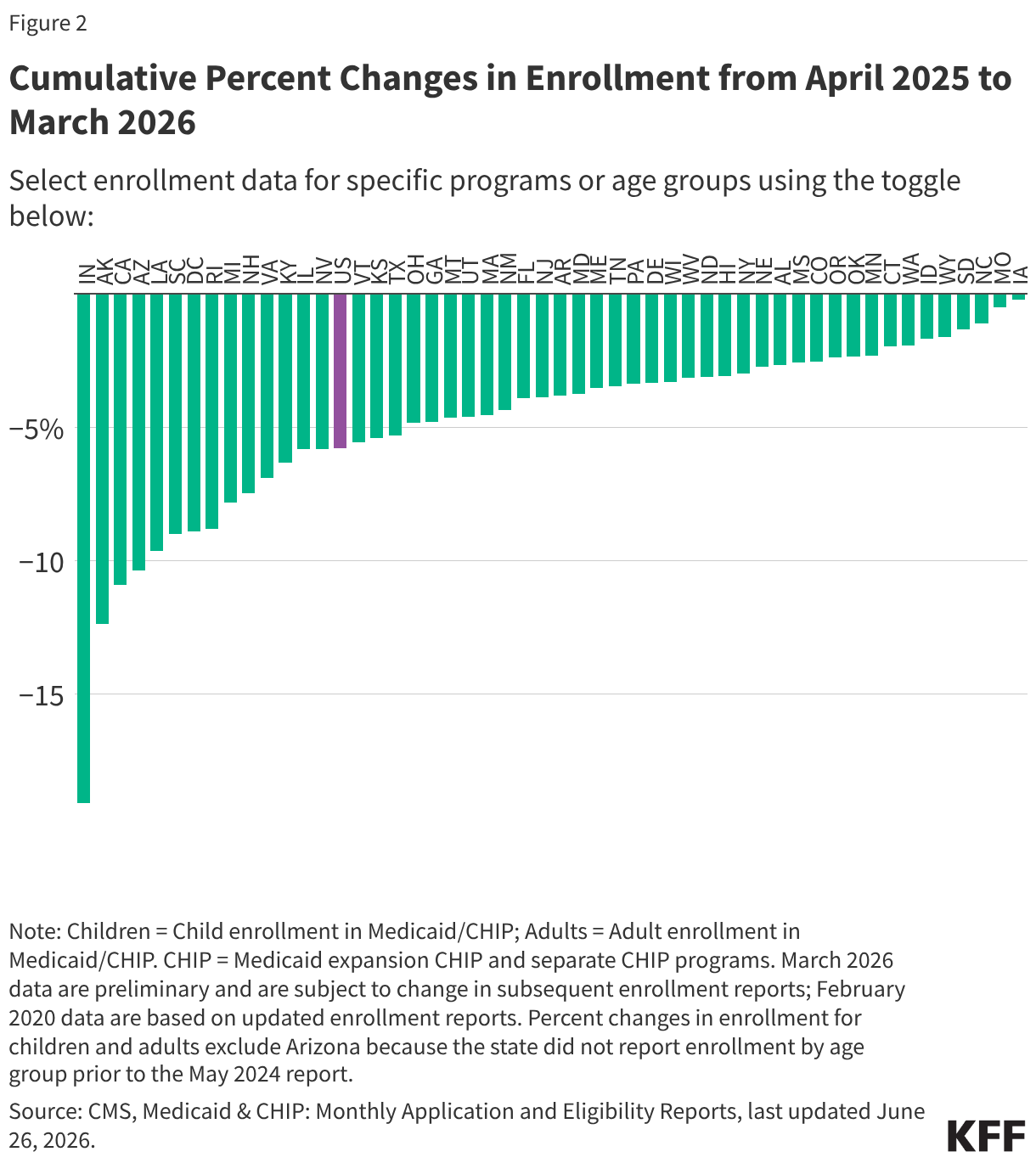
As of June 2026, newly released preliminary data from CMS—alongside state-level reporting compiled by health policy research organizations such as KFF—illustrates the trajectory of enrollment stabilization following the conclusion of the formal unwinding period. The latest data captures full-benefit enrollees across diverse demographics, offering granular visibility into both child and adult participation in Medicaid only, CHIP only, and combined programmatic structures.
According to June 2026 figures, nationwide enrollment continues to reflect post-unwinding stabilization, though year-over-year metrics show localized variations across states. While the dramatic contraction seen immediately following the expiration of continuous coverage has plateaued, total enrollment numbers remain distinct from the peak numbers recorded during the height of the public health emergency. Analysts note that these preliminary reports, subject to minor revisions in subsequent federal releases, provide an essential barometer for tracking baseline health coverage trends, though they exclude individuals receiving limited benefits, such as family planning-only services.
The Post-Pandemic Unwinding Period: A Massive Administrative Reckoning
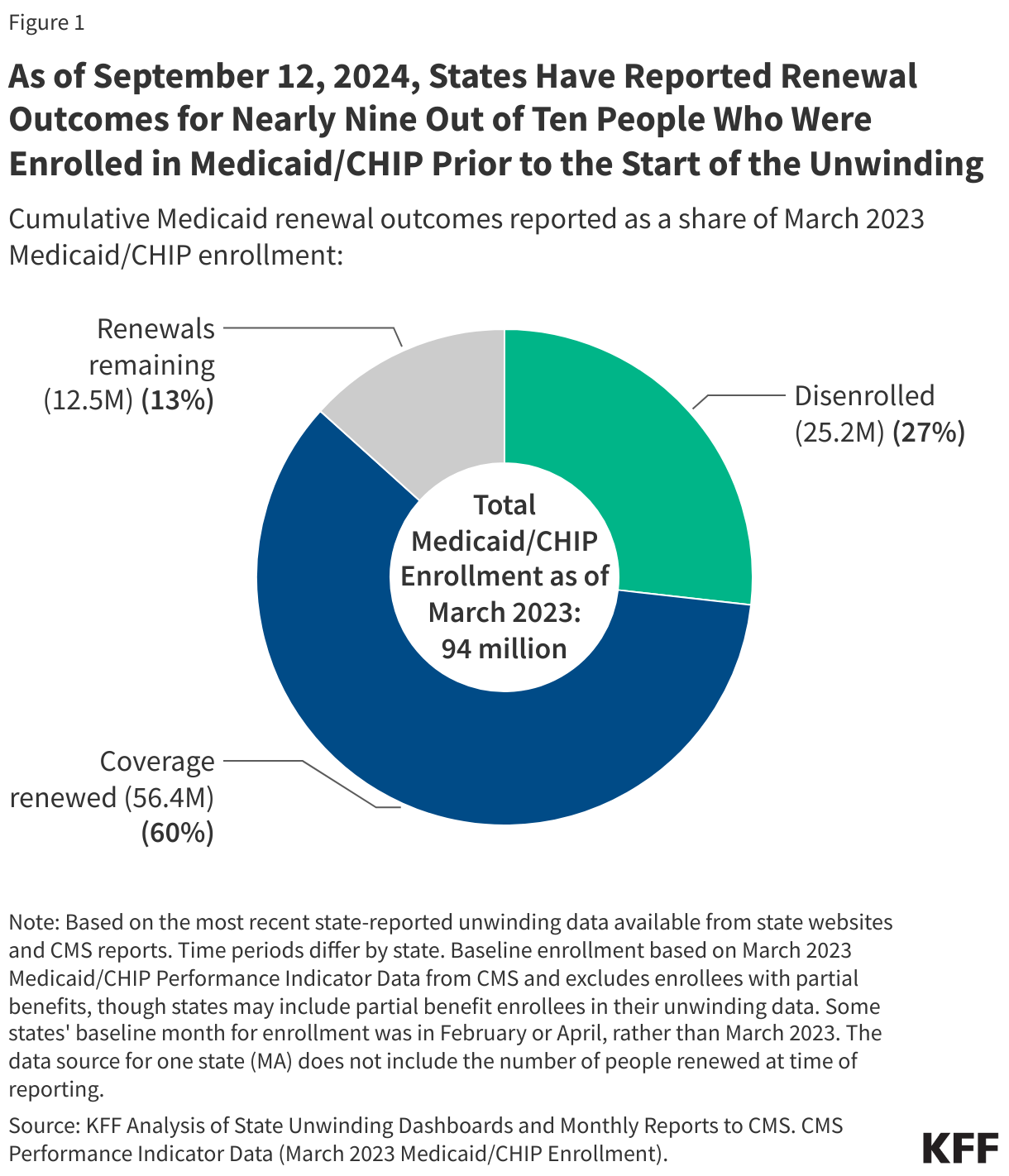
The most disruptive chapter in recent public health coverage history began when Congress decoupled the continuous enrollment requirement from the COVID-19 public health emergency, setting the stage for what became known as the "unwinding." Beginning in early 2023, states were given a 12-to-14-month window to restart routine eligibility redeterminations and process renewals for every single person enrolled in Medicaid and CHIP—a monumental task involving more than 80 million beneficiaries.
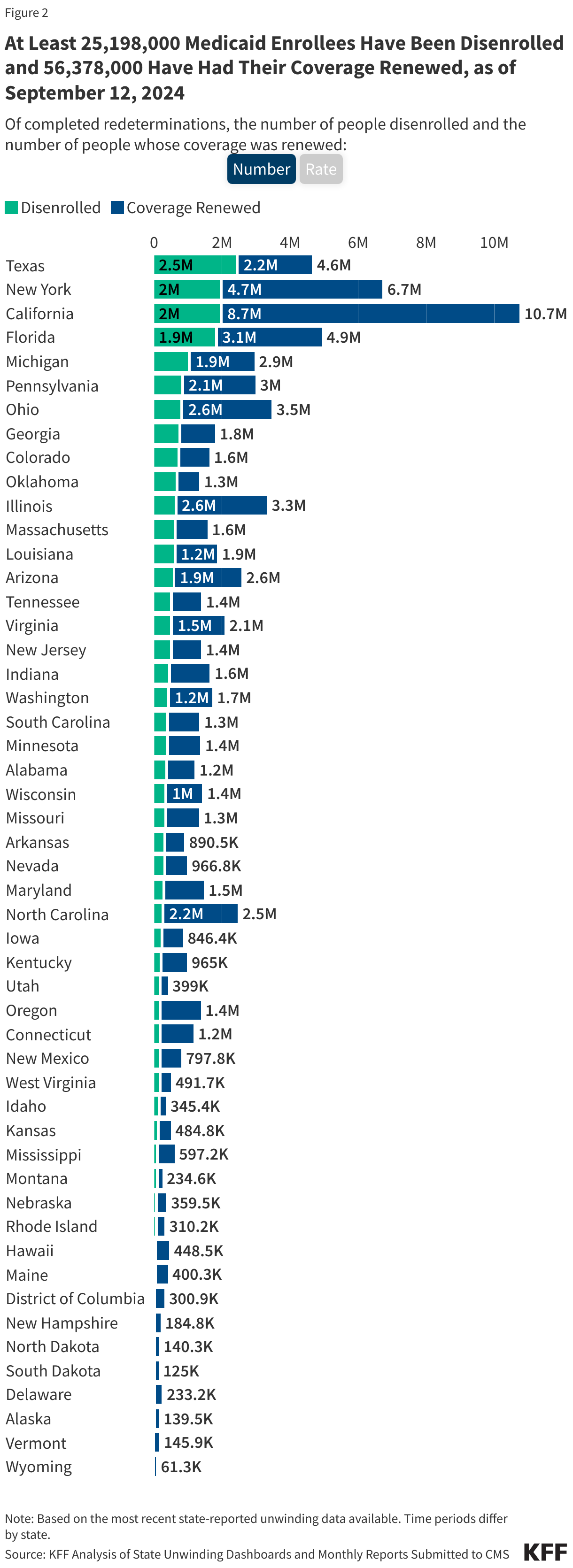
With the vast majority of states having completed their unwinding processes by mid-to-late 2024, cumulative data finalized in September 2024 highlights the sheer magnitude of this administrative exercise. States successfully reported renewal outcomes for approximately nine out of ten individuals who were enrolled in Medicaid or CHIP at the outset of the unwinding. Out of these completed redeterminations, cumulative metrics show that at least 56,378,000 enrollees successfully had their coverage renewed, while at least 25,198,000 individuals were disenrolled.
A central narrative of the unwinding period was the extreme degree of administrative churn and the high volume of procedural disenrollments—terminations occurring not because an individual was confirmed ineligible for the program, but because they failed to complete or return the necessary paperwork within the required timeframe. According to comprehensive analyses of state-reported data as of September 12, 2024, approximately 69% of all disenrollments were driven by procedural reasons rather than substantive eligibility determinations. When measured against all completed renewals, procedural disenrollments accounted for roughly 21% of cases, while accounting for approximately 20% of all renewals due overall.
Furthermore, state renewal outcomes demonstrated a heavy reliance on automated administrative data matches, known as ex parte renewals. Overall, roughly 61% of individuals who retained their Medicaid coverage during the unwinding were successfully renewed through these automated, paperwork-free ex parte processes. However, states that utilized robust outreach strategies, modernized communication channels, and effective ex parte protocols generally experienced lower procedural disenrollment rates compared to jurisdictions with less flexible administrative infrastructures.
Dramatic Disparity Across State Jurisdictions
One of the most striking findings from the unwinding data is the wide variation in disenrollment rates and administrative efficiency across different states. Because Medicaid is jointly funded and administered by federal and state governments, the execution of the unwinding varied drastically from coast to coast.
Disenrollment rates among completed redeterminations ranged dramatically—from a high of approximately 57% in Montana to a low of roughly 12% in North Carolina. These disparities were driven by multiple factors, including state-specific policy choices regarding managed care outreach, the flexibility of state eligibility systems, the adoption of temporary federal mitigation strategies, and whether a state had expanded Medicaid under the Affordable Care Act prior to the unwinding. States that heavily prioritized direct consumer assistance, partnered closely with community health centers, and extended timelines for processing returned packets typically mitigated massive coverage losses more effectively than states relying solely on automated mail notices sent to outdated addresses.
Federal Policy Shifts: The 2025 Reconciliation Law and Future Projections
Even as states adjust to post-unwinding baseline numbers, the regulatory and legislative environment surrounding public healthcare is shifting once again. The passage of the 2025 federal budget reconciliation law introduced significant structural changes to the Medicaid program that will profoundly impact enrollment trajectories over the coming decade.
Most notably, the 2025 reconciliation legislation mandates that adults in the Medicaid expansion group, as well as participants in certain Section 1115 waiver programs, satisfy new federal work and reporting requirements beginning in January 2027. Under these provisions, non-exempt beneficiaries must document a specific number of monthly work, educational, or community engagement hours to maintain their health coverage.
Public health analysts and policy researchers anticipate that these new compliance mandates will lead to a gradual reduction in Medicaid enrollment over the next ten years compared to projections under prior law. While proponents of the policy argue it promotes personal responsibility and transitions individuals toward employer-sponsored insurance, critics and healthcare advocates express serious concern that administrative burdens, reporting complexities, and bureaucratic hurdles will result in coverage losses for eligible individuals who struggle to navigate the new verification requirements—mirroring the procedural disenrollment challenges seen during the pandemic unwinding.
Data Limitations and Methodological Considerations
For researchers, policymakers, and journalists tracking these trends, navigating public health data requires an understanding of methodological nuances. CMS-reported data often lag by several months and rely on preliminary state submissions that are subsequently updated three months after the original reporting date to account for pending cases and administrative resolution.
Additionally, discrepancies often exist between federal CMS datasets and data published locally on state-specific unwinding dashboards. State dashboards frequently incorporate more timely updates or capture pending renewals differently than federal reporting structures. Furthermore, because data limitations prevent tracking granular changes by specific eligibility pathways—such as tracking exact shifts within the adult expansion group independent of other populations—analysts must rely on multi-source evaluations, including KFF’s specialized tracking tools and state health facts databases, to paint a complete picture of coverage dynamics.
As public health financing enters this new legislative era marked by work requirements and post-pandemic stabilization, continuous monitoring of enrollment metrics remains vital for ensuring equitable access to healthcare for millions of vulnerable Americans.
Related posts: