WHO and African Union Forge New Era of Health Sovereignty and Strategic Partnership in Geneva

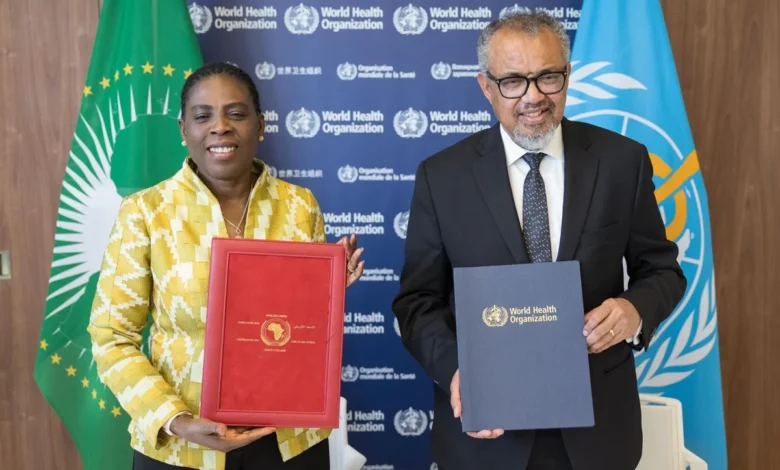
Against the backdrop of profound global financial shifts and dwindling bilateral aid, the World Health Organization (WHO) and the African Union (AU) Commission have officially renewed their longstanding strategic partnership. The formal signing of an updated Memorandum of Understanding (MoU) took place on the sidelines of the 78th World Health Assembly in Geneva, Switzerland. This high-level accord reinforces a shared, unwavering commitment to advancing regional health security, aggressively pursuing universal health coverage (UHC), and driving sustainable development across the African continent.
The newly minted agreement arrives at a pivotal juncture in international public health. It directly addresses the vulnerabilities exposed by declining overseas development assistance while championing a decisive paradigm shift: moving away from historical models of aid dependency and stepping firmly into an era of domestic health sovereignty and self-reliance. By centering the Department of Health, Humanitarian Affairs, and Social Development of the AU Commission at the core of implementation, the accord empowers African leadership to dictate the terms of its own healthcare future.
A Defining Moment for Primary Health Care
The high-stakes signing ceremony featured distinguished leaders from both international bodies. Her Excellency Ambassador Amma Adomaa Twum-Amoah, Commissioner for Health, Humanitarian Affairs and Social Development, signed the document on behalf of His Excellency Mahmoud Ali Youssouf, Chairperson of the African Union Commission. They were joined by Dr. Tedros Adhanom Ghebreyesus, Director-General of the World Health Organization.
The agreement bridges ideological gaps between multilateral agencies and regional policy executors, creating a streamlined framework designed to eliminate bureaucratic redundancies. For decades, international health interventions in Africa have occasionally suffered from fragmented approaches, where external donors dictated priorities that did not always align with local realities. This updated MoU seeks to rectify that historical imbalance. By harmonizing WHO’s unmatched technical, normative, and operational leadership with the African Union’s formidable political leverage, the partnership aims to accelerate progress toward the health-related Sustainable Development Goals (SDGs).
Commissioner Twum-Amoah did not mince words regarding the urgency of the moment. Addressing delegates and press corps in Geneva, she framed the agreement as a necessary philosophical and structural departure from the status quo.
"This Agreement marks a new chapter in AU-WHO cooperation," Commissioner Twum-Amoah stated. "By working together more closely, we can better respond to the health needs of our populations and ensure that no one is left behind. The African Union values WHO’s central and leading role in global health and looks forward to deepening this strategic partnership in support of our shared goals. We need to move from budgeting for survival to planning for health sovereignty."
Navigating Financial Pressures and the End of Bilateral Aid
The urgency underpinning the Geneva meeting is deeply rooted in contemporary macroeconomic realities. Over the past several years, traditional donor nations across North America and Europe have faced severe domestic economic pressures, rising inflation, and shifting geopolitical priorities. Consequently, bilateral health aid to developing nations—particularly in sub-Saharan Africa—has experienced dramatic cuts. Programs dedicated to combating infectious diseases such as HIV/AIDS, tuberculosis, and malaria, alongside maternal and child health initiatives, have found themselves facing severe funding cliffs.
For a continent that has historically relied heavily on external financing for significant portions of its public health budgets, these sudden shortfalls threaten to reverse decades of hard-won health gains. Infant mortality rates, which had steadily declined since the turn of the century, face renewed threat. Epidemic preparedness protocols, tested severely during the West African Ebola epidemics and the global COVID-19 crisis, risk underfunding just as new pathogens emerge.
It is within this volatile financial climate that Dr. Tedros Adhanom Ghebreyesus emphasized the existential importance of the renewed partnership.
"This renewed agreement comes at a critical time, as cuts to bilateral aid imperil the health of millions in Africa," Dr. Tedros warned during the signing proceedings. "It reflects our determination to translate our partnership into tangible results for the people of Africa, and support countries to leave behind the era of aid dependency and transition to sustainable self-reliance. We are proud to stand with the African Union in driving forward the health priorities of the continent."
Chronology of Cooperation: From 2019 to the 78th World Health Assembly
To fully appreciate the significance of the updated MoU, it is instructive to examine the institutional timeline that paved the way for this moment. Cooperation between the WHO and the Organization of African Unity (OAU)—which transitioned into the African Union in 2002—has existed for decades, but modern strategic frameworks have required constant adaptation to face shifting global health landscapes.
-
2019: The Predecessor Framework
The groundwork for the current relationship was firmly established with the signing of a comprehensive Memorandum of Understanding in 2019. That agreement sought to align the WHO’s Thirteenth General Programme of Work (GPW 13) with the African Union’s Agenda 2063: The Africa We Want. It prioritized emergency preparedness, regulatory harmonization through the nascent African Medicines Agency (AMA), and efforts to combat non-communicable diseases. -
2020–2022: The Crucible of the COVID-19 Pandemic
The utility of the 2019 framework faced an immediate, brutal test with the arrival of SARS-CoV-2. The pandemic exposed stark global inequities, particularly vaccine nationalism that left African nations at the back of the queue for life-saving inoculations. In response, the AU and WHO collaborated closely through platforms like the Africa Vaccine Acquisition Trust (AVAT) and the Partnership for African Vaccine Manufacturing (PAVM). These initiatives proved that regional coordination could yield results, laying the psychological and political groundwork for deeper integration. -
2023–2024: The G20 Breakthrough and Elevating African Voice
A monumental geopolitical shift occurred when the African Union was granted permanent membership in the G20 during the 2023 New Delhi summit. This elevation transformed the AU from a regional bloc into a primary global economic and political decision-maker. Suddenly, African leaders had a direct seat at the table where global financial architectures, debt relief, and health security funding are debated and decided. -
May 2025: The 78th World Health Assembly in Geneva
Culminating these historical developments, the signing of the updated MoU at the 78th WHA represents the institutionalization of this newly acquired global influence. The updated agreement reflects a matured partnership built not on charity, but on mutual strategic interest and shared sovereignty.
Five Pillars of Collaboration
While the broad strokes of the agreement focus on health security and universal health coverage, the operational core of the Memorandum of Understanding outlines five distinct, highly coordinated areas of collaboration designed to maximize efficiency and resource allocation:
- Strengthening Health Systems and Primary Health Care (PHC): Emphasizing community-based care, robust supply chains, and the training and retention of health workforce professionals to ensure care reaches the most remote populations.
- Health Security and Emergency Preparedness: Enhancing early warning surveillance systems, cross-border disease intelligence sharing, and operational readiness to rapidly contain outbreaks before they cascade into continental or global crises.
- Regulatory Harmonization and Local Production: Supporting the operationalization of the African Medicines Agency (AMA) to streamline drug approvals, combat substandard and falsified medications, and catalyze local vaccine and pharmaceutical manufacturing across the continent.
- Data Governance and Digital Health: Leveraging technological innovations, digital health records, and robust epidemiological data collection to drive evidence-based policymaking and resource distribution.
- Sustainable Financing and Advocacy: Developing domestic resource mobilization strategies, reducing out-of-pocket health expenditures for impoverished households, and advocating collectively on global stages for equitable health financing structures.
Broader Implications for Global Health Governance
The implications of this renewed MoU extend far beyond the administrative offices of Addis Ababa and Geneva. They signal a broader, irreversible decentralization of global health governance. For decades, the narrative of international health development was defined by Western philanthropic foundations and donor agencies prescribing solutions for the Global South.
Today, that top-down model is experiencing structural fatigue. With the AU holding a permanent seat at the G20, and with regional institutions like Africa CDC gaining unprecedented operational credibility, African nations are demanding agency over their public health destinies. The WHO, recognizing this shift, is strategically positioning itself not as an external director, but as an indispensable technical partner operating in service of African-led priorities.
Furthermore, the emphasis on local manufacturing is arguably the most economically transformative element of the partnership. Historically, Africa imports roughly 70 to 80 percent of its pharmaceutical products and over 99 percent of its vaccines. This extreme reliance on external supply chains proved catastrophic during global supply shocks. By committing to local production ecosystems—bolstered by regulatory frameworks like the AMA—the continent is laying the foundation for a multi-billion-dollar bio-manufacturing industry that will generate employment, retain capital, and secure public health independence.
Challenges Ahead
Despite the optimism radiating from Geneva, formidable challenges remain. Translating a high-level diplomatic document into tangible, grassroots results will require immense political will, transparent governance, and rigorous anti-corruption safeguards within domestic health sectors. Domestic resource mobilization—the cornerstone of the "health sovereignty" argument—remains difficult for many African nations burdened by crushing debt servicing obligations and sluggish post-pandemic economic recoveries.
Many African governments still fall short of the historic 2001 Abuja Declaration commitment, which urged nations to allocate at least 15 percent of their annual budgets to the health sector. Bridging this fiscal gap while bilateral aid contracts will require innovative financing models, public-private partnerships, and potentially debt-for-health swaps championed by international financial institutions.
Conclusion
The renewal of the Strategic Partnership Memorandum of Understanding between the World Health Organization and the African Union Commission is much more than a routine diplomatic renewal; it is a declaration of intent. By confronting financial austerity with strategic unity, and by pivoting from survival-driven budgeting to structural health sovereignty, the AU and WHO are charting a resilient course for the future. As these two organizations operationalize their five key pillars of collaboration in the months and years ahead, the ultimate measure of their success will be felt in the clinics, villages, and cities across Africa—where sustainable health security is no longer an aspiration, but a lived reality.
For further media and institutional inquiries, designated representatives may be contacted directly:
- Professor Julio Rakotonirina | Director | Department of Health, Humanitarian Affairs and Social Development | African Union Commission | Email: [email protected]
- Ms. Stéphanie Seydoux | Director | DG Envoy for Multilateral Affairs | World Health Organization | Email: [email protected]